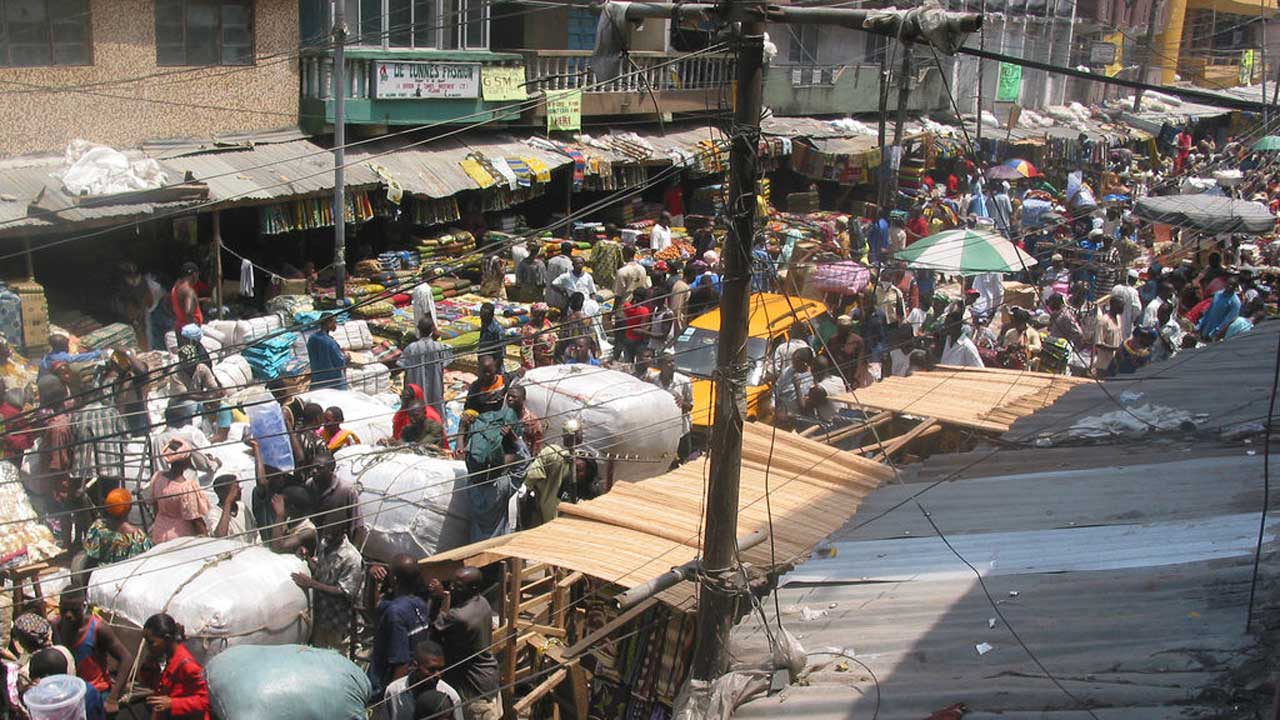
A combination of unchanging shopping habits of Nigerians and a daily struggle to make ends meet in a slowly recovering economy has continued to breathe life into street trading in Lagos, the country’s commercial capital, decades after the birth and expansion of modern retail outlets.
Many Nigerians tend to shop on short notice, kind of buy-as-you-go attitude. Hence, they are accustomed to dashing into makeshift stalls within their neighbourhoods to buy from bread to milk, detergent and soft drinks.
While shopping, they can choose from a sea of commodities available in shops that extend from purpose-built stores all the way into the street such that cars and pedestrians have to wrestle for space along a narrow way and manage not to knock over tray of pepper, raw meat or fish.
Always hunting for a bargain, people looking to buy soup ingredients, for instance, want to haggle for the best price within a short span of time.

Street sellers understand this demand for haste and desperately want to attract the highest share of patronage. To ensure this, they make sure their wares are displayed to the full glare of every roving eye.
Purpose-built shops are not in short supply, though. More are even being developed as homeowners in areas such as Balogun, a popular shopping area, convert their block of flats into stores. The Lagos State government, for instance, has remodelled stalls in Oshodi, Ikeja, Tejuoso and Oyingbo. Still, visibility and proximity, which being on the street offers, beat being in a four-storey building.
“When I rented this facility in 2016, it was about N7,500 monthly. We paid for security and cleaning. But last August, it was reduced to N3,500, in response to people’s complaints about affordability. Apart from the fact that it is expensive, people are always in a hurry in Lagos and want to buy their things quickly,” said Emmanuel, a wholesale stockfish supplier at the rebuilt Oyingbo Market, who spoke on the condition that only his first name will be mentioned.
“Since I started selling, people don’t come here to buy. I have to take it downstairs. Only those who do wholesale come to us to buy. Most people prefer to shop outside than come inside. But if everyone is inside, the market will work,” he said.
Emmanuel is one of the few occupiers in the near-empty market since it was remodelled in 2015. Sellers in the 66 parking spaces of the four-storey building jostle for customers. Locally instituted tax collectors charge one-time entry fee of about N10,000 for the space allocated.

“The other charges are N400 per day. After that, you will continue to sell until you are tired of selling,” Chinedu, one of the collectors at Oyingbo market, told BusinessDay reporter who disguised as a selling seeking a space.
Meanwhile, the market’s 270 lock-up shops, 632 open shops, 48 open offices, three cold rooms and one fire service station are under-utilised.
Well-constructed shopping complexes such as this are still far from the needs of 30-year-old jewellery vendor at the Ojuwoye market in Mushin. After being unlucky to get street-facing shop on the ground floor, she pays N4,000 monthly for a tiny space on the side of the road, where visibility is guaranteed. A good view of her wares makes sales rapid; it shortens the time it takes to get impulse buyers to dip their hands in their purses. Her shop, meanwhile, simply serves as a warehouse.
Shops on lease in areas with significant pedestrian traffic such as Aganran, a section of the Mushin market occupied by weave-on and hair attachments vendors, range between N35,000 to N40,000 on a monthly basis, BusinessDay found.
At Balogun, one of the largest markets in Lagos, rent is as high as N800,000 and above N1 million annually, depending on the size of the shop, the location and the type of commodity or services sold. Those with the financial muscle to run businesses with millions in turnover, such as fabrics, footwear or jewellery sales can be found in these shops.
For those without the capital and unable to pay lower rents –majority of the street traders fall into this category – they simply negotiate to pay a paltry sum like N3,000 to use the idle space in front of those who can afford the high rental fees.
Findings further show that some of the vendors directly on the streets pay rents to popular omo oniles (land grabbers) who occasionally remit an off-the-record amount to government taskforce agents responsible for getting street traders off the road to look the other way. They equally pay homage to traditional rulers of the area where the market is located.
Ann Ojukwu has spent 13 years selling eggs and yams at the Agboju market, near Festac. After the demise of her husband in 1995, she has been the sole supporter of their five children, two of whom she struggled to support through the university. The graduates are trapped in the net of unemployment; the others are in vocational schools and unable to help the 63-year-old grandmother retire from the roadside.
However, the stories of all street traders are not entirely heart-rending like Ojukwu. There is a growing army of young and energetic youths pitching their tents on the streets every day in the quest to make a living.
Opposite Ojukwu, Iya Segini had just lost her space to some group of young Hausa men selling different varieties of vegetables. The young men were able to raise N200,000 to secure the roadside space after the legal owner of the land demolished the makeshift structure, displaced sellers and started leasing afresh. Iya Segini, who sells fresh pepper and tomatoes, could only raise N30,000.
Thirty-year-old Adane sells Atlantic croaker fish at Agboju market in Festac Town, Lagos. When BusinessDay visited the market, she had on artificial eye lashes, her hair attachment packed into a bun, and an Android phone in her hands.
Traders like Adane aren’t among the 37 million Micro, Small and Medium Enterprises (MSMEs) which the World Bank, in a 2017 report, estimates are constrained by a $158 million funding gap. With less than N5,000 they can buy a bag of salt and resell in pocket-friendly bits. The same amount is all Iya Mulikat needs for her noodles business and it’s enough also for Mama Ada who sells vegetables.
The entry barrier is low. There is no hassle about company registration, little or no worries about capital, running costs such as rent, power, security, taxes and a long list of other hindrances to formal businesses. Paying for a location where they can enjoy peak sales from 5pm, when their customers return home from work, is perhaps their biggest cost.
Street trading is the only way these people can avoid falling into extreme poverty along with the millions of others in a country now regarded as the poverty capital of the world.
“If I don’t trade every day, I won’t be able to survive,” says Iya Segini.
The economy is failing a population projected to be the third-largest in the world by 2050. Not enough jobs are being generated. And when available they are in low-paying, under-productive and unstable jobs of the informal economy which generated 68 percent of jobs between 2013 and 2016. PwC, a consultancy, reckons the incidence of high unemployment in Nigeria derives from the slow pace of job creation which is unable to keep up with labour force growth.
“To reduce the unemployment rate, we estimate that employment growth of at least 4-5 percent is required. This would translate to at least 3 million new jobs annually. Delivering jobs capable of boosting incomes and reducing poverty requires creating more high productivity jobs within the formal sector,” PwC said in a 2017 report titled ‘Structural Transformation and Jobless Growth in Nigeria’.
Temitayo Ayetoto