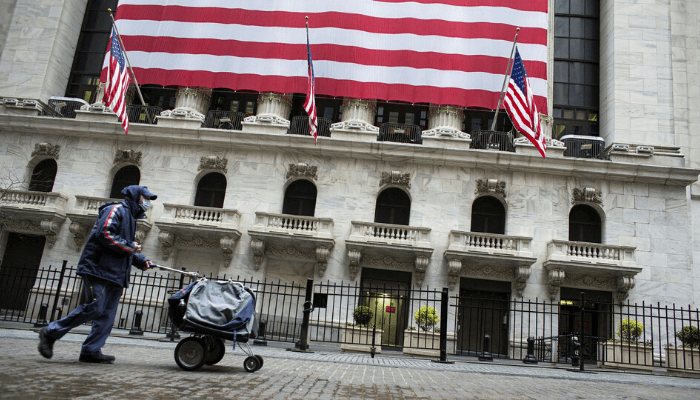
Wall Street opened lower as flare-ups in coronavirus cases in Asia and Germany triggered fears of a second wave of infections and highlighted the potential stumbling blocks in reopening economies.
The S&P 500 fell 0.6 per cent on opening after closing higher on Friday despite the release of grim data showing US unemployment had hit its highest level since the second world war. The tech-heavy Nasdaq Composite, which last week crept into positive territory for the year, dropped 0.2 per cent.
New virus outbreaks in South Korea, China and Germany have shed light on the challenges facing governments seeking to loosen social restrictions, as millions of Europeans and Americans prepare for the tentative reopening of their economies.
“The news reinforces the ‘stop and go’ nature of the recovery from Covid-19, and the potential for second and third waves,” said Stephen Gallo, European head of forex strategy at BMO Capital Markets.

European equities fell, led by stocks in the travel sector, even as many countries across the continent moved to relax their coronavirus-induced lockdowns.
London’s FTSE 100 was down 0.3 per cent while Frankfurt’s Xetra Dax reversed its early gains to fall 1 per cent.
Travel stocks dropped as the UK planned to put a 14-day quarantine requirement in place for the majority of arrivals to the country.
Shares in low-cost carrier easyJet tumbled as much as 8 per cent, as British Airways owner IAG warned that the quarantine requirements would heap further pressure on the aviation industry.
London Heathrow airport, which on Monday reported a 97 per cent drop in passenger traffic in April, said 200,000 people passed through its terminals for the month, the same number it would typically serve in a day.
“Aviation is the lifeblood of this country’s economy and, until we get Britain flying again, UK business will be stuck in third gear,” said John Holland-Kaye, chief executive of the airport group.

Oil prices gained after the announcement by Saudi Arabia that it will cut oil production by a further 1m barrels a day, reducing its total output to 7.5m b/d in June, in a bid to balance supply with the hit to demand from widespread lockdowns.
Brent crude, the international benchmark, rose 0.1 per cent to $31.01 a barrel while West Texas Intermediate, the US marker, was up 2.2 per cent to $24.05 a barrel.
Equities have been buoyed in recent weeks by hopes that a gradual restart in global economic activity could fuel a broad rebound. The UK, France, Spain, Denmark and Norway are all set to lift some measures to ease the economic impact of the pandemic.
That optimism has allowed investors to brush off some of the most dismal economic readings on record to help the FTSE All-World index climb more than 25 per cent from lows reached in March.
Patrik Schowitz, global multi-asset strategist at JPMorgan Asset Management, said investors would need to see evidence that corporate earnings had hit a trough in order to be convinced that stock markets would not retest those lows.
“To gain confidence in a bear market low, equity investors traditionally need some visibility into the scale of a recession’s damage to corporate profits,” Mr Schowitz said.
In Asia-Pacific trading, Japan’s benchmark Topix index and Hong Kong’s Hang Seng closed up 1.5 per cent.
Investor sentiment was bolstered by the weekend announcement from the People’s Bank of China that it would lower real lending rates and “place support for [the] recovery of the real economy in a position of greater priority”.
Shanghai’s CSI 300 index closed 0.1 per cent lower as Wuhan, the original centre of the outbreak in China, reported its first clutch of cases since a strict lockdown on the city was lifted about a month ago.