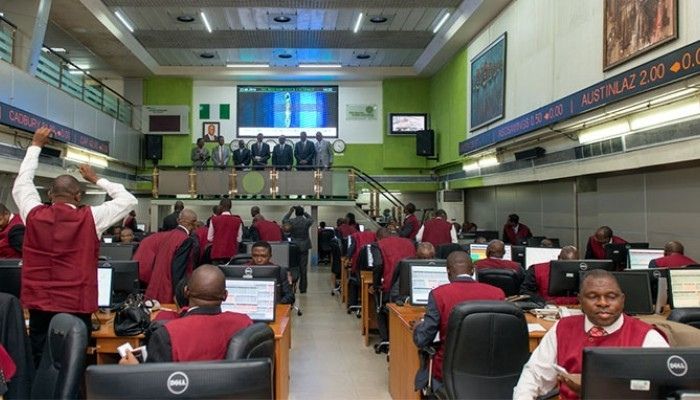
Nigerian Stock Exchange (NSE) market-wide circuit breaker kicked on Thursday, November 12, 2020, at 12:55pm, its first time in four years.
The circuit breaker kicked when NSE All-Share Index (NSE ASI) rose beyond the set threshold of 5 percent, triggering a 30-minute trading halt of all stocks.
Nigeria’s listed stocks have become the new “Gold” in town, attracting local investors and retail clients – some speculative and others just seeking yields better than the almost zero returns in the Money Markets.
Also, the absence of big international sellers contributed to this strong move on the Bourse – the first in many years.

The NSE circuit breakers are triggered during periods of extraordinary volatility in the equities market in order to maintain an orderly market, and to allow liquidity to re-aggregate.
In just one trading day, the stock market of Africa’s largest economy rallied by N1.084 trillion to N18.467 trillion from the preceding day low of N17.383 trillion.
Also, the NSE All Share Index (ASI) increased by 6.23 percent from day open low of 33,268.36 points to 35,342.46 points.
Thursday’s record became the first time the circuit breaker had kicked in since its introduction in 2016. The market’s positive return year-to-date (YtD) has hit a new high of +31.67 percent.
The Circuit Breaker protocol was triggered by the increase of the NSE ASI from 33,268.36 to 34,959.39. The market reopened at exactly 1:25pm with a 10-minute intraday auction session, before resuming continuous trading till the close of the day at 2:30pm.

During the halt of trading, no order could be placed until trading resumed. However, existing orders could be withdrawn or cancelled but could not be modified.
Trading halts did not affect the clearing, settlement, and depository operations for matched trades, as these functioned as normal. Furthermore, all existing orders keyed in prior to the trading halt were re-activated and were matched upon resumption of trading.
Circuit breakers are trading halts used by exchanges to guard against sharp fluctuations on the market. They are designed to give the market an opportunity to take a break and adjust to all available information before re-opening.
The purpose is to dampen extraordinary volatility swings on market prices by providing time to restore equilibrium between buyers and sellers.
Circuit breakers have the objective of dampening both market upswings and market downswings, and will complement the price limits on individual stocks already in place.
Furthermore, the ASI of the NSE climbed 6.23 percent, its biggest daily gain since April 1, 2015, the first trading day after President Muhammadu Buhari was elected into office.
“For the first time since I have been in this market we had to use the circuit breaker today to suspend trading for about 30 minutes because the market was overwhelmed with demand,” Ayorinde Akinloye, a research analyst at CSL Stockbrokers, said.
Dangote Cement, Nestle, Nigeria Breweries, and Presco were the top advancers.
“I will tie the driver to the low-interest environment and to the realisation that low-interest rate might be here for a while,” Yinka Ademuwagun, research analyst, FMCGs, United Capital plc, said.
With a year-to-date return of 31.67 percent, the NSE ASI stood at 35,342.46; the stocks added 2,074.10 points to move higher than the previous close of 33,268.36.
Meanwhile, rates on T-bills plunged further on Wednesday as CBN settled its stop rates at 0.04 percent, 0.15 percent and 0.3 percent for the 91-day, and 182-day and 364-day maturities, a further decline from the previous stop rates auction of 0.34 percent, 0.5 percent and 0.9 percent.
More than N435 billion worth of unsuccessful transactions were recorded at the Nigerian Treasury Bills (T-Bills) auction conducted Wednesday by the Central Bank of Nigeria (CBN) on behalf of the Federal Government of Nigeria (FGN) as limited attractive instruments forced investors to bid at rates as low as 1 percent each for the 92-day and 182-day bills and 1.9 percent for the longer 364-day bill.
The outlook for equity investors
The Nigerian stock market is riding on the low-interest-rate environment to post-rally as it gained the most on Wednesday since April 1 2015.
With the low-interest rate environment, stocks’ valuation is expected to increase owing to the low discount rate and this in return is positive for both the market and the investors.
“The valuation in the market has increased and has been the major driver and it will remain till the end of year. Meaning equities will continue to rally,” Yinka Ademuwagun, research analyst, FMCGs, United Capital, said.
Impact on Economy
While the state of the economy is not a contributor to the rally of the equities market following its fragile state coupled with the inflation, analysts do see the rally in the stock market also having a slight indirect impact on the economy through the wealth effect.
The wealth effect is a behavioural economic theory suggesting that people spend more as the value of their assets rise.
“The excess liquidity in the market is going mostly into equities and other investment instruments. The real investment would have been invested in the various companies, funding and direct impact,” a Lagos-based economist said.
What the rules on circuit breakers say
Rule 15.46: Trading Halts Due to Extraordinary Market Volatility (Index Circuit Breakers) says: The Exchange shall halt trading in all stocks and shall not reopen for the time period specified in this Rule if there is a Significant Market move in either direction.
For purposes of this Rule, a Significant Market move means a five percent (5%) move in price of the All Share Index between 10:15am and 13:45pm on a trading day as compared to the closing price of the All Share Index for the immediately preceding trading day.
Halts in trading: If a Significant Market move occurs after 10.15am and any time up to and including 13.45pm The Exchange shall halt trading in all stocks for thirty (30) minutes.
The Exchange shall not halt trading if a Significant Market move occurs after 13.45pm; The Exchange shall halt and reopen trading based on a Significant Market move only once per trading day; If, following the reopening of trading after a Significant Market move halt, the All Share Index moves further by a minimum of five percent (5%) below its closing value on the immediately preceding trading day, during any trading day The Exchange will halt all trading for the remainder of the day.
The rules also state that the last traded price in any security prior to the closing of the market shall be deemed the closing price in such security for the day.