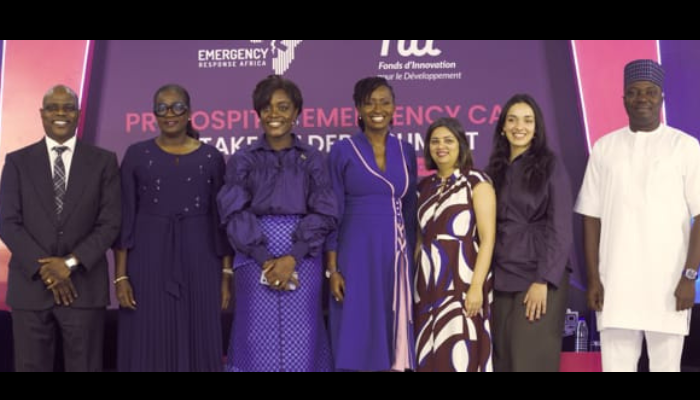
Emergency Response Africa (ERA) has hosted the inaugural Prehospital Emergency Care Stakeholder Summit, Beyond the Ambulance, in Lagos. The summit, held at Four Points by Sheraton, brought together healthcare executives, policymakers, emergency responders, and industry experts to discuss challenges and solutions for improving emergency medical services in Nigeria.
Folake Owodunni, CEO of Emergency Response Africa, opened the event, followed by goodwill messages from key dignitaries. Speakers included Dr. Saidu Ahmed Dumbulwa, Director at the Federal Ministry of Health and Social Welfare and National Programme Manager of the National Emergency Medical Services and Ambulance System (NEMSAS); Dr. Dayo Adeyanju, National Coordinator of the Maternal Mortality Reduction Innovation and Initiatives (MAMII); Dr. Abike Dabiri-Erewa, CEO of the Nigerians Diaspora Commission; Dindembolo-Zaya Kuyena, Trade Commissioner representing Carlos Rojas-Arbulu, Deputy High Commissioner of Canada; and Mrs. Njide Ndili, President of the Healthcare Federation of Nigeria.
Dr. Benjamin Wachira, Founder of the Emergency Medicine Kenya Foundation and Associate Professor at Aga Khan University, Nairobi, delivered a keynote address titled Reimagining Emergency Care Systems in Africa: Opportunities Beyond the Ambulance. He highlighted the role of technology in prehospital care.
Dr. Tomi Coker, Honourable Commissioner for Health in Ogun State, presented a session on Rural Maternal Health Emergency Transport: A Tool for Reducing Maternal and Neonatal Mortality in Ogun State. She outlined efforts in Ogun State to combat maternal and neonatal mortality through the Maternal and Newborn Mortality Reduction Innovation and Initiative (MAMII). She reiterated the government’s commitment to improving maternal and newborn survival rates by addressing infrastructure deficits, workforce gaps, and integrating technology in healthcare.

Dr. Cyril Oshiomole, Honourable Commissioner for Health in Edo State, and Dr. Adaeze Oreh, Honourable Commissioner for Health in Rivers State, also attended the summit. Discussions focused on building a sustainable emergency response system, leveraging technology in prehospital care, and community-driven first response models. Panelists explored policy and regulatory frameworks to standardise emergency medical services across Africa.
The Fund for Innovation in Development (FID), a key financing partner of the Edo Emergency Medical Service (EDOEMS) project, was recognised for its contributions. Amina Zakhnouf, Investment Officer at FID, stated, “At FID, we believe that innovation is key to solving some of the world’s most pressing challenges, including poverty, inequality, and access to emergency medical services. By supporting projects like EDOEMS and the Prehospital Emergency Care Stakeholder Summit, we are helping to create scalable solutions that can transform emergency care in Nigeria and beyond. We are excited to see the impact of these interventions in saving lives and improving health outcomes.”
Nigeria has a shortage of emergency medical services, with only 0.4 ambulances per 100,000 people, far below the World Health Organisation’s recommendation of one per 10,000. This gap contributes to preventable deaths, particularly among mothers and newborns. More than 80% of maternal deaths in Nigeria could be avoided with timely emergency care, highlighting the need for improved access to medical services.
In closing remarks, Owodunni called for increased collaboration between government, the private sector, and development partners to expand emergency response systems nationwide. ERA remains committed to working with state governments to implement and improve emergency medical systems and strengthen Nigeria’s healthcare system.