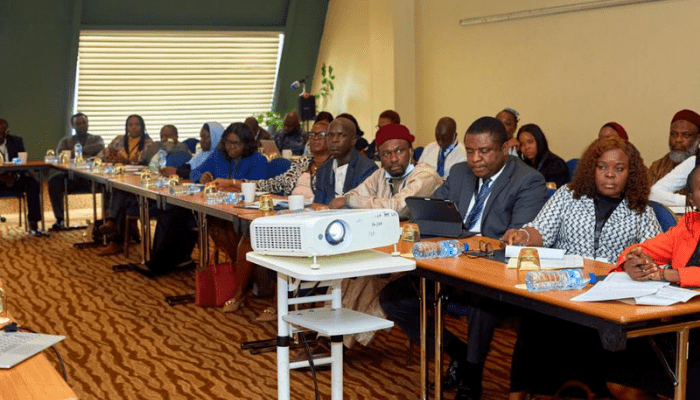
Stakeholders in Nigeria’s digital economy have called for a regulatory convergence to foster growth, development and investments in the sector.
This call was made during the stakeholder workshop on digital regulatory reforms organized by Stears and the UK Foreign Commonwealth Development Office in Abuja on Monday.
Digital regulatory convergence refers to the establishment of a single authority by blurring the regulatory boundaries for telecommunications, information technology and broadcasting.
Read also: Nigeria can become world leader in digital economy – Osinbajo

Michael Famoroti, co-Founder & head of intelligence, Stears Business said several economic sector are increasingly leveraging innovation and technology to efficiently carry out their operations which has necessitated a clear and concise regulatory framework to guide their activities.
“The presence of multiple regulatory bodies in Nigeria’s digital economy has dampened the growth of the technology and innovation sector,”he said.
Highlighting other challenges in the sector, Famoroti said there is an asymmetry in engagement between regulators and operators, lack of political will and incentives to implement regulatory measures.
He said there is a lack of independence and autonomy across regulatory bodies adding that there is a clear overlap in the functions and mandates of regulators.
Famoroti advised that the existing legislation of regulatory authorities must be amended to ensure that MOUs between regulators are reviewed annually, adding that a unified communications regulator be created by collapsing agencies like NCC, NBC, NIPOST, etc.

“The digital economy is important to Nigeria so it is important that we move ahead with enabling regulations; Innovation and technology will continue to evolve so the goal is to try and create a framework that regulators can use in the next few decades to keep up with emerging trends in technology and ensure that the regulatory landscape and regulators themselves continue to be enablers of the digital economy ,” he said.
“Technology is converging and we cannot avoid it, we need to see how to get the benefit of this converging technology rather than all of us trying to protect our domain,” Franca Aiyetan, Director, Broadcast monitoring, National Broadcasting Commission said.
However, Emmanuel Edet, Head, legal services unit, National Information Technology Development Agency (NITDA), noted the recommendations from the project and stated that they are targeted at achieving certain goals and will not solve all the challenges in the sector.
“A better approach will be to have all the regulators in that sector work together to achieve a common goal ,” Edet said
Similarly, Babatunde Bamgboye, head, legal enforcement and regulations, Nigeria Data Protection Bureau (NDPB) said there is no agency of government in that does not have specific statutory role and in most cases counterparts in other jurisdictions across the world.
“The best we can achieve is to have memorandum of understanding to recognize that no single institution can sit in silo and try to regulate every sector but we can collaborate under the government which is a single entity and carry out the mandate given to us,” he said.
Josephine Amuwa, director, legal and regulatory services, Nigerian Communications Commission (NCC) said there is need to recognize the state governments who are also interested in some of the issues been discussed in emerging technology and to see how their states can benefit from the opportunities it presents. She added that it the digital economy is a national resource and should benefit all Nigerians.