The use of “Doctor” (Dr.) for recipients of honorary doctorate degrees is generally discouraged and often considered incorrect in formal or academic contexts. Here’s a breakdown:
1. Honorary vs. Earned Degrees:
* An earned doctorate (Ph.D., Ed.D., M.D., J.D., D.Sc., etc.) is awarded after completing rigorous academic requirements (coursework, research, dissertation, defence).
* A honorary doctorate (Doctor of Humane Letters, Doctor of Science, Doctor of Laws, etc.) is conferred as a recognition of significant lifetime achievements, contributions to society, a field, or an institution, without the recipient having completed the academic work.

2. Formal Protocol & Academia:
* Universities: Most universities explicitly state in their policies that honorary degree recipients should not use the title “Dr.” professionally or academically. The honour is in the recognition, not the conferral of academic privileges.
Style Guides: Major style guides (like the Chicago Manual of Style) advise against using “Dr.” for honorary degree holders.
Academic Context: Using “Dr.” based solely on an honorary degree within an academic setting is often viewed as misleading or inappropriate by those who hold earned doctorates.
3. Social Context & Personal Choice:
Informal/Social Use: Some honorary recipients might use “Dr.” socially or in non-academic/professional settings (e.g., on social media, in community events). However, this is a personal choice and still contentious.

Listing the Degree: The appropriate way to acknowledge an honorary degree is to list it with the suffix “h.c.” (honoris causa) or clearly state “honorary” after the degree (e.g., John Smith, LLD (honorary); Jane Doe, D.Litt. h.c.).
4. Potential for Misunderstanding:
Using “Dr.” without qualification implies an earned doctorate. This can lead to misunderstandings about the holder’s academic credentials.
Conclusion:
No, recipients of honorary doctorates should not formally or professionally use the title “Doctor” (Dr.).
The honour lies in the recognition, not the right to the academic title.
Doing so is generally against university policies, academic etiquette, and style guide recommendations.
The correct way to acknowledge the honour is to list the degree with “h.c.” or “honorary.”
In short: While the university addresses them as “Doctor” during the conferral ceremony as a mark of respect for the occasion, this does not grant them the ongoing right to use the title professionally or academically. They remain Mr., Mrs., Ms., Miss, Mx., or their professional title (if they have one, like Professor, Senator, etc.), with the honorary degree listed appropriately.**
I am a “Doctor” o, !
I have about 20 honorary doctorates, but I always insisted no one should call me a doctor because they are chieftaincy titles. It is almost fraudulent. But when I did my PhD for a few weeks after my viva, I quarrelled with anyone who did not call me a doctor ???? (It was hard work…not a joke.) SLS!!
THE ISSUE OF HONORARY DOCTORATE
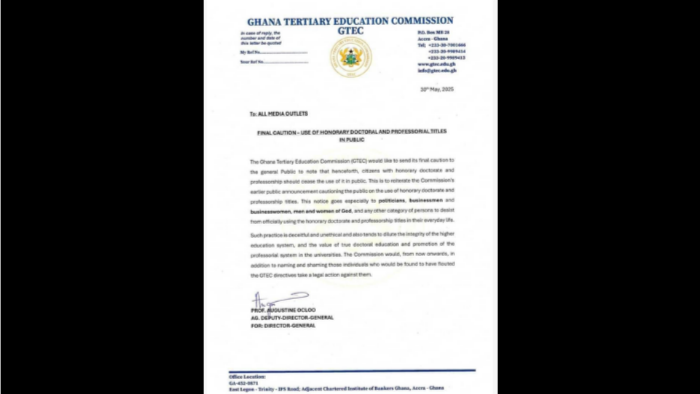
This directive from Ghana has once again shown us that though Ghanaians and Nigerians are ‘cousins’, the former are more organised and respectful of societal values. In Nigeria, almost every serious politician, church leader, and business executive has one or more honorary doctorates. Even I, a Unilag-trained medical doctor, have been offered multiple times with the offer letters calling me Dr. Truth is that the dealers have noticed the fakeness and gullibility of some Nigerians to the extent that many big men and women are ‘doctors’.
Unfortunately, most of these arrangee doctorate awarding institutions are unregistered in their home countries, or they are at best registered mostly for the purpose of dishing out honorary degrees for fees. These are also known as Degrees Mills.
The Nigerian government can emulate Ghana, copying this best practice to sanitise the academic system. That way, the age-old motivating saying, ” The heights attained by great men were not reached by sudden flight, but they, while their companions slept, were toiling up into the night, ” can push everyone to earn if they want it and not buy the title or, worse, flaunt it like a badge.

Judiciary Workers Strike delays FG suit against Akpoti-Uduaghan for Akpabio and Bello.
The ongoing strike by judiciary workers in the Federal Capital Territory has postponed the proposed arraignment of Senator Natasha Akpoti-Uduaghan by the Federal Government for the alleged defamation of Senate President Godswill Akpabio and the former Kogi State governor, Mr Yahaya Bello.
The Federal Government filed criminal defamation charges against Senator Natasha Akpoti-Uduaghan, who represents Kogi Central Senatorial District, accusing her of making defamatory statements against Senate President Godswill Akpabio and former Kogi State Governor Yahaya Bello. The charges stem from statements she allegedly made during a live broadcast on Channels Television’s Politics Today programme on April 3, 2025, where she claimed that Akpabio and Bello conspired to assassinate her. The suit, filed on May 16, 2025, at the Federal Capital Territory High Court (case CR/297/25), alleges that Akpoti-Uduaghan knowingly made imputations that would harm the reputations of Akpabio and Bello, in violation of Sections 391 and 392 of the Penal Code Law.
Senator Akpoti-Uduaghan was due to be arraigned on 3 June 2025, but the arraignment was delayed due to a judiciary workers’ strike that shut down courts in the Federal Capital Territory. Her lead counsel confirmed her anticipated court appearance and compliance with court directives, although it remained unclear whether the Federal Government intended to proceed with the arraignment on that date.
The Federal Government is the complainant in the suit, with Akpoti-Uduaghan as the sole defendant. The case includes testimony expected from both Senate President Godswill Akpabio and former Governor Yahaya Bello. The charges specifically cite statements made by Akpoti-Uduaghan alleging that Akpabio emphasised that she should be killed in Kogi, and that her security was withdrawn to make her vulnerable to attacks.