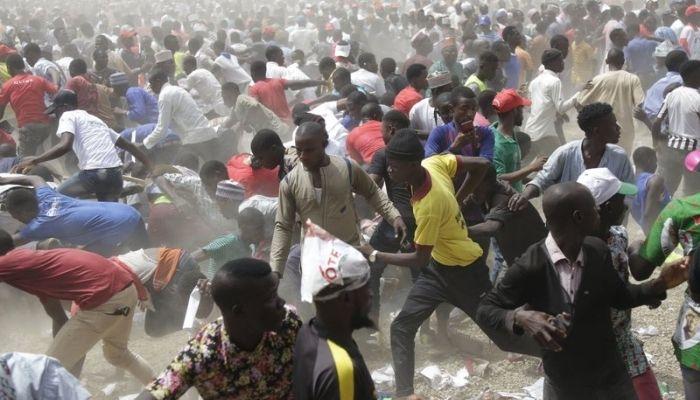
Political violence rarely erupts without warning. Before it explodes, it sends signals: a disrupted rally, an ambushed convoy, a burnt party office, a murdered polling agent, a community silenced by fear. These are not random episodes. They are early rehearsals of a deeper national breakdown.
Nigeria is witnessing too many of these signs at once, and the most urgent question is no longer whether danger is gathering but whether the federal government has the will, capacity, and seriousness to stop it before it becomes a full democratic emergency.
“ Political violence rarely stays confined to elections. Once armed gangs, cult networks, and informal militias are recruited for partisan purposes, they do not simply disappear after campaign season.”
Recent incidents across the country should trouble every patriot. When gunmen invade a political gathering, when armed men attack convoys linked to opposition figures, when party offices are set ablaze, or when an election agent is allegedly killed while defending a vote, such acts must never be dismissed as routine electoral friction. They are evidence that politics is being stripped of persuasion and steadily replaced by intimidation. Once that shift begins, elections may still be held, parties may still campaign, and ballots may still be printed, but the spirit of democracy is already under assault.
This is precisely why the federal government cannot afford the comfort of distance or the excuse of federalism. Political violence in a state is never merely a state problem. It is a test of the authority of the Nigerian state itself. The constitution vests coercive power, security coordination, intelligence capacity, and prosecutorial influence substantially in the hands of the federal centre. When violence grows and impunity deepens, the failure is not only local; it is national. Abuja becomes answerable.

That responsibility is even heavier because voter confidence in Nigeria is already dangerously weak. A democracy in which citizens increasingly withdraw from participation is a democracy in visible distress. People do not rush enthusiastically to polling units when politics begins to resemble war. They retreat into silence. They weigh their safety against their civic duty and often choose survival. That withdrawal leaves the political field open to those who specialise in coercion. Every frightened voter who stays home strengthens the hand of those who believe violence is an effective electoral strategy.
The federal government must therefore understand that intervention is not simply about sending police after an incident has happened. It is about restoring the credibility of the state as the impartial guarantor of political freedom. Once citizens begin to suspect that security agencies are reactive, selective, or compromised, democracy begins to lose moral legitimacy. The issue is not only whether the government condemns violence but also whether it acts swiftly enough to prevent it, investigate it thoroughly, and punish it consistently. Words without consequences only embolden offenders.
Nigeria has been here before, and the lesson is sobering. The memory of political violence in Rivers State during the 2015 governorship election still lingers because it left behind not only blood and destruction, but also the enduring impression that the system moved on without justice. That is always the most dangerous outcome. Violence becomes more than an event; it becomes a precedent. Once perpetrators conclude that the state lacks either the courage or the interest to prosecute them, they evolve from thugs into political instruments. Impunity then becomes policy by another name.
This is where federal intervention becomes decisive. The presidency; the National Security Adviser; the Inspector-General of Police; the Department of State Services; the military high command, where necessary; and the Attorney-General of the Federation must not treat these warning signs as isolated disturbances. They should see them for what they are: assaults on constitutional order. There should be a coordinated federal response mechanism for political violence risk, especially as 2027 approaches. That response must include intelligence-led monitoring of flashpoints, rapid deployment to vulnerable areas, special investigative teams, public prosecution of offenders and sponsors, and clear communication that the Nigerian state will not tolerate violence as an extension of politics.
Crucially, federal government intervention must go beyond arresting expendable foot soldiers. Nigeria has suffered too long from a pattern in which the visible attacker is briefly detained while the sponsor, financier, and political beneficiary remain untouched. That culture must end. The real test of state seriousness is whether it can trace violence up the ladder of responsibility. Who funded it? Who armed the perpetrators? Who provided cover? Who stood to gain? Until these questions are answered with prosecutorial courage, the cycle will continue.

There is also a wider national security dimension that the federal government must not ignore. Political violence rarely stays confined to elections.
Once armed gangs, cult networks, and informal militias are recruited for partisan purposes, they do not simply disappear after campaign season.
They mutate into long-term criminal ecosystems. They feed banditry, extortion, territorial violence, and social instability. What begins as election intimidation can become a wider breakdown of law and order. In that sense, early federal intervention is not merely about protecting democracy; it is about preventing the criminalisation of the republic.
History is merciless on governments that ignore these warning signs. The crisis that engulfed Western Nigeria in the First Republic did not begin as a sudden collapse. It grew through manipulated contests, retaliatory violence, arson, and state failure. Operation Wetie was not just a regional tragedy; it was a national warning that when political violence is tolerated, democracy itself can be buried. The federal authorities of that era failed to act with sufficient wisdom and urgency, and the consequences were catastrophic. Nigeria cannot afford to repeat that error under a democratic government in the twenty-first century.
President Bola Tinubu’s administration must therefore rise above partisan temptation. No ruling party should imagine that violence which weakens opponents today will strengthen the state tomorrow. What appears useful in the short term can delegitimise the entire democratic order in the long term. A government that looks away while rivals are intimidated may later discover that it has licensed a political culture it can no longer control.
The federal government must intervene firmly, visibly, and lawfully. It must treat attacks on opposition actors, party structures, electoral agents, and politically exposed communities as attacks on the republic itself. Security agencies must prevent, not merely react. Prosecutors must pursue sponsors, not only pawns. And the presidency must speak with moral clarity, making it unmistakable that power in Nigeria is to be won by persuasion, not by petrol bombs, bullets, or fear.
The signs are already here. The smoke is visible. The smell of danger is in the air. If the federal government fails to act now, then any explosion of political violence before 2027 will not be a surprise. It will be the consequence of warnings ignored, signals trivialised, and responsibility deferred.
At that point, history will record not that Nigeria was ambushed by chaos, but that it saw the storm coming and chose not to intervene.