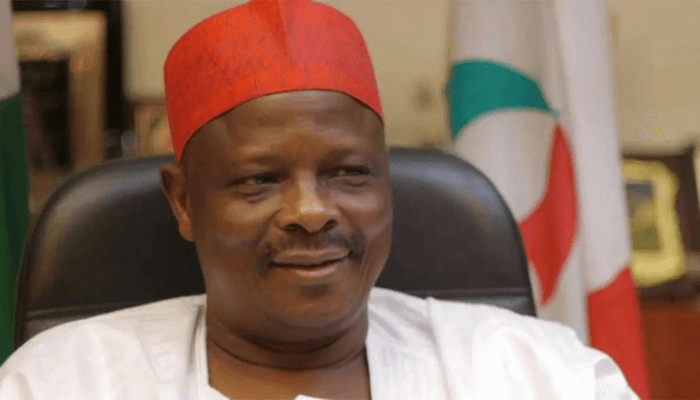
Many Nigerians have expressed shock after a bill introduced in the United States Congress identified former governor of Kano State and national leader of the New Nigeria Peoples Party (NNPP), Rabiu Musa Kwankwaso, as among individuals and groups that could face visa bans, asset freezes and other sanctions over alleged violation of religious freedom.
The proposed Nigeria Religious Freedom and Accountability Act of 2026 would direct the U.S. Departments of State and Treasury to consider targeted sanctions under the Global Magnitsky Act on individuals or entities responsible for severe religious freedom violations.
In addition to Kwankwaso, the bill named the Miyetti Allah Cattle Breeders Association of Nigeria and certain Fulani ethnic militias.
The development, which trended heavily on Wednesday, triggered widespread disbelief among political stakeholders and supporters of the former governor, many of whom questioned the basis of the reported mention and whether it stemmed from misinformation or mistaken identity.

Read also: US sanctions bill: NNPP backs Kwankwaso, tells US to investigate before it legislates
Although opinions have been mixed from Nigerians, there are those who say it was time those responsible or have links to the spate of killings, kidnapping and generally aiding insecurity in Nigeria are punished.
“The mention of his name is surprising, but they should investigate, we have lost too many Nigerians to the terror war and insurgency and it is time those behind this crime are held to account,” Olisa Okeha, public affairs commentator, said.
Kwankwaso, a two-term governor of Kano State, former Minister of Defence, senator, and presidential candidate of the New Nigeria Peoples Party (NNPP) in 2023, has not been formally designated a terrorist sponsor by the U.S. government.
However, the mere suggestion of his inclusion in legislative discussions abroad has stirred intense political debate at home, particularly in Kano and across northern Nigeria.

Other public commentators said the United State under the current administration of Donald Trump could not be taken seriously, arguing that they want to see evidence linking Kwankwaso to terrorism before believing.
“They said they are targeting him because he spoke out; if that is true it is shameful to them. Many of us know that sharia was not implemented in Kano alone. Bring evidence out,” a source who did not want his name in print said.
Confusion over Sharia reference
Part of the controversy stems from the allegation by the United State lawmakers that Kwankwaso was described as the “originator” of Sharia law implementation in Nigeria, an assertion many analysts say contradicts historical records.
Nigeria’s expansion of Sharia-based criminal law codes in the early 2000s is widely associated with initiatives undertaken in Zamfara State under former governor, Ahmed Sani Yerima, with several northern states subsequently adopting similar frameworks within constitutional provisions.
Kano State, under Kwankwaso as governor, implemented the Islamic legal code, joining other northern states such as Zamfara, Sokoto, Katsina, Yobe, Jigawa and Borno.
Legal experts pointed out that the adoption of Sharia-based systems occurred through state legislative processes and remains subject to Nigeria’s constitutional structure, appellate review, and federal oversight.
Against that background, experts say the attempt to single out one individual for broader constitutional developments has raised questions about accuracy and context.
Ekemini Udim, a legal practitioner, expressed shock about allegations linking Kwankwaso to terrorism financing.
Udim noted that he had not heard Kwankwaso’s name being linked to terrorism.
“I’m surprised to see Rabiu Kwankwaso’s name in that list. I think the US needs to give us more clarifications. I have not really heard his name being bandied around terrorism, but maybe America has better information than Nigeria has not had over the years.
“Maybe, the US is able to monitor activities of the former governor and minister and they now think there’s need to make it clearer for all of us in Nigeria to understand.”
Read also: US Republicans to sanction Kwankwaso, Miyetti Allah in new rights bill
Kwankwaso targeted – Kwankwasiyya, NNPP kick
Since the report broke, the NNPP and Kwankwassiya movement, a political group loyal to Kwankwaso, have strongly rejected the proposal, describing it as unfair and politically motivated.
Many political ally of the Kano politician have also spoken in his favour, while vowing for his integrity.
Speaking to BusinessDay, Ladipo Johnson, who is the National Publicity Secretary of the NNPP, said the allegation was untrue and misleading.
Johnson, who is a long-term close political associate of Kwankwaso, stated that many Nigerians would not believe what the offence the United State lawmakers are alleging the Kano politicians has committed,
“It is false and misleading; not many people would believe them, we know what Kwankwaso can do. The publicity will only make him more popular,” he said.
Similarly, the New Nigeria Peoples Party in a reaction, also expressed shock over a proposed bill before the United States Congress which named its national leader, Kwankwaso, among individuals recommended for targeted sanctions over alleged religious freedom violations in Nigeria.
The party dismissed any suggestion that Kwankwaso was responsible for religious freedom violations.
“We see this development as a contrived action against an innocent man who clearly has no relationship with religious fundamentalism in Nigeria.
“His record is there in the public domain, either in public office or in private life and it is advisable for people to investigate such things properly, before reaching such conclusions,” a statement by the NNPP said.
The party noted months before the latest development, Kwankwaso had reacted to the decision by US President Donald Trump to redesignate Nigeria as a Country of Particular Concern over alleged religious persecution.
According to the party, “The months before the latest development, Kwankwaso had openly reacted when President Donald Trump redesignated Nigeria as a Country of Particular Concern over alleged religious persecution.
“In a statement posted on his X handle at the time, Kwankwaso cautioned against what he described as oversimplified characterisations of Nigeria’s internal challenges.
“Kwankwaso stated that it was important to emphasise that our country is a sovereign nation whose people face different threats from outlaws across the country.”
However, in a post shared on X, Moore had written to Kwankwaso, “Governor, do you care to comment on your own complicity in the death of Christians? You instituted sharia law. You signed the law that makes so-called blasphemy punishable by death.”
Further questioning the allegation, the NNPP asked, “But is this enough to accuse Kwankwaso of severe religious freedom violations? Why were the other state governors who introduced Sharia in their states not accused as well?
Kperogi, Galadima, Sanni react
Farooq Kperogi, political analyst and columnist explained why Kwankwaso was singled out in a proposed United States bill seeking visa bans and asset freezes on Nigerian political figures.
In a commentary titled ‘Why Kwankwaso Was Singled Out in a US Bill’, Kperogi argued that Kwankwaso’s inclusion has little to do with religious extremism and more to do with his public criticism of America’s designation of Nigeria as a Country of Particular Concern.
According to Kperogi, Kwankwaso is an unlikely candidate for accusations of religious fanaticism, noting that as governor of Kano in 2000, he initially resisted the introduction of Sharia law and only declared it after sustained pressure from clerical groups and the public.
Kperogi explained that tensions resurfaced years later when Kwankwaso openly criticised the US position on Nigeria’s religious freedom challenges, warning that such labeling oversimplified complex security issues and risked deepening interreligious divisions.
Kperogi suggested the controversy may boost Kwankwaso’s national profile, potentially strengthening his appeal among northern voters and elevating him beyond Kano politics — much like former president Muhammadu Buhari once did across the region.
“The explanation is straightforward. Kwankwaso was the only nationally prominent Nigerian politician who openly criticised the United States’ designation of Nigeria as a Country of Particular Concern,” Kperogi said.
Another political commentator, Shehu Sani also called on United States legislators to verify the facts before targeting Kwankwaso, saying there is no record of him supporting or condoning violence or discrimination.
Buba Galadima, chieftain of the NNPP, described allegations linking former Kano State Kwankwaso to terrorism as politically motivated.
Speaking in an interview, Galadima, who is a close-ally of the Kano politician alleged that the claims are aimed at weakening Kwankwaso’s potential presidential or vice-presidential ambition ahead of the 2027 general elections.
“The insinuation that Kwankwaso was a financier of terrorism is baseless. It is an attempt to smear a peaceful Nigerian ahead of the 2027 elections,” Galadima said.
He further accused some media organisations and political actors of spreading unverified reports in a bid to tarnish Kwankwaso’s reputation.
Galadima also clarified that Kwankwaso did not implement Sharia law in its strictest form, noting that the political fallout from that period contributed to Ibrahim Shekarau’s eventual emergence as governor.
Also speaking, Isaac Idahosa, a Christian cleric and Kwankwaso’s former running mate, described the U.S. visa ban proposal as a “gross injustice” and said it was based on inaccurate information about Kwankwaso’s record of promoting peaceful coexistence.
Opinions divided along partisan lines in Kano
In Kano, reactions have been sharply divided along partisan lines. Loyalists within the NNPP and the Kwankwasiyya movement dismissed the development as external interference in Nigeria’s domestic politics, while some critics urged caution, calling for transparency and clarification from United States authorities.
Political observers say Kano remains a critical electoral bloc heading toward 2027, and any international controversy surrounding one of its dominant political figures is bound to reverberate nationally.
“Whether factual or exaggerated, international scrutiny elevates a politician’s profile,” said a Kano-based political analyst. “In northern politics, being perceived as targeted externally can sometimes reinforce internal solidarity.”
Indeed, some commentators argue that the episode has unintentionally amplified Kwankwaso’s visibility beyond regional boundaries.
Once often labeled a primarily Kano-based political heavyweight, the former governor now finds his name circulating in global policy discussions, a development that may reshape perceptions of his influence.
Broader political calculations
Beyond the immediate controversy, analysts see strategic implications.
Kwankwaso has remained an influential figure in northern politics, commanding disciplined grassroots following symbolised by the red caps of the Kwankwasiyya movement.
In recent years, he has positioned himself as a vocal critic of federal policies affecting northern Nigeria, framing debates around marginalization, governance, and security reform.
With internal divisions continuing to challenge both the APC and PDP blocs in parts of the North-West, the NNPP’s cohesion in Kano gives Kwankwaso leverage in coalition calculations ahead of 2027.
Political observers argue that international attention even when contentious can alter domestic power equations by reframing a leader from regional actor to national stakeholder.
Foreign policy experts note that congressional bills often undergo multiple revisions before passage and may include recommendations that are amended or removed.
They say the bill would not survive second reading in the US legislature.
Still, the symbolic weight of being mentioned in the context of religious freedom concerns carries reputational consequences, especially for a politician with national ambitions.