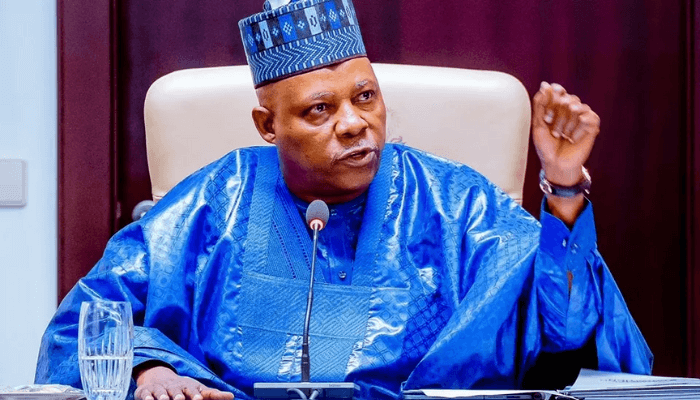
Vice President Kashim Shettima on Tuesday identified the absence of strong fiscal disciple as a major factor weakening Nigeria’s federal structure.
Speaking at the Leadership annual lecture and award ceremony at the banquet hall of the Presidential Villa, Abuja, Shettima noted that Nigeria’s federal structure was not flawed, adding that the challenge has to do with “resource management”.
He blamed what he called “ deficit of our collective fiscal responsibility”, even as he berated the subnational governments for poor resource utilisation.
Read also: Nigeria, Sweden deepen biateral ties as Shettima receives Swedish princess

He however assured that the administration of President Bola Tinubu is poised to confront Nigeria’s problem frontally, through reforms.
“ Our problem often stem from poor management of resources, but we have chosen the path of reforms. It is bold, often difficult, but necessary,” he said.
Shettima noted that every opportunity to engage in a conversation aimed at rethinking Nigeria’s federal system is both timely and necessary.
He stated that Nigerian challenge, when carefully considered, lies less in the structure of our federalism and more in the deficit of our collective fiscal responsibility.
“The problems we attribute to our federal system often stem from the poor management of what is already within our grasp, not from any inherent flaw in our constitutional architecture. The issue is not merely how much each federating unit accrues, but how judiciously such resources are utilised.”

He stated that the Tinubu administration has chosen the path of reform. It is bold, often difficult, but necessary, adding that ” One such step is our unflinching pursuit of local government autonomy-a vision we are realising through the sanctity of due legal process
He cited the recent Supreme Court pronouncements in favour of autonomy, which he said ” underscore our commitment to building a federal structure that works for the grassroots. This is how we make the federation functional: by bringing governance closer to the people
” To those who argue that Nigeria’s federalism is fundamentally flawed because of its fiscal nature, I urge caution. Federalism, as practised around the world, is not a one-size-fits-all system. There is no universal template. Each country’s federal arrangement is shaped by its history, culture, and political experience.”
Shettima while referencing other countries such as Canada, for instance, added that federalism emerged as a compromise between linguistic groups.
“In Germany, the structure was initially so decentralised that consensus from all 16 Länder was required to pass national policies-until reforms in 2006 shifted powers for greater efficiency. Spain, despite its fiscal concessions to regions like the Basque Country and Navarre, still contends with separatist agitations.
Shettima who argued that there is no perfect system, said “Every federation evolves, reforming to meet its unique realities. Nigeria is no exception. We must resist the temptation to romanticise foreign systems or prescribe imported solutions that fail to account for our distinct social, ethnic, and demographic complexities.
” What we seek, therefore, is not a photocopy of another country’s model, but a federal structure tailored to our aspirations. It must reflect our values, ensure accountability, and foster development at all levels. The only road to such a destination is through sincere dialogue, and this conference is a laudable example.”
Speaking further on the Tinubu’s administration, the Vice president said the “policy choices pursued by this administration-from the removal of fuel subsidies to the introduction of tax reform bills-are aimed not only at guaranteeing a fiscally responsible federation but also at creating a system that offers each state both increased allocations and the opportunity to participate in debates and reforms for long-term fiscal stability.”
Read also: Tinubu’s bold decisions shield future leaders from tough choices — Shettima
He stated that Nigeria’s national experience has shown, time and again, that ” the greatest threats to our progress have stemmed from the mismanagement of resources and corruption.
“What matters Asaba most to everyday Nigerians-whether in Owerri or Sokoto-is not the abstract theory of federalism but whether governance delivers water, electricity, schools, roads, and hospitals.
” while we compare notes on how to improve our federalism, we must not lose sight of the dysfunctions that have been allowed to fester under the current system. If we at the national level deliver on our promises, if our governors manage their allocations with prudence, if our local governments are truly autonomous and accountable, if every kobo is deployed with the people’s interest in mind, then the structure will serve us well”.