|
Getting your Trinity Audio player ready...
|
…Acknowledges proposals for 18 new LGAs
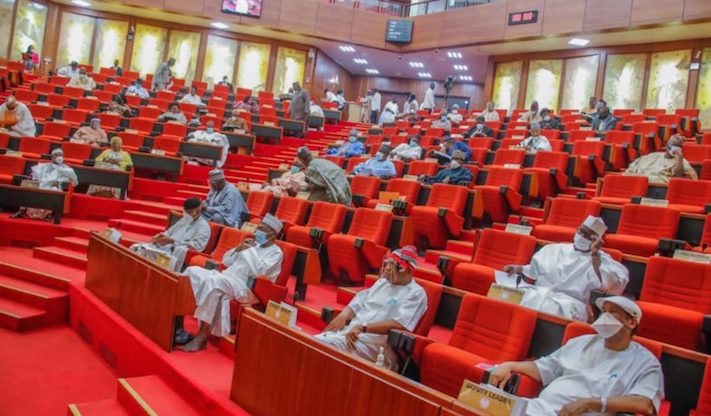
The Nigerian Senate has acknowledged the receipt of 31 separate proposals seeking the creation of new states across the country, alongside 18 additional requests for the establishment of new local government areas.
The proposals come at a point Africa’s most populous nation faces revenue shortages and high cost of governance.
Opeyemi Bamidele, Senate leader, said at the South West regional review of the constitutional amendment process, that the proposals reflect the rising demand for administrative restructuring and more equitable governance across Nigeria’s six geopolitical zones.

According to Bamidele, the North-West and North-East zones each submitted six proposals for new states, while eight came from the North-Central, five from the South-East, six from the South-South, and four from the South-West.
In terms of local government areas, the Senate Constitution Review Committee has received seven requests from the North-West, five from the North-Central, and one each from the North-East, South-East, and South-West, while three came from the South-South.
Read also: 36 commissioners kick against Senate proposed electricity act amendment bill
The documents obtained by BusinessDay revealed the diverse origins and motivations behind these demands.
Ned Nwoko, in his proposal, called for the creation of Anioma State out of the current Delta State.

In the letter entitled, ‘Anioma as Equity State,’ Nwoko emphasised that the creation of Anioma State is not merely about redrawing boundaries or political convenience but a matter of equity, fair representation, and justice.
He pointed out that the South-East currently has five states, while other geopolitical zones have six or seven states.
On its part, the Movement for the Survival of the Ogoni People of the USA, Inc. (MOSOP-USA) is advocating for the creation of Bori State from the present Rivers State, citing the need for political autonomy and development in Ogoniland.
In Kaduna State, both the Southern Kaduna People’s Union and the Kaduna Development Elders Initiative are championing the creation of Gurara State, citing persistent marginalisation.
Similarly, the Ochetoha K’Idoma and Senator Abba Moro are calling for the establishment of Apa State from the current Benue State.
On his part, Hakeem Fawehinmi, a professor, has proposed the creation of seven new states per geopolitical zone to balance the federation and prevent what he described as ‘unviable fiefdoms.’
In the Niger Delta, the Itsekiri Leaders of Thought have put forward a case for the creation of Warri State.
Other suggestions include Edu and Kainji states from Niger, Savannah State from Borno, Amana State from Adamawa, and Mambila State carved out from Taraba, Nasarawa, and Benue states.
There is also a proposal to merge Southern and Western Bauchi (including Zaar, Jarawa, and Warji communities) with Plateau State, and to transfer Southern Gombe to Amana State.
Boundary adjustments
Further boundary adjustments and new regional configurations have been proposed to reflect ethnic and linguistic realities.
These include integrating Yoruba-speaking communities in Kwara and Kogi into the South-West, and merging Tiv-speaking parts of Taraba and Kogi with Benue.
It was also suggested that Doma and Keana areas of Nasarawa could form a Lower Middle-Belt region, while parts of Borno, Gombe, Bauchi, and Yobe could constitute an Eastern Middle-Belt region.
Another recommendation is the formation of an Upper Middle-Belt zone from the remaining parts of Nasarawa, Southern and Western Bauchi, Plateau, Southern Kaduna, Niger, and Zuru-speaking areas of Kebbi State.
Read also: Senate on the varsity establishment spree
In Enugu State, the Adada State Movement renewed its call for the creation of Adada State, while the Oro National Patriots insisted that state creation should be evaluated on merit, using principles similar to those employed in the United States, such as geographical contiguity, economic viability, and topographical considerations.
These developments follow the February presentation by the House of Representatives Constitution Review Committee, which also proposed the creation of 31 additional states, prompting widespread public reaction.
Benjamin Kalu, deputy speaker, who chaired the committee in the absence of Speaker Tajudeen Abbas on Friday, read out the proposal during plenary. The suggested states included: Okun, Okura, and Confluence from Kogi; Benue Ala and Apa from Benue; FCT State; Amana from Adamawa; Katagum from Bauchi; Savannah from Borno; Muri from Taraba; New Kaduna and Gurara from Kaduna; Tiga and Ari from Kano; Kainji from Kebbi; and Etiti, Orashi, Adada, Orlu, and Aba from the South-East.
Other proposed states included: Ogoja from Cross River; Warri, Ori, and Obolo from the South-South; and Torumbe, Ibadan, Lagoon, Ijebu, and Oke Ogun/Ijesha from the South-West.
However, the proposals were swiftly criticised by leading regional organisations such as the Yoruba socio-cultural group Afenifere and the Arewa Consultative Forum, who dismissed them as unrealistic and politically driven.
Fiscal crisis
The renewed calls for 31 additional states have emerged against a backdrop of mounting economic pressure in Nigeria.
According to the Debt Management Office (DMO), as of March 31, 2025, Nigeria’s total public debt had ballooned to N149.39 trillion, up 22.8 percent year-on-year from N121.67 trillion and rising by N4.72 trillion (3.3 percent) from the previous quarter
Nigeria’s 2025 budget contains a deficit of N13.39 trillion, which is to be funded through a combination of revenue and borrowing. Debt servicing for 2025 is estimated at N16.3 trillion, but revenue-to-GDP is about 13.2 percent, lower than Rwanda’s 24 percent and South Africa’s 23.3 percent.
Most of Nigeria’s 36 states depend heavily on monthly Federal Account Allocation Committee (FAAC) disbursements, with more than 20 states unable to finance 20 percent of their budgets from internally generated revenue.
Lagos and Rivers remain outliers, covering around 70 percent of their expenses through IGR.
Proposal are mainly emotionally-based
Maryam Ibrahim, lawyer and civic rights activist, explained that many of the memoranda rely on ethnic and sentimental grounds rather than the strict legal criteria required for constitutional amendments.
“The framers of the constitution wanted a federation, not a patchwork of ethnic enclaves,” she said,
“State creation is constitutionally permissible, but it’s intentionally difficult to achieve for a reason: to maintain national cohesion and avoid unnecessary fragmentation.
“Most of the current proposals, while emotionally charged, may not meet the legal thresholds of Section 8 of the 1999 Constitution. We must avoid politicising what should be a rigorous constitutional process.”
The social advocate further added, “The clamour for new states reflects the deep sense of exclusion many communities feel under the current federal structure.
Read also: Senate moves to amend Electricity Act to criminalise vandals, strengthen power sector
“But instead of creating more states, we should focus on strengthening regional development commissions and devolving powers to the states we already have.”
She warned that continuing to multiply states could worsen administrative costs and dilute governance capacity.
“We have 36 states already struggling to pay salaries. Adding 31 more will only deepen inefficiency if not backed by solid economic reasoning.”
Auwal Ibrahim Musa Rafsanjani, executive director, Civil Society Legislative Advocacy Centre, stated the need to deepen accountability structures in the current states and local governments, noting that many rural communities remain underdeveloped even in smaller states.
He said, “State creation won’t fix corruption, weak institutions, or political exclusion.
“Nigeria’s challenge is not the number of states, but the quality of governance. People are agitating because they believe new states will bring development closer. What we need instead is a constitutional amendment that mandates equitable distribution of federal projects, inclusive governance, and fiscal autonomy.”