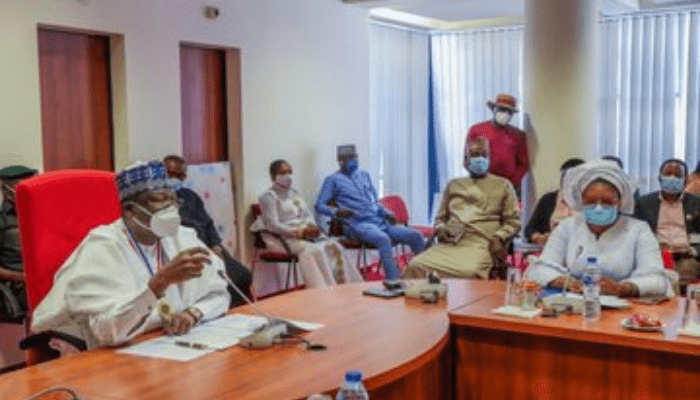
The Senate President, Ahmed Lawan, has advocated more use of technology and less human interaction in order to tackle corruption in Nigeria.
He stressed the need to introduce measures that will make the stealing of public funds difficult, so as to prevent corruption before it occurred instead of wasting resources investigating and prosecuting corruption cases.
Lawan spoke on Thursday during his conferment as Patron by the Chartered Institute of Forensic and Investigative Professionals of Nigeria (CIFIPN).
He said, “Our experience in the National Assembly recently has shown that the revenue-generating agencies of government, many of them, will collect revenues but not all the revenues are remitted to the appropriate account of government. We believe that we can do better if we deploy technology in the collection and transmission of the revenues.”

The Senate President lamented that previous had wasted the resources of the country in the past and have little to show huge resources.
Besides, he said many countries had deployed technology to reduce corruption and was working for them.
“Therefore, we must emphasise on how to prevent it and make it difficult for especially Civil Servants, I am sorry to say that, those who are entrusted with public funds to have undue access and opportunity to divert public funds.
“We have to prevent it because some believe that if they try they can get away with it and the best way to deal with this is to make it difficult and where possible impossible to access public funds for personal use. This anti-corruption framework can enhance the prosecution and sanctioning process.”
“We have emphasized prevention as a good route to reducing corruption, given the tendency of individuals to exploit weaknesses in systems. People are more likely to take advantage of loopholes than they can create them. Technologies are additionally expected to reduce loopholes, because of their sophistication, the skills required, and the fact that they are structured.

“Effective usage also requires time to establish. Using technologies therefore limits, or prevents the chances of infractions, and eventually saves prosecutorial time and resources.
“Many countries have reduced corruption through science and technology for their ability to limit human interaction and then ensure that operations are strictly procedural.”
Lawan said the fight against corruption was worth considering the damage it was causing the nation.
“The angle from which the Chartered Institute of Forensic and Investigative Professionals of Nigeria (CIFIPN) is coming from, is surely a practical approach.
“It is practical because it seeks to provide skills to relevant professionals on the use of science and technology to prevent, detect, and to investigate corruption. It also envisages mechanisms against re-occurrence.
“This anti-corruption framework can enhance the prosecution and sanctioning process.”