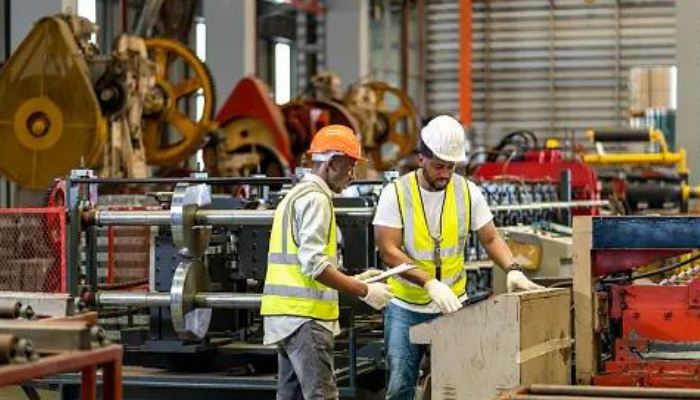
After several years of shutdowns and stalled investments, manufacturers are finally revving up their factory engines again on the back of renewed investor confidence.
Investor confidence is gradually returning to Africa’s most populous nation after a raft of monetary and fiscal policies targeted at transforming the nation into a market-led economy. The foreign exchange market liberalisation in 2023 has seen the naira stabilise since late last year, with rates reflecting market dynamics.
As a result, portfolio investors bet $8.05 billion in the first half (H1) of 2025, nearly the entire inflow in 2024, which was $8.53 billion.
The game has now moved from portfolio investments to direct investments as manufacturers return to the trenches.

Read also: Nigeria rallies investors as reforms gain traction
BUA Group began production at its newly completed gypsum manufacturing facility located in Port Harcourt, Rivers State, in December 2024.
The group also entered into an agreement with Starlinger & Co. Limited of Austria to expand into the production packaging materials.
BUA Group recently commenced the development of a 700-ton-per-day mini-LNG plant at Ajaokuta, Kogi State.
Similarly, Dangote Group has applied to begin work on a seaport near his fertilizer and oil refinery plants to make it easier to export his liquefied natural gas. In March 2025, the group began building its $2 billion polypropylene facility in Lagos.

“One advantage of the reforms, like the foreign exchange (FX) reforms, is that it now makes local production cheaper versus imports,” Aliko Dangote, chairman of Dangote Group, said last Thursday.
Represented by Aliyu Suleiman, group chief strategy officer of the biggest conglomerate in Africa, Dangote said at BusinessDay CEO Forum last Thursday that “in the area of oil and gas, which of course is the largest and a major focus, we will expand the refinery, as a project exists, and also continue to invest in petrochemicals.”
Also, Flour Mills of Nigeria Plc is investing $500 million in its sugar operations in Niger State, with a view to raising output four-fold to 400,000 tons.
John Coumantaros, Flour Mills chairman, noted in December 2024 that the group will be spending $100 million in setting up a cassava-processing plant to reduce cassava starch imports.
The fast-moving consumer goods company (FMCG) spent N1.8 trillion on raw materials in the 2023/2024 year.
“Our dream is to have a pan-African food business that is headquartered in Nigeria. We will take advantage of the African Continental Free Trade Area (AfCFTA) so that we can expand our footprint into those regions,” Flour Mills chairman said.
In February 2025, Johnvents, a Nigerian agribusiness and manufacturing firm, signed a $40.5 million loan deal with UK’s Development Finance Institute (DFI) to more than double its cocoa processing capacity to 30,000 metric tons annually.
The loan will advance the company’s ambitious goal to achieve 100 percent traceable cocoa, with at least 90 percent certified by 2027.
Read also: Expectations as AIHS gathers investors, innovators, policymakers to reimagine housing
Also, Guala Closures, a global manufacturer of spirits, wine, edible oil, water, and a wide range of other beverages, set up a manufacturing plant in Lagos in April 2025.
The construction of the plant, which spans nearly 5,000 square meters, was completed in 22 weeks and reached operational start-up by the end of 2024.
“Our global presence and in-depth knowledge of local markets allow us to stay close to our global customers, addressing their specific needs in every region of the world with customized solutions and outstanding service,” said Andrea Lodetti, CEO of Guala Closures.
Manufacturing investments in the second half (H2) of 2024 witnessed a 19.4 percent increase compared to the first half (H1) as the economy began seeing the upsides of FX policies and petrol market liberalisation.
What has changed?
The Central Bank of Nigeria (CBN) eliminated the heterodox exchange rate seen in the last administration and introduced a market-led approach, where price allocates dollars. The bank launched FX code and the Electronic Foreign Exchange Matching System (EFEMS) to entrench transparency in the FX market.
The policies have reduced arbitrage in the FX market and brought stability in the system.
“In the last one month or more, we’ve seen calmness in the market,” said Gabriel Ogbechie, managing director and chief executive officer of Rainoil, one of Nigeria’s biggest integrated downstream oil and gas companies.
“I’ve always argued that the problem is not what the exchange rate is. But let it be stable so we can plan,” Ogbechie said during a session organised by PwC last Thursday.
What needs to change
However, analysts say the investment inflows are still not enough.
“We have scored wins in the last two years,” said Ike Ibeabuchi, an emerging markets expert.
Read also: Developer hosts London Afri-Vest summit to rally diaspora investors
“But the authorities must now bring down inflation and raise the disposable incomes of Nigerians. Foreign direct investors are interested in investing in markets where people can buy their products.
“We also need to improve other aspects of doing business such as business registration, court processes, access to capital and electricity, and infrastructure.”