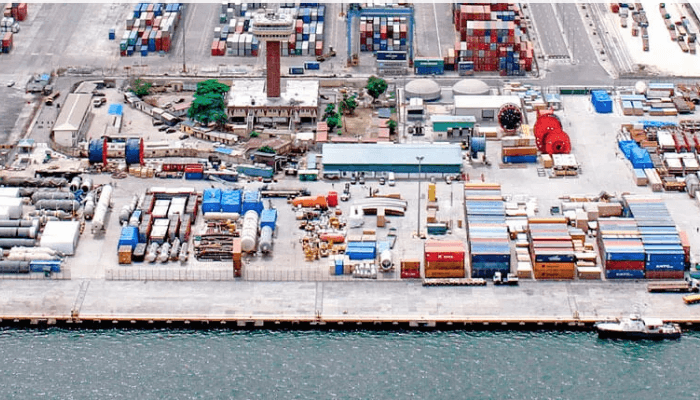
From the last administration, the Federal Government of Nigeria has spent a lot of resources, both human and material, to reform the nation’s seaports in order to have them securely and economically sustainable. To date, congestion at Nigerian seaports, especially those in Lagos, by containers and inadequate infrastructure within the seaports and other associated infrastructure in the country is of serious concern.
“It is unfortunate that Nigerian ports have been categorised by experts as the least efficient in West Africa.”
From records, Lagos ports that handle over 80 per cent of Nigeria’s imports have continued to face severe congestion due to inadequate infrastructure and administrative bottlenecks, and this is believed to be negatively impacting trade and economic expansion.
Remember, in 2017, Hadiza Bala Usman, as the then managing director of the Nigerian Ports Authority, introduced reforms to allow importers to choose terminals freely. This move was part of a wider idea to open up the port’s system and allow for free trade zones and enhance competition among port operators. Despite the reforms, the issue of congestion and delay at the seaports has remained.
According to the Lagos Chamber of Commerce and Industry (LCCI), Nigeria has lost an estimated N7.6 trillion annually due to congestion at Apapa and Tin Can Island ports. It notes that trucks queue for days waiting for access, costing the economy $55 million daily in lost activities. These inefficiencies at the nation’s ports cost the business community over ₦2.5 trillion annually.

These figures – costing the nation N7.6 trillion and the business community N2.5 trillion annually – added to internally generated revenue will be a significant portion of the nation’s Gross Domestic Product (GDP). This will translate into substantial implications for tax revenue, job creation, and overall economic growth.
For instance, Nigeria is supposed to handle most of the export and import cargoes of the Niger Republic, our landlocked neighbour. But due to inefficiency and bottlenecks at Nigerian seaports, we lost Niger Republic’s cargoes to Benin Republic, Togo and Ghana. Even cargo due to Nigeria has been lost to her immediate neighbouring nations. It is unfortunate that Nigerian ports have been categorised by experts as the least efficient in West Africa.
To date also, challenges at the nation’s seaports continue despite efforts like implementing a National Single Window aimed at reducing costs by up to 25 per cent.
The Nigerian economy suffers significantly from inefficient port operations, as recent analyses show poor infrastructure in the ports results in substantial economic losses. With reports showing that the cost of doing business at Nigerian ports is among the highest in West Africa.
The port-stay duration for wet bulk cargo in Lagos increased to 4.3 days as of January 13, 2025, up from 3.8 days the previous week, reflecting ongoing delays and unnecessary bottlenecks.

Congestion not only disrupts supply chain mechanisms but also imposes significant costs on businesses, as it eats into the profit margins of importers and invariably chokes economic growth.
As experts have posited, for many decades, seaports have been considered more as gateways through which maritime trade flows and at the same time as strategic intermediaries in the supply chain. The seaport, as a maritime infrastructure, can only be as efficient as the people who work in it daily.
Read also: Top 10 African countries with the highest number of seaports terminals in 2025
In other climes, different ports often specialise in different types of shipments. Selecting the wrong port can add miles, time and therefore cost to a shipment not appropriately routed. If a port’s infrastructure is not adequate – the port has not got appropriate facilities, resources or road infrastructure – customer service will be impaired. The implication is that higher costs will be incurred by shipping lines, forcing the shipping line to increase costs, thus increasing the total cost of the supply chain.
The first thing Nigeria must do to stimulate the seaports to grow the economy is to make her seaports competitive. A competitive seaport is one that has a proven record of collaboration with industry, regulators and legislators to benefit shippers. The competitive port offers alternative services to container transport, such as an ability to handle traditional break-bulk cargo; oversized, over-dimensional project cargo; or roll-on/roll-off cargo ranging from automobiles and tractors to defence equipment.
In an ideal world, ports within a given country should compete to be the first choice for shippers’ supply chains by providing a wealth of intermodal connections, capacity, distribution facilities, promising no delays and shorter times spent in them.
More importantly, decentralising Nigeria’s seaports is crucial for stimulating the seaports to grow the economy, and addressing congestion and bottlenecks should involve activating seaports in Calabar, Onne, Warri, and other areas, which will offer several benefits. Job creation is a significant advantage, as developing regional seaports can provide employment opportunities beyond urban centres like Lagos. This will help to distribute wealth more evenly and reduce migration.
Reduced congestion is another benefit, as distributing cargo across multiple ports will reduce pressure on major hubs like Apapa. Faster clearance times reduce costs associated with delays and enhance operational efficiency. The decentralisation will also enhance regional economic development, stimulating local economies through increased trade activities.
As long as our seaports remain inefficient and the business environment is unfriendly for whatever reason, there is a cost implication to the inefficiency – depriving the maritime industry of necessary contributions to the nation’s economic growth, noted MA Johnson, a columnist, in an article.