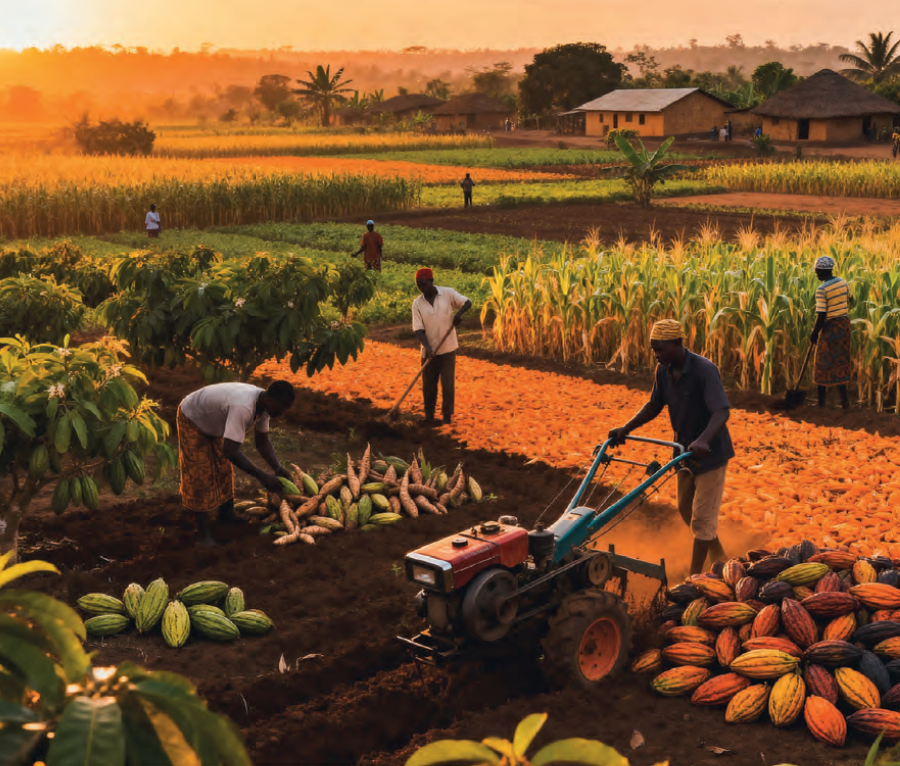
Every nation carries within its history the story of how it first learned to sustain itself, how people tilled the land, exchanged goods, built communities, and gradually shaped an economy. In Nigeria, that story once revolved around the quiet rhythm of agriculture. Long before modern industry and crude oil reshaped national priorities, the country’s fortunes were tied to its soil. Cocoa from the southwest financed iconic infrastructure; groundnut from the north funded education; palm oil from the southeast powered export trade. These were the early pillars of economic identity, reliable, community-driven and deeply woven into daily life. The reality today tells a different story.
Agriculture, the sector that once built regions and sustained livelihoods, has slipped into neglect. The oil boom radically altered Nigeria’s economic trajectory, turning the country from a celebrated exporter to a dependent importer. The consequences are now unmistakable: rising food inflation, foreign-exchange pressure, rural unemployment, and a widening gap between domestic production and national demand.
Yet Nigeria still possesses transformational agricultural assets: 84 million hectares of arable land (FAO), a youth population in which over 42 percent is unemployed or underemployed, and a food market projected to exceed $100 billion by 2030. These are advantages most countries would celebrate. In the last five years, data from the National Bureau of Statistics shows increased youth participation in fish farming, greenhouse cultivation, food processing, and digital agritech. Younger Nigerians are re-entering a space once dominated by ageing farmers. But without the right structures, this renewed interest risks becoming another unrealised national opportunity.
Nigeria’s decline in agricultural strength is not mysterious. It reflects decades of inconsistent policy and weak programme continuity. The Green Revolution of the 1980s, the Presidential Fertiliser Initiative, the Anchor Borrowers Programme, and elements of the Agricultural Transformation Agenda all began with optimism but struggled with transparency, monitoring, and sustainability. The Office of the Auditor-General reported billions in unpaid or unverifiable Anchor Borrowers loans, undermining the credibility of public agricultural initiatives. A revival of the sector must begin with acknowledging these lapses and designing frameworks that survive political cycles.

Modernisation remains a central challenge. Smallholder farmers still produce more than 80 percent of Nigeria’s food, yet many operate with tools unchanged for generations. The country’s mechanisation rate remains below 2 horsepower per hectare, among the lowest in Africa. In Ethiopia, however, yields has doubled in key crops through coordinated investment in irrigation, machinery, and modern input systems. Kenya now uses digital farming platforms that support millions of farmers with real-time data and access to markets. Nigeria’s potential is even greater, but only if the nation commits to equipment leasing schemes, improved seedlings, climate-smart technologies, and irrigation corridors designed to protect production from erratic rainfall.
Agriculture must also be linked directly to industrialisation. For decades, Nigeria has exported raw produce while importing finished goods at a loss. Tomatoes should not leave the country only to return as paste, and cocoa should not be shipped as beans only to return as chocolate at many times the price. States such as Ogun, Oyo, Kaduna, Cross River and Edo already show the gains of processing clusters that turn raw output into finished or semi-processed goods. A national revival must prioritise processing hubs, storage centres and agro-industries that absorb farm output and create stable jobs.
Infrastructure remains one of the most decisive missing links. Poor rural roads, limited storage facilities, and near-absent cold-chain networks lead to massive post-harvest losses. Studies show that Nigeria loses up to N3.5 trillion annually to spoilage, an amount that dwarfs the federal agricultural budget. This loss is not an unavoidable outcome of farming; it is the direct result of inadequate storage, weak logistics, and neglected transport systems. Addressing this requires targeted federal and state collaboration to upgrade rural roads, build cold rooms, and establish distribution networks that link farm clusters to regional and urban markets.
Financing is another persistent challenge. Access to affordable credit remains limited, with high interest rates and impossible collateral requirements. Innovative systems such as cooperative credit pools, warehouse receipt systems, commodity exchanges and digital credit scoring, can unlock capital for millions. But these tools must be insulated from political interference. Young farmers especially need loan schemes that are reachable, transparent and paired with accountability mechanisms.
Security, however, may be the most urgent factor. Vast agricultural belts in Plateau, Kaduna, Benue, Katsina and Niger States have become hotspots of conflict. Even in southern states like Edo and Ondo, farmers now find it difficult to get to their farms. Banditry, kidnapping, and communal clashes have pushed thousands off their farmlands. According to ACLED, over 60,000 Nigerians have been killed by violent groups since 2011, with farmers and rural dwellers disproportionately affected. Bandits and suspected herders kill, maim or rape women who go to their farms and this has affected production. No modernisation effort can succeed in an environment where farmers cannot access fields and transporters avoid key highways.

Human capital development is equally essential. Modern agriculture requires agronomists, food scientists, extension workers, logistics professionals and technologists. Universities, agricultural colleges and research institutes must be revived and upgraded to reflect 21st-century realities, integrating research, biotechnology, climate adaptation strategies and digital tools. A productive agro economy cannot thrive without a skilled workforce to drive innovation.
Nigeria has the land, the people and the market to rebuild agriculture as its strongest economic engine. What it needs today is consistent policy, modern infrastructure, security and long-term investment that survives politics. With sustained commitment, agriculture can once again anchor national prosperity and secure a more resilient, self-reliant future.