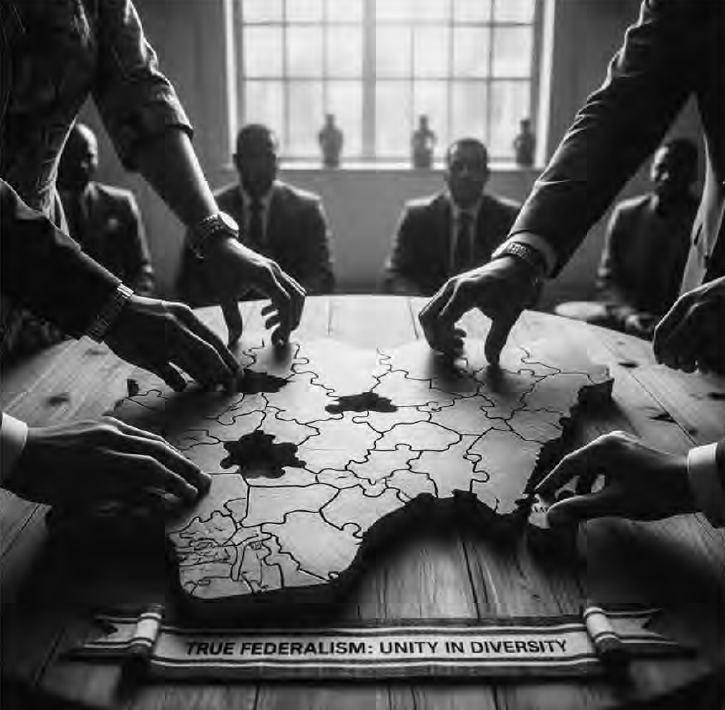
Nigeria’s long-running debate over “true federalism” has become a conversation trapped in circles – like a rodent caught in a can, dissipating an effusion of energy but progresses little. Each decade rehashes the same arguments, framed in familiar language that offers movement without direction. The result is a national discourse rich in emotion but poor in concrete action.
For decades, the dominant assumption has been that there exists a single, ideal model of “true federalism” – a holy grail of constitutional perfection to which the nation must return. This belief, often anchored in nostalgia for the independence-era constitution, frames the First Republic as a golden era of regional autonomy and fiscal balance. Major nationality groups such as Afenifere, Ohanaeze Ndigbo, PANDEF, and the Arewa Consultative Forum as well as the Middle Belt Forum have repeatedly advanced this vision, insisting that only a wholesale restructuring through a ‘big bang’ constitutional conference can restore that prelapsarian order.
This viewpoint gained traction for understandable reasons. It was forged in the pro-democracy rhetoric of the military era, notably through the principled calls for a Sovereign National Conference (SNC) by the Anthony Enahoro-led Movement for National Reformation during General Babangida’s tortuous transition. Rooted in the political ferment of the 1950s, its proponents viewed the First Republic as an age of fiscal autonomy and regional vigour. The intellectual legacy of that period continued to shape national debates even after 1999. Given the country’s enduring governance challenges – insecurity, economic stagnation, and inefficiency in public service delivery – the reasoning behind this backward gaze appears sound.
Yet this attachment to the past has become an intellectual cul-de-sac. By remaining fixated on an idealised notion of “true federalism,” national discourse has stalled – serving no purpose other than to draw cynicism. This cynicism is evident in the rhetorical question of a former president: “What is true federalism? Nobody has an answer.” Such feigned confusion has functioned as a political ploy, perpetuating the status quo by dismissing reform as too abstract for serious pursuit. The impasse also persists in the disconnect between civic and political actors. Citizen-led initiatives such as PRONACO, founded by Anthony Enahoro and Wole Soyinka, and The Patriots, now led by Emeka Anyaoku, have done the rigorous work of outlining fundamental issues around regional structure, resource control, and minority rights. Yet, once in power, even politicians who previously championed “true federalism” often retreat into periodic constitutional tinkering, treating core structural imbalances as “no-go areas.” This pattern reflects not only bad faith but also the predictable consequences of a system where opportunism continually triumphs over principle.

The consequences are far-reaching. The broader public has largely disengaged from the structural debates. During the most recent constitutional review rounds, public conversation focused more on immediate crises of scarcity, insecurity, and secessionist agitation than on the architecture of governance itself. The result is a vacuum – a civic withdrawal that leaves the design of Nigeria’s political future in the hands of actors whose motivations are narrow and transactional. This disconnect is similarly visible in the struggle to galvanise a broad, national response to Nigeria’s recent designation by the United States as a “country of particular concern.”
The path forward requires a reorientation of both concept and approach. The fixation on the word “true” has frozen discourse. Federalism is not monolithic. Across the world, federations reflect different historical bargains: the United States emphasises states’ rights within a strong centre; Canada’s asymmetric model accommodates Quebec’s distinctiveness; India’s linguistic states balance unity with diversity; and the United Kingdom, though formally unitary, operates a functional federation through devolved powers under an unwritten constitution. Nigeria’s task is not to rediscover a lost model but to design one that fits its evolving realities.
Equally important is an acknowledgment that the much-referenced “golden era” was an incomplete experiment. The 1950s federal debates, though visionary, left deep questions unresolved, particularly those concerning minority protection. The Willink Commission of 1957 confirmed fears of ethnic domination but merely proposed “special areas,” postponing state creation amid the urgency of independence. Romanticising this unfinished framework does not solve Nigeria’s federal question; it merely protracts a historically botched job.
A functional and inclusive federal arrangement for Nigeria must, therefore, be founded on a few enduring principles: a constituent structure that reflects diversity while ensuring effective governance; a constitutional division of powers that balances autonomy with cooperative service delivery; protection of minority and cultural rights; equitable distribution of resources; and a clear definition of the role of identity – ethnic or religious – in a plural society.
Government can no longer seek refuge in incremental amendments that skirt the core structural issues. The necessary blueprints already exist in the outputs of civic efforts such as PRONACO, The Patriots, and the 2014 National Conference. What is required is the political courage to synthesise these proposals into a coherent framework for genuine renewal. Federalism must cease to be a nostalgic slogan and become a living instrument of governance, one that aligns Nigeria’s diversity with the demands of effective and equitable nationhood.