|
Getting your Trinity Audio player ready...
|
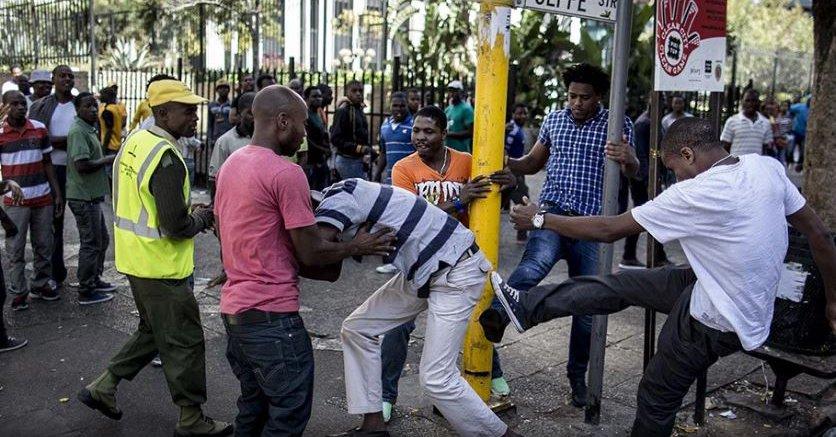
As African leaders, business tycoons and members of civil society organizations were arriving Cape Town, South Africa to discuss Sub-Saharan Africa’s future, those who arrived early were greeted with xenophobia. The future of Africans which squarely rests on the ability of its leaders to create inclusive and sustainable growth at a time of rapid transformation in the fourth industrial revolution was to be the main thrust of the 28th World Economic Forum (WEF) on Africa.
The scheduled WEF meeting on Africa holding in South Africa themed “Shaping Inclusive Growth and Shared Futures in the Fourth Industrial Revolution” has been poorly attended by African countries as a result of the so-called “xenophobic” attacks. Some African heads of governments were conspicuously absent.
When the news, and associated noise generated by the xenophobic attacks in South Africa went viral on social media, it was food for thought as to one of the many reasons why Africa remains underdeveloped. Resurgence of xenophobia is certainly not in Africa’s interest. Xenophobia attack in a digital world is certainly a wrong strategy for survival of Africans in the global arena.
What could have been the remote and immediate root cause of the xenophobic attack at a time when there is hardly any African country that one can boast of as being at the threshold of economic development? Please, kindly permit me to recall that Africa has always been at the sad end of epoch-making events. Although, Africa as a result of the havoc caused by slave trade, lost out during the industrial revolution of the 18th century.

One should not waste a lot of energy on reasons why we have not acquired the capacity for our survival. We have no reason to miss the train of the fourth industrial revolution which is now accelerating though the world at a fast rate.
Why xenophobic attack in South Africa? Is it because some South Africans feel they are marginalized by foreigners in their own country? I learnt that some South African men, particularly youths, feel that African immigrants are competing with them on dwindling and scarce resources. Some of the scarce resources include beautiful South African girls who chose to befriend wealthy and good-looking foreigners.
If this was true, then it is a misplaced anger and such should be condemned totally. Fellow Africans should not see themselves as competitors but fellow compatriots who are working hard to have basic necessities of life.
I feel those who are in control of resources and responsible for South Africans misery are not Nigerians neither are they Zimbabweans. They are neither Mozambicans nor Zambians. They are not Tanzanians working in restaurants and Ethiopians running small shops as well as those Africans who work as mechanics. One could see misplaced anger, prejudice and inferiority complex created by decades of apartheid and oppression of the black South Africans rearing their ugly heads in the xenophobic attacks.
We read and witness retaliatory assaults on South African-owned businesses in other African countries. For instance, in Nigeria, MTN, Shoprite, and MultiChoice outlets were attacked. These attacks are borne out of ignorance. Nigerians who attacked these shops have forgotten that their brothers and sisters are the ones working in these organisations. Consequently, Nigerian families will suffer, unemployment will rise, Nigerian insurance companies will pay and ultimately, Nigerians will lose.

Africans do not need a culture of violence. We need a technology-driven culture. The culture of violence has penetrated deep into the fabrics of many African societies because we are ceaselessly preoccupied with very petty conflicts that are of no strategic importance, using weapons designed and produced by developed countries. The ultimate war, which I have stressed in the past five years, is the survival of the black people with full rights and respect within the international community. Regrettably, this has always been ignored by most leaders in Africa.
Africans are always fighting the wrong war and that is why the continent of Africa is suffering from economic stagnation. African countries should strategise on ways and means to successfully implement the African Continental Free Trade Agreement (AfCFTA). If xenophobic attacks continue, it will significantly threaten intra-African trade because many countries have infrastructure gap.
We have 54 countries in Africa with different states of readiness. Currently, Africa has the lowest percentage at barely 18 percent of intra-regional trade in the world when compared with 70 percent in Europe. Many roads, ports, railways and air networks are below acceptable standards in most African countries. So, this is the time for greater partnership and cooperation among African countries, not xenophobic attacks.
Having many youths within the working age is an opportunity if well harnessed. It is also, a huge threat if many are jobless. What should be on top of the agenda in any African nation is how to get our youthful population working. This will require massive investments by African countries in order to provide the next generation the skills required for jobs in the services and manufacturing sectors as Africa diversifies away from reliance on volatile commodities. The industry of tomorrow will be driven largely by automation.
Rather than focus on xenophobia, Africans should marshal out a continental plan to fight corruption, poverty, hunger, ignorance and misery. The recovery of Africa from economic stagnation should be of concern to all Africans and importantly, those in governments. Africans must not forget that debts are rising and the only way we can get out of this dilemma is having a new spirit and a genuine mind-set to develop ourselves.
It is not right for Africans to fight themselves. We must begin to develop capacity for survival as the fourth industrial revolution accelerates. Africans must be seen to be making concerted efforts to acquire the capacity for survival in the global arena.
MA Johnson