|
Getting your Trinity Audio player ready...
|
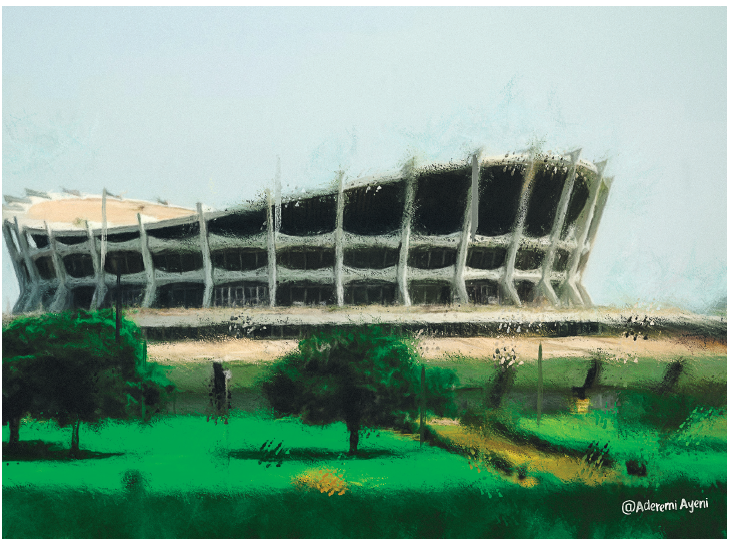
Nigeria’s National Theatre, a monument once vibrant with the echoes of the nation’s artistic soul, for a long time stood as a parable of neglect and possibility. Its current restoration process has ignited debates that transcend bricks and mortar. At stake is a question central to Nigeria’s identity: can a nation reconcile the preservation of cultural memory with the relentless demands of economic progress? This tension, mirrored across post-colonial Africa, demands a nuanced reckoning with history, ambition, and the fragile interplay between art and commerce.
The architecture of memory
Commissioned in 1976 in preparation for the 2nd World Festival of Arts and Culture (FESTAC), the National Theatre was conceived as a stage for Nigeria’s cultural ascendancy. Its design — a sweeping concrete edifice inspired by Bulgaria’s Palace of Culture and Sports — became a visual metaphor for national unity, its silhouette often likened to a military officer’s cap, an unintentional nod to the era’s political undercurrents. For decades, it hosted performances that wove together the country’s 250 ethnic identities, from Yoruba folk operas to Igbo Atilogwu Dancers. Yet by the 2000s, leaking roofs and crumbling facades mirrored the broader decay of public infrastructure, a casualty of underinvestment and institutional ambivalence toward the arts.
The N25 billion intervention fund to restore the complex represents more than architectural salvage. It is a wager on Nigeria’s creative economy — a sector contributing 2.3 percent to GDP through Nollywood, Afrobeats, and fashion. The project’s scope — refurbishing 3,500-seat main bowl (auditoriums), banquet hall(s), and cinematic spaces — aims to position the theatre as a hub for tourism and global events. Yet beneath this ambition lies a delicate dance: How does one retrofit a cultural icon for commercial viability without erasing its soul?

The double-edged sword of commercialisation
Critics argue that the theatre’s reinvention risks privileging profit over purpose. The inclusion of luxury retail spaces and corporate event venues has sparked fears of gentrification, where artist collectives and grassroots troupes — long the lifeblood of Nigerian theatre — are priced out by multinational tenants. This tension is not unique to Lagos. Cape Town’s Zeitz Museum of Contemporary Art, housed in a re-purposed grain silo, faced similar scrutiny over whether its glossy galleries would marginalise local artists. The Nigerian dilemma, however, is compounded by the theatre’s symbolic weight as a rare public space uniting disparate communities.
Proponents counter that financial sustainability is non-negotiable. While the current renovation is tactfully framed as corporate social responsibility (CSR) by the sponsors, there are expectations of returns through venue rentals and tourism revenues. This pragmatism reflects a broader African trend: Kenya’s National Theatre in Nairobi now leases spaces to banks and cafes to subsidise artistic programming. The challenge lies in crafting a revenue model that cross-subsidises accessible arts initiatives rather than displacing them.
Technical restoration has been meticulous. Over 70 sculptures and mosaics, which include Ben Enwonwu’s iconic bronze works, were preserved during renovations, a nod to the theatre’s role as a living archive. Yet material conservation alone cannot resolve deeper fissures. Nigeria’s cultural policy, last updated in 1988, lacks mechanisms to protect such spaces from commercial capture. Contrast this with Senegal’s approach to Gorée Island, where strict heritage laws balance tourism with historical integrity.
The theatre’s revival coincides with a generational shift in Nigerian creativity. Young filmmakers and musicians, leveraging digital platforms, increasingly bypass traditional gatekeepers. A restored National Theatre could offer these voices a physical nexus — provided programming prioritises incubation over spectacle. Initiatives like Lagos Fashion Week’s mentorship programmes demonstrate how commercial success and artistic nurturing can coexist.

The National Theatre’s fate hinges on governance. A hybrid model, blending public oversight with private-sector efficiency, offers promise. South Africa’s Artscape Theatre in Cape Town operates under a trust structure where government, artists, and businesses jointly steer programming. Nigeria might adopt similar frameworks, ensuring artist representation on the theatre’s board and earmarking revenue shares for community grants.
Legislative action is equally critical. Ghana’s 2011 Cultural Policy mandates that 20 percent of profits from heritage sites fund local arts education. Nigeria could legislate similar provisions, anchoring the theatre’s commercial activities to tangible cultural dividends. Concurrently, digital integration — virtual reality tours, online ticket subsidies for students — could democratise access beyond Lagos’ elites.
The National Theatre’s scaffolding is more than metal and wood; it is a metaphor for Nigeria’s perpetual reconstruction. To truly honour this legacy, the nation must reject false binaries between culture and commerce. Let the restored complex host both blockchain conferences and Igbo Udu drum workshops. Let its cinemas screen Nollywood premieres alongside free matinees for schoolchildren. Above all, let its governance model enshrine transparency, ensuring that the ambitions of bankers and bureaucrats never drown out the poets and playwrights.
For succeeding generations, the lesson is clear: cultural spaces thrive not through nostalgic preservation or unbridled commercialisation, but through ecosystems that value art as both heritage and livelihood. Nigeria’s policymakers must now craft legislation that protects such venues as public trusts, while creative industries must advocate for inclusive growth. The curtain is rising — not on a finale, but on an improvisation where memory and modernity share the stage.