Summary: Nigeria’s power grid is losing its biggest customers, and with them, its financial lifeline. From cement giants to industrial estates, high-volume electricity users are unplugging from the national grid and generating their own power, leaving behind a fragile system increasingly propped up by overburdened residential consumers. As factories hum with privately generated electricity, households are left in the dark– literally and financially– paying more for less reliable power.
This is not just a quiet exodus; it’s a slow-motion collapse of the grid’s business model. With billions of watts stranded and tariffs spiking for everyday Nigerians, the country is teetering on the edge of an energy reckoning. What happens when the only customers left are the ones who can least afford the power? This gripping investigation dives into Nigeria’s silent power shift—and what it will take to stop the lights from going out for good.
Large commercial and industrial consumers, once the bedrock of Nigeria’s power revenue, are increasingly turning away from the inefficient national grid.
This shift has left residential customers and small-scale businesses, who are already grappling with unreliable electricity, facing not only blackouts but also rising bills.

Nigeria’s electricity supply chain has always had three main customer classes: residential and small-scale businesses; commercial users consuming between 12 and 36 megawatts; and industrial giants, cement factories and heavy manufacturers, pulling 36 megawatts or more.
Read also: All On backs solar firm Salpha with N2bn investment to expand electricity access
Of these, the commercial and industrial users have traditionally been the golden goose. They were bulk buyers, billed at premium rates and known for their timely payments.
But that business model is unravelling.
Exodus of the bulk buyers

Cement plants run on their gas turbines. Manufacturing clusters invest in solar and diesel hybrids. Even mid-size commercial estates now build independent mini-grids to avoid the uncertainty of national supply.
For instance, in Ilupeju industrial hub, Lagos, a plastic manufacturing plant hums with activity.
The factory, once a major consumer of electricity from Nigeria’s national grid, now generates its power from an on-site 40-megawatt gas-fired plant. The decision to go off-grid, according to management, was not just about reliability; it was about survival.
“We were losing millions every month to downtime. The national grid just couldn’t give us the consistency we needed,” said the plant’s operations manager, who requested anonymity. “Now, we generate our power by using diesel generators for production and solar batteries for light at night.”
This plant is not alone.
Across Nigeria, industrial and commercial power users are quietly but decisively exiting the national grid. Frustrated by years of unreliable supply, unpredictable load shedding, and rising tariffs, these high-demand consumers are building their power generation systems—solar, gas, diesel, and hybrid mini-grids—leaving the national grid increasingly dependent on its weakest customer class: residential and small-scale business users.
“The moment these big players began to generate their power, the financial foundation of the grid cracked,” a senior executive in Nigeria’s power sector told BusinessDay.
Data from the Nigerian Electricity Regulatory Commission (NERC) showed several private companies and institutions in Nigeria are now generating a combined total of over 13,000 megawatts (MW) of electricity for their use, exceeding Nigeria’s grid supply of 4,500MW and 5,000MW.
These companies have secured licenses from NERC to generate ‘captive power’—a model where electricity is produced solely for internal consumption and not sold to external users.
Records show that permits for captive generation have been issued to various firms as far back as 2010, with more approvals in 2016, 2020, and 2022.
Read also: How we spend ₦26m every month on electricity — AFUED acting VC
However, interest in captive generation has surged since 2023, following President Bola Tinubu’s signing of the enactment of the Electricity Act, a new law that allows states and private players greater autonomy in electricity generation and distribution.
For instance, Dangote Group produces around 1,500MW for its operations. The Dangote Refinery alone has a dedicated 435 MW power plant, enough to meet the electricity demands of the entire Ibadan Electricity Distribution Company franchise area.

Speaking at the Afreximbank Annual Meetings and AfriCaribbean Trade & Investment Forum in 2023, Aliko Dangote said, “We don’t put pressure on the grid. We produce about 1,500 megawatts of power for self-consumption.”
NERC’s data shows that 249 firms and institutions currently hold permits for captive power generation, contributing approximately 5,180MW to the national energy landscape. When combined with the Dangote Group’s output, the cumulative figure surpasses 6,500MW.
Some of the largest contributors include Pure Flour Mills Limited in Rivers State, which holds a license for 546MW, and Nigeria LNG, which generates 360MW. Other significant players are Lafarge Africa’s United Cement Company (105MW), Total E&P Nigeria Limited (174 MW), Esso Exploration & Production Nigeria (76MW), First Global Commerce Solutions (77MW), Flour Mills of Nigeria Plc (70MW), and Lafarge Cement Wapco (90MW).
Read also: KEDCO, Kano manufacturers on war path over persistent electricity outages
The list of captive power producers spans a wide array of sectors, including telecoms, oil and gas, manufacturing, food and beverage, and banking.
Notable firms include MTN Nigeria, NNPC, Shell, Nigerian Breweries, Mobil Producing, Warri and Kaduna Refineries, Seven-Up Bottling, Procter & Gamble, Guinness, Chevron, Nestlé, and Unilever. Infrastructure and industrial players like Lekki Port, Indorama Petrochemicals, Julius Berger, and Sagamu Steel are also on the list.
Additionally, several universities have turned to captive power solutions to secure stable electricity. These include the University of Lagos, Obafemi Awolowo University, Bayero University Kano, and the University of Benin, among others.
Medical and agricultural institutions, as well as the Nigerian Defence Academy, which recently received a permit to generate 2.5MW, are also adopting this model.
Left behind & overburdened
The consequences of this shift are cascading down the supply chain, and it is Nigeria’s residential users who are paying the price.
This imbalance is most visible in Band A, a category of customers promised at least 20 hours of electricity per day. In April 2024, the Nigerian Electricity Regulatory Commission (NERC) approved a new tariff of N206.80/kWh for Band A users, a significant jump from previous rates.
“It’s like we’re being punished for being on Band A,” said Ifeanyi Nwosu, a banker who lives in a serviced apartment in Lekki. “We barely get up to 15 hours of power some days, but we’re paying more than anyone else.”
Experts argue that Band A customers are being used to make up for lost revenue from industrial and commercial users. As wealthier customers flee the grid, those who remain are being charged more to keep the system afloat.
“Band A is carrying the weight for the commercial class,” Aisha Mohammed, an energy analyst at the Lagos-based Center for Development Studies said. “The grid was never designed to run profitably on residential customers alone. Their consumption is lower, and many are on estimated billing or defaulting payments. It’s not sustainable.”
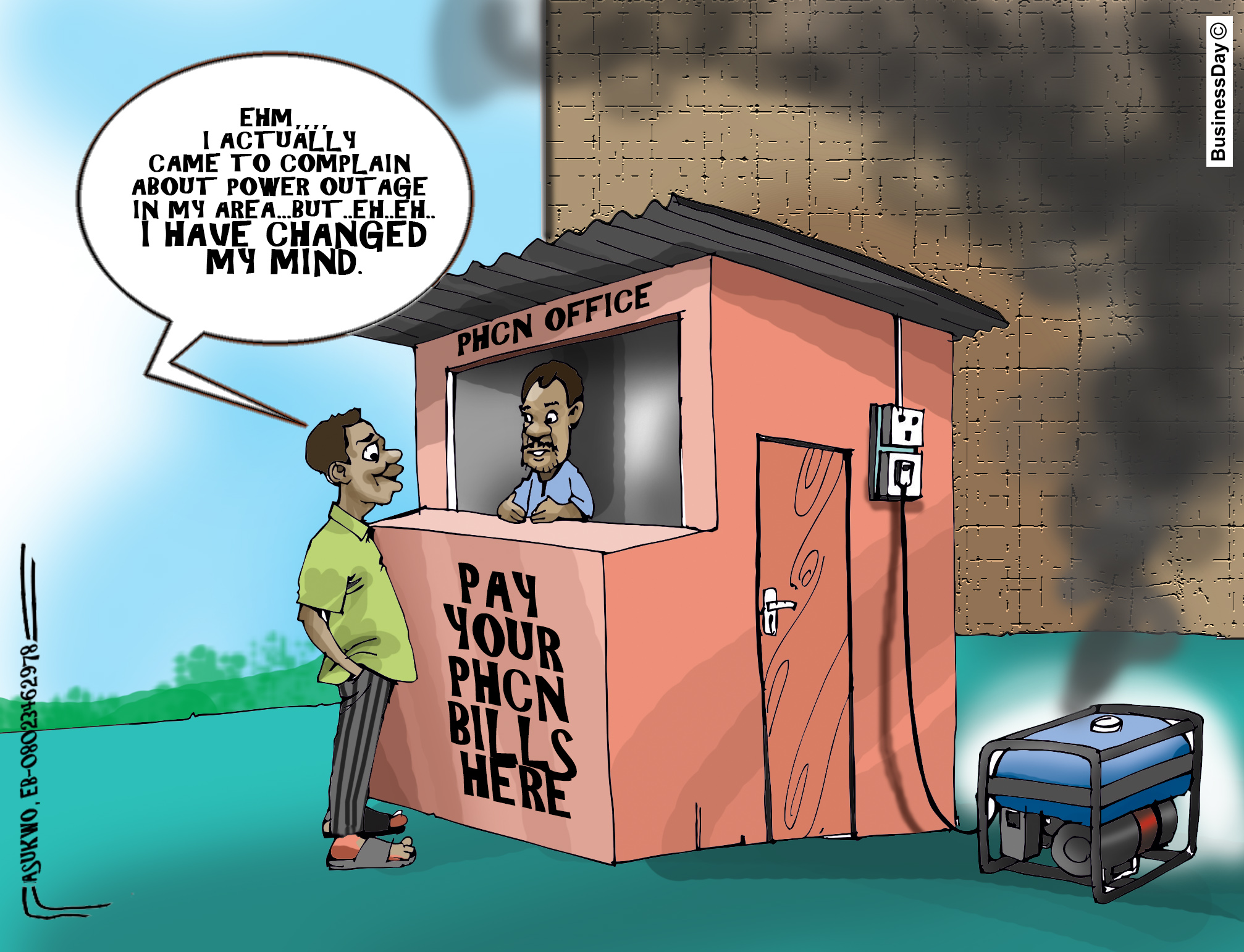
For residents under the Band A electricity tariff, the result is a vicious cycle. Poor supply leads to higher costs, which leads to more self-generation through petrol or diesel generators, making household expenses skyrocket. Meanwhile, the dream of constant power remains elusive.
Read also: National Integrated Electricity Policy 2024 and road to attaining energy security in Nigeria
A system in disarray
The departure of big consumers from the grid not only affects revenue but also destabilises the energy balance and grid planning.
Power plants built to serve both industrial and residential consumers now face load rejection from distribution companies who cannot absorb the excess supply meant for departed bulk buyers. This, in turn, leads to a bizarre paradox: there’s often power available but no way to distribute or monetise it.
“It’s like a market where your biggest customers have walked away and you’re left selling only sachets of water instead of truckloads,” Mohammed said.
This lopsided structure exposes deeper systemic flaws.
Data from Power Generation Companies (GenCos) shows a stark paradox where available generation capability far outstrips average generation, leading to massive ‘stranded generation’ year after year.
In 2013, the nation’s grid saw 1,031MW of electricity left untapped, a figure that dramatically surged to 2,735MW in 2014 and further to 3,010MW in 2015, despite a rising generation capability. The peak of this inefficiency was observed in 2016, when a staggering 3,917MW was stranded, representing more than half of the 7,184MW available.
While 2017 saw a slight dip in stranded power to 3,373MW, the figures remained stubbornly high. Years 2018 and 2019 consistently recorded over 3,500MW of stranded electricity, with 3,520MW left unutilized in both years.
Even in 2020, a year impacted by global events, 3,742MW remained unused, despite available capability reaching 7,793MW, the highest in the dataset.
The trend continued into 2021 and 2022, with 2,249MW and 1,816MW stranded respectively, showing a slight improvement but still signifying significant waste. The year 2023 again saw over 2,227MW of power going to waste, and 2024 closed with 2,180MW stranded.
Even in the early months of 2025 (Jan-Feb), the issue persisted, with 2,025MW unutilised despite available generation capability climbing to 6,831MW and average generation reaching a relative high of 4,806MW.
Read also: World Bank calls for end to Nigeria wasteful, regressive electricity subsidy
Experts suggest that the only viable path forward is a restructuring of the tariff system to reflect real costs while providing targeted subsidies to the most vulnerable. Investment in metering infrastructure, regional mini-grids, and transparent governance is also critical.
Adetayo Adegbenle, PowerUp Nigeria’s executive director, said major companies abandoning the national grid is detrimental to grid stability.
He argued these companies, ideally ‘anchor tenants,’ are crucial for a balanced system where demand matches generation at 50Hz frequency.
Their departure, he stated, shifts the burden largely onto residential consumers, contributing to grid instability and higher prices.
Adegbenle advocated for incentives to entice these businesses back, believing it would lead to a more stable and affordable grid, leveraging the country’s existing ‘stranded generation’ capacity.