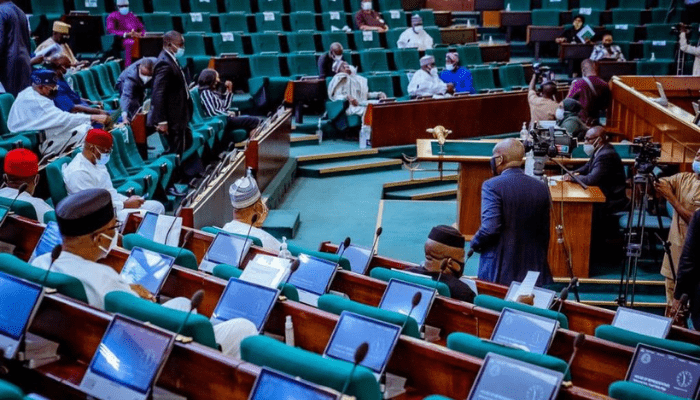
The House of Representatives Ad-hoc Committee set up to ascertain the total inventory, assets, and liabilities of the Nigerian National Petroleum Company Limited (NNPC) will in few days meet with the Minister of Finance, Budget and National Planning, Zainab Ahmed, and Minister of State for Petroleum Resources, Timipreye Sylva on the transfer of assets from the defunct Nigerian National Petroleum Corporation.
The Ad-hoc Committee Chairman, Kingsley Chima who disclosed this after a meeting in Abuja said the panel will also meet with the NNPC Chief Executive Officer, Mele Kyari, and the Central Bank of Nigeria (CBN) Governor, Godwin Emiefele.
The interface works out modalities for the full implementation of the Petroleum Industry Act (PIA) section 53(2-5) which provides that the government of the federation shall hold full ownership of the NNPC Limited with the share held by the duo of Federal Ministry of Finance Incorporated and Ministry of Petroleum Incorporated on behalf of the government.
Section 53(5-8) however stipulates the government’s intention to set in motion the process of immediate commercialisation and privatisation of the operation and future private ownership of NNPC Limited.

Also, section 54 of the Act provides that: “all assets and liabilities of the NNPC will be transferred to NNPC Limited. The Minister of Petroleum and Finance are saddled with the responsibility of determining the assets, interests, and liabilities of NNPC which are to be transferred within 18 months of the PIA coming into effect.”
The Ad-hoc Committee, therefore, resolved to request detailed information on NNPC assets, interests, liabilities, and up-to-date audited reports from the CEO of NNPC Limited.
It also resolved to request for yearly audited reports of NNPC from Nigeria Extractive Industries Transparency Initiative (NEITI) with a view to juxtaposing the NNPC audited reports with that of NEITI.
Read also: Oil production vessel explodes in Niger Delta
The Committee’s Chairman, Chima observed that despite the abundant natural endowment, the oil and gas industry has been plagued with corruption, mismanagement, crisis, environmental degradation, lack of refining capacity, among others.

“The decision of the House is in sync with the provisions of Sections 88and 89 of the 1999 constitution of the Federal Republic of Nigeria [as amended). It is also hinged on the provisions of Section 54 of the recently signed Petroleum Industry Act. 2021.
“The legislative intervention is in alliance with section A 1.03 of the introduction part of the Legislative Agenda of the 9th Assembly (2019 – 2023) which states that, ‘the 9th House will seek to undertake reforms of critical sectors of the Nigerian society and economy with a view to improving the conditions that allow for investment, innovation, and economic growth.
“Crude oil dominates Nigeria’s economy and accounts for about 86% of export earnings in our country. We have the largest oil and gas reserves in Sub-Sahara Africa with an estimated 37 billion barrels of oil and 188 trillion cubic feet of gas as of July 2021.
“It is depressing that, despite the abundant natural endowment, the oil and gas industry has been plagued with corruption, mismanagement, crisis, environmental degradation, lack of refining capacity, etc.
“The petroleum Industry Act, 2021 was enacted to cure the maladies of oil and gas industry and provides legal governance, the regulatory and fiscal framework of the Industry.
“It came at a time when fossil fuel-reliant frontier markets are contending with the implications of the global transition to cleaner and renewable energy sources,” he said.
Chima noted that the Committee was mandated to ascertain the total inventory, Assets, Interests, and Liabilities of NNPC and its Subsidiaries before transfer to the NNPC Limited to ensure a glossary accounting system and report back within eight weeks.