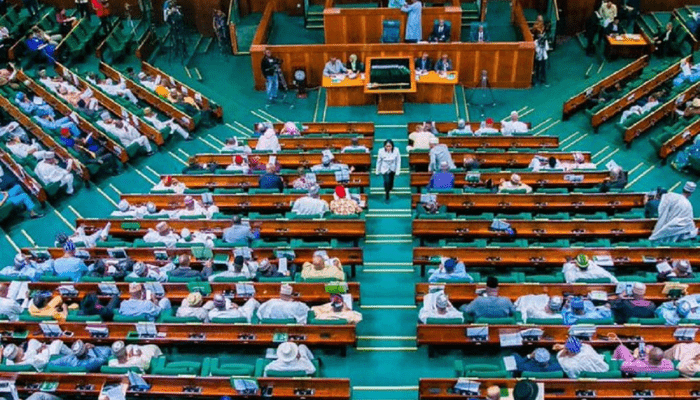
The House of Representatives has directed Federal Ministry of Power, Works and Housing to stop forthwith the procurement processes on the N42 billion electrification for Federal Universities across the country. The resolution was passed sequel to the adoption of a motion sponsored by Darlington Nwokocha (PDP-Abia).
In his lead debate, Nwokocha noted that the rural electrification access program in the federal universities is a pilot scheme designed by the Federal Ministry of Power, Works and Housing to electrify eight federal universities in the first instance and later replicate same across the country.
“The House notes that the sum of N9.5 billion was appropriated for the projects in the 2017 Appropriation Act.
READ ALSO: How Nat’l Assembly new funding plan for rural electrification may lift millions out of poverty

“The House is aware that the projects, which were supposed to be spread across the six geopolitical zones of the country were not evenly distributed, but mainly concentrated in some zones to the disadvantage of the others, which is against the principle mm federal character enshrined in section 14(3) of the Constitution of the Federal Republic of Nigeria, 1999.
“The House is also aware that the projects, which were initially approved at N9.5 billion in the Appropriation Act, were later awarded at the total cost of N42 billion in violation of the Public Procurement Act.
“The House is concerned that the contracts were selectively awarded to two contracting companies that do not have any records of achievements in the fields which is tantamount to further violation of the Public Procurement Act,” Nwokocha said.
To this end, the House mandated the Committee on Power and Public Procurement to investigate the allegation and report back to the House within three weeks for further legislative action.
Also at plenary, the House passed three bills through third reading.

One of the bills seeks to provide for the protection of the identity of officers, agents, sources if information, informants and methods and methods of operation of national security agencies from unlawful disclosure and to protect their establishment, facilities and equipment against unauthorized access and to provide for the promotion and enhancement of national security.
Another bill seeks to establish a regulatory framework for the water resources sector in Nigeria, provide for the equitable and sustainable development, management, use and conservation of Nigeria’s surface water and groundwater resources.
Similarly, the bill which seeks to protect human rights online, protect internet users in Nigeria from infringement of their fundamental freedom and to guarantee the application of human rights for users of digital platforms and or digital media, scaled through third reading.
Also at plenary, the House passed the bill which seeks to amend the hydroelectric power production areas development commission Act, 2010, to make provisions for reduction of percentage on revenue generated by any company or authority from operations of hydroelectric dams and for other related matters scaled through second reading.
KEHINDE AKINTOLA, Abuja