This is an important year for the European Union. In May 2015 European leaders will celebrate the 70th anniversary of the end of World War II. As the Allied powers began to feel that the wind was blowing in their favour, 1944 through the Bretton Woods conference was to lead to the emergence of a new international economic order centred on the American dollar as the world’s reserve currency and a prominent role for the IMF and the World Bank as the world’s leading international financial institutions. The subsequent multilateral conference at San Francisco led to the promulgation of the Atlantic Charter which led to the creation of the United Nations. The leading European countries, France, Britain and the defunct Soviet Union – the victorious allies – were leading actors in the creation of the United Nations Organisation.
The emergence of Europe from the ashes of the war was one of the most remarkable developments of modern times. For centuries European thinkers from Hugo Grotius to Immanuel Kant and Victor Hugo dreamt of a single European homeland that would be at peace with itself and with the world. But it was to take centuries of bloodshed before this dream could be realised. From the Thirty Years’ War which culminated in the Treaty of Westphalia 1648 to the violent Napoleonic adventures, the young Henry Alfred Kissinger wrote his Harvard PhD thesis on the foundations of the political equilibrium which sustained the peace for almost a century. It was later to be published with the title, A World Restored. Kissinger underlined the balance-of-power diplomacy as the system of statecraft which guaranteed the post-Napoleonic international equilibrium. He singled out Viscount Castlereagh of Britain and Count Metternich of Austria as the key statesmen who understood this balance-of-power and who played it to good effect.
World War I and World War II upset the old equilibrium, plunging the Old Continent, once again, into renewed conflict. In-between the wars, the conflict over colonial territories and the beggar-thy-neighbour policies in trade and international finance were to lead to depression and hyper-inflation. Europe, and in particular, Germany, were in ruins. This is why the little white devil Adolf Hitler came out with a demonic rhetoric which swayed the German crowds into a wild frenzy, plunging the whole of Europe into darkness. More than 60 million people perished, the bulk of them Russians.
It is in this spirit that we can better appreciate the enormous importance of the New Europe. After World War II, private businesspeople such as Jean Monnet took the initiative to convince European leaders of the need to build new regional institutions to ensure regional development while building the basis for renewed confidence. Statesmen such as Paul-Henri Spaak of Belgium, Konrad Adenauer of West Germany and Charles de Gaulle of France bought the idea. At the heart of the New Europe were the Original Six, namely, France, Germany, Italy and the Benelux countries (Belgium, Netherlands and Luxembourg). The European Coal and Steel Community (ECSC) was created in 1951 to fuse together the strategic industries of the European countries to ensure they serve the cause of peace and social progress rather than as the basis of a new armaments contest. IT worked remarkably well. The Marshall Plan by the United States was a major boost to the European recovery. It was the most extraordinary movement of capital in peacetime for social and economic reconstruction.

READ ALSO: Path to diminishing housing deficit in Lagos
The Treaty of Rome 1957 was negotiated by the Original Six as the constitutive document of the European Common Market which was to metamorphose into the European Economic Community. Europe has been a long adventure in statecraft and community building for the last 60 years. The institutions such as the Commission, the Parliament, the European Court of Justice and others have been built painstakingly to ensure a new regional grouping based on the rule of law and a rules-based international order. In 2012 the EU was awarded a well-deserved Nobel Prize for Peace. Europe has been remarkably successful in ensuring peace in Europe. It has also been a moderating and civilising voice in international relations. Europe is also the largest donor in the world, providing nearly €10 billion in official development assistance to developing countries, about half of which goes to our continent of Africa. For the recent Ebola crisis in West Africa, the EU has donated €1 billion to aid the fight against the dreaded disease and to promote post-Ebola reconstruction of the health systems of the affected countries.
Through the Cotonou Agreement with the African, Caribbean and Pacific Group of States (ACP), the EU promotes a contractually-based approach to international economic development. While Europe will provide aid, our countries must do their part in ensuring good governance, transparency and the rule of law. Europe has a strategic partnership with Africa based on the principle of reciprocity, interdependence and mutually-shared obligations. We realise that, for better or worse, we are partners of destiny. In the long span of history going back to classical times, Africa was the granary of the Roman Empire. By the sixteenth century, our relations were transformed from those of civility to those of racism, slavery and colonialism. There are still occasions when our relations are coloured, if not haunted, by the burden of history.
The Economic Partnership Agreements which the EU are pressuring African countries to sign up to are not entirely based on honest principles. Europe wants to have access to Africa’s natural resources on the cheap while taking over our bourgeoning domestic markets for nothing. Africa, if we are to subscribe to this new coercive trade system, would remain the drawers of water and the hewers of wood. For another millennium, we would remain at the bottom of the global international political economy. Such heresy cannot stand. We must therefore stand firm and negotiate an agreement that is honest, fair and just to all concerned. The future of our continent may well depend on it.

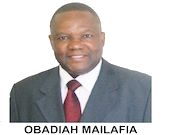
Obadiah Mailafia