..2026 NGX listing on track
Nigeria’s Dangote Group is embarking on a bold expansion of its oil refining complex, with plans to more than double capacity to 1.4 million barrels per day (bpd) by 2028, a scale that would make it the largest single-site refinery in the world and strengthen Nigeria’s drive toward energy self-sufficiency.
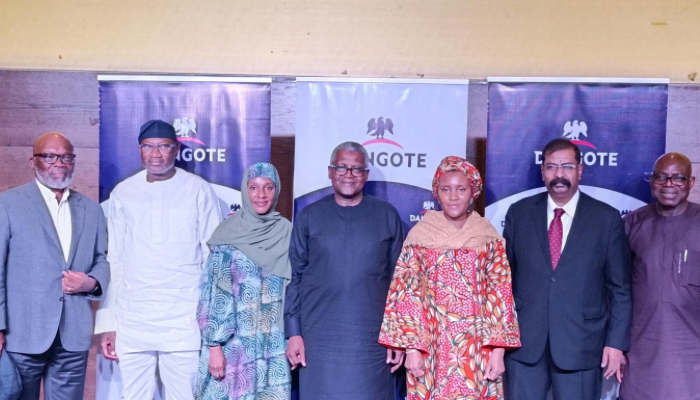
Announcing the plan in Nigeria’s commercial capital on Sunday, Aliko Dangote, president of the Dangote Group, said the decision underscores the company’s confidence in Nigeria’s economic prospects and Africa’s ability to lead the next phase of global industrial transformation.
“We are expanding the Dangote Refinery from 650,000 barrels per day to 1.4 million barrels per day,” Dangote said. “When completed, this will be the largest refinery ever built at a single site, surpassing India’s Jamnagar refinery.”

Dangote described the project as an endorsement of President Bola Tinubu’s industrialisation agenda and his push to make Nigeria a net exporter of refined petroleum products.
“This expansion reflects our belief in Africa’s potential and our commitment to building energy independence for our continent,” he said.
According to Dangote, the expansion will be completed within three years, with construction leveraging existing infrastructure such as ports, land, and logistics systems established during the refinery’s first phase.
“It will take much less time this round because we already have the foundation — the port, the land, the pipelines,” Dangote said. “We know where all the challenges lie from experience.”
While declining to disclose the total investment value, Dangote confirmed the project had been “fully costed internally.” The first phase of the refinery, which began operations earlier this year, cost roughly $20 billion.

The new line will mirror the design of the current 650,000 bpd facility, ensuring redundancy and continuous output during maintenance shutdowns.
“Even if you shut down one line for 40 days, the other keeps running at 50% capacity,” he explained.
Read also:Dangote becomes first African to reach $30 billion net worth
Dangote acknowledged that crude availability had posed difficulties in the refinery’s early months, with some Nigerian producers preferring to export their oil rather than sell locally. But he said recent government policies now prioritise domestic refining.
“At 650,000 barrels a day, you can struggle for feedstock,” he admitted. “But the President’s policy is clear, we cannot keep exporting crude and importing fuel. That must change.”
Nigeria currently pumps about 1.8 million bpd, below its OPEC quota, but Dangote said the government’s target of 2.4 million bpd would provide enough supply to serve both domestic refiners and exports.
“If we were once at 2.4 million, we can get there again,” he said. “With investment and policy consistency, Nigeria can easily meet the needs of local refiners.”
The expansion will create over 65,000 jobs during the construction phase and significantly boost output from the petrochemical complex. Polypropylene production will double from 900,000 metric tonnes to 2.4 million tonnes annually, while fuel quality will be upgraded from Euro 5 to Euro 6 standards, among the cleanest globally.
“Over 85percent of our workforce will be Nigerian,” Dangote said. “We’re building not just infrastructure but human capital. Our goal is to refine opportunities for our people.”
The refinery’s power generation capacity will also be expanded from 500 megawatts to 1,000 megawatts, ensuring uninterrupted operations and potentially supplying nearby industrial users.
Dangote called on other investors to join the federal government’s effort to expand local refining, stressing that competition will strengthen the sector and ease supply constraints.
“We don’t want to be the only player,” he said. “There are people with more cash than we have. They should go and buy or build refineries so no one talks about monopoly.”
He confirmed that several companies are already in discussions with Nigerian National Petroleum Company (NNPC) Limited to revive dormant refineries through joint ventures.
“A $1 trillion economy doesn’t come easy. Everyone must play their part,” Dangote said. “We are doing ours.”
As part of its long-term vision, Dangote revealed that the refinery and petrochemical complex will list on the Nigerian Exchange (NGX) by 2026, allowing Nigerians to invest directly in the nation’s most ambitious industrial project.
“We want Nigerians to own part of this refinery,” he said. “It should belong to the people whose oil it refines.”
He also said that the refinery’s operations have already stabilised local fuel markets, helping to curb supply disruptions that have plagued Nigeria for years.
“For the first time in decades, Nigerians can approach the festive season without fuel scarcity,” Dangote said. “We’ve had stable prices and consistent quality since production began.”
Dangote expressed gratitude to the federal and Lagos State governments, local communities, and financing partners for their continued support. He described the refinery’s next phase as a testament to “Nigeria’s resilience and leadership potential.”
“This expansion is not just about capacity,” he said. “It’s a statement of confidence, in our people, in our leadership, and in the future of this continent.”