Ground handlers operating in Nigeria have continued to count losses over low passenger traffic as a result of the impact of COVID-19. This challenge is however compounded with what operators describes as poor pricing by local and foreign carriers that do not pay amounts equivalent for ground handling services rendered to them.
Stakeholders have said that in a bid to cushion the effects of COVID-19 on the operations of ground handlers, there needs to be an urgent price adjustment to reflect on costs of operations.
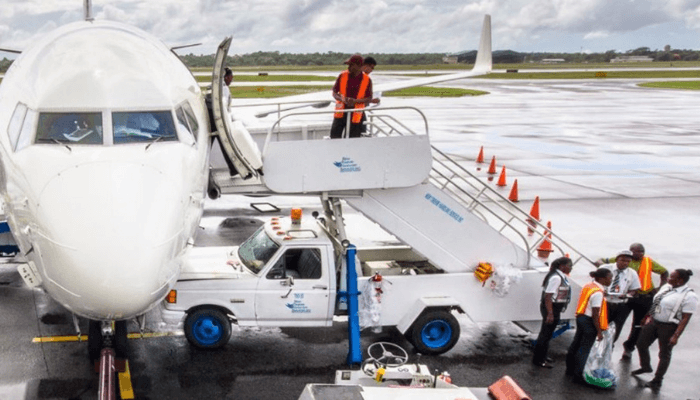
Ground handling refers to the wide range of services provided to facilitate an aircraft flight or aircraft ground repositioning, preparation for and upon conclusion of a flight which will include both customer service and ramp service functions.
Ground handlers offer services ranging from ticketing, check-in, baggage handling, lobby management, special needs handling, lounge management, cargo services, aircraft boarding and dismemberment, marshalling, aircraft towing and cleaning, refuelling, pushback and catering amongst others.

BusinessDay’s checks show that rates charged by ground handling companies in Nigeria are the lowest in African countries.
For instance, in Guinea, ground handlers charge $1,673 for narrow body aircraft and $4,715 for wide body aircraft; Senegal charge $2,250 (narrow body aircraft) and $5,259 (wide body aircraft); Cameroon – $1,400 (narrow body aircraft) and $4,500 (wide body aircraft); Sierra Leone – $2,250 (narrow body aircraft) and $5,250 (wide body aircraft) and Ghana – $1,500 (narrow body aircraft) and $4,150 (wide body aircraft).
In Nigeria, the rates oscillate between $400 and $1,139 for narrow-body aircraft, depending on the negotiating power of a foreign carrier and $3,000 and $3,200 for wide-body aircraft, depending on the negotiation of the foreign carrier.
The narrow body aircraft include B737, Airbus A320, ER 135 and ATR aircraft, while the wide-body aircraft are categorised as B767, A330, B777, B747 and A380 aircraft.
Read also: Lagos Aviation Academy awards scholarship to YTHLF participant

Investigations show that despite the huge naira devaluation, these rates have been on since late 1980s and 1999 as ground handlers continue to buy spare parts and instruments for their operations in dollars.
More worrying are the economic, security and safety effects of low handling rates on the Nigerian aviation industry, especially the Federal Airports Authority of Nigeria, (FAAN), which loses billions of naira annually from the five per cent gross annual turnover paid by the ground handling companies.
Kayode Oluwasegun-Ojo, former managing director, Nigerian Aviation Handling Company Plc (NAHCO) said if ground handlers charge for a service that is less than cost-reflective, it means they are not getting their cost back and on the long run, it will not be sustainable.
Oluwasegun-Ojo added that lack of sustainability for aviation has serious implications because aviation actually starts from the ground and aircraft land on the ground.
“If you are charging less than cost, it means you are subsidizing from somewhere and this will have an impact on the service you provide, equipment on the ground and others.
“You know that most accidents/incidents in the aviation industry actually occur on take-off and landing. So, it is extremely important that we take care of what happens on the ground and in this case, via the ground handlers in charging the cost-reflective tariff. That means you can recover costs with some margins for hospitality, including being able to pay taxes to the government. Companies that make losses will not be able to pay taxes,” he explained.
Oluropo Owolabi, former managing director, MD, SAHCO said ground handling companies in Nigeria are suffering just because the authority is not stamping its regulation on these airlines and calling the ground handling companies to order.
Owolabi stressed that this act has painfully affected the revenues of the handlers and the take-home of FAAN at the end of the year, adding that the total sales that ground handlers pay as remuneration to FAAN at the end of every year surely will diminish.
He called on the NCAA to wade in because the government is losing on foreign exchange as foreign carriers take undue advantage of the ground handling companies.
“NCAA should stamp its authority. There should be a minimum rate with sanction to anyone that violates it and should be treated as a saboteur to the government.
“Though the sub-sector is deregulated just as you said, but the take-home of the government annually is being vandalized when appropriate charges are not collected. So, the government can’t keep quiet on that,” he said.
Sam Oluwole, chairman, Board of Trustees, Association of Aviation Ground Handlers (AGHAN) said the bane of the sub-sector currently is the extremely low charges by ground handling charges in Nigeria, which is not commensurate with the quality of service that ground handlers render daily, including the safety and security.
Oluwole said three aspects that concern ground handlers at the moment are economic, safety and security of the industry.
He recalled that as far back as 1986, grand handlers were charging about $1,139 to handle a narrow-body aircraft for instance, but today, despite the crash of naira against the dollars and other currencies, some of the handlers charge as low as $300.
“What we are trying to set is what we consider as a minimum handling rate, which will be observed by all ground handling companies. There should be a uniform rate, which the NCAA is going to supervise.
“NCAA should be able to regulate this by ensuring that the Service Level Agreements (SLAs) are maintained and there is no undercutting. An airline goes to Handler A, gets their rates and goes to Handler B to cajole them to charge lower,” he said.
He said AGHAN is not agitating for an increment per se but wants to regularize the rates.
Whatever we are charging now is lower than what we did in the 1980s and early 1990s. We just want to be at par with other countries, Oluwole said.
He said the NCAA needs to play its roles as regulators, just as the Central Bank of Nigeria (CBN) does in the banking industry.