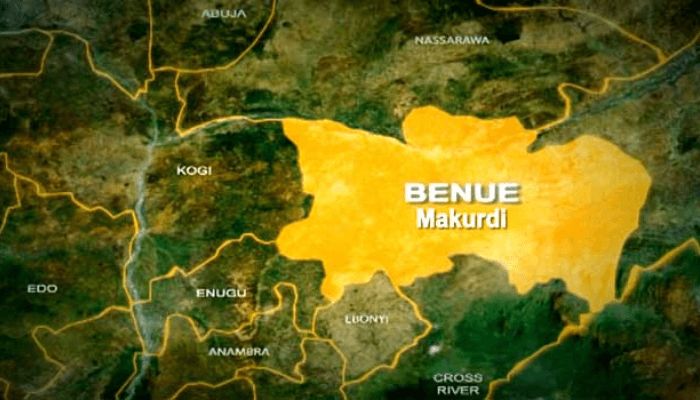
Once celebrated as Nigeria’s food basket, Benue has become a landscape of abandoned farms, displaced families, and unhealed wounds.
In Makurdi, Guma, Logo, Agatu, Kwande, Gwer West, and Ukum, farmers no longer worry about pests or rainfall; their greatest threat now comes from the barrel of a gun and the hooves of cattle.
Over the years, repeated attacks by suspected armed herdsmen have devastated agriculture, leaving hunger and fear in their wake.
The local governments hardest hit include Guma, Logo, Agatu, Gwer West, Katsina-Ala, Kwande, Ukum, Makurdi, Apa, Okpokwu, and Ogbadibo.

According to the State Emergency Management Agency (SEMA), more than 1.5 million people have been displaced and many now live in makeshift Internally Displaced Persons (IDPs) camps across the affected local governments.
Recently, Gov. Hyacinth Alia said the Federal Government, in collaboration with Benue Government, was putting together a robust security system to nip the menace in the bud.
“The killings by herders and other criminal elements are not peculiar to Benue alone.
“It is a wider problem affecting parts of the North-East and North-Central,” Alia said.
However, the survivors of these attacks, who are mostly small-scale farmers, tell stories of destruction, insecurity, and abandonment.

Mr Terna Iorver, a farmer in Kwande Local Government, said they used to farm with joy but in recent years, they farm in fear.
Iorver, a 52-year old maize farmer, said that while on their farms they kept one eye on the crops and the other on the bush, ready to run if they heard gunshots.
He said most of their fertile farmlands lied deserted as families had fled ancestral lands, leaving behind scorched fields and dreams buried under ash.
For Mrs Mnena Utoo, a widow and mother of four from Logo Local Government, farming was her survival until it became a death sentence.
“Cows once ate my maize; when I confronted those looking after them, they threatened to kill me.
“Then one night, they came with guns and torches and killed people in my community. I lost everything, my husband, my crops and, my home; now, I sell firewood to feed my children in a camp for displaced persons,” Utoo said.
John Edor, a rice farmer from Agatu Local Government, said he remembered on daily basis the day his livelihood ended.
“I had seven hectares of rice, all gone; the cattle trampled on it. The herdsmen returned again and again; I was forced to flee with my family.
“Now, I wait in line for food rations; from a provider to a beggar; that is what this conflict has turned some of us into,” Edor said.
In Guma Local Government, Veronica Orban, a groundnut farmer, said her family narrowly escaped death in June 2025.
“They shot at us as we tried to escape; my husband was hit in the leg; he cannot walk properly now; we live on charity; we are at the mercy of donors,’’ she said.
Joseph Ikyo, a yam farmer from Katsina-Ala, said he lost not only his crops, but also his father who was killed when he refused to abandon the farm.
“I buried him with my own hands; since then, I cannot go back to my village; the land is cursed with blood,” Ikyo said.
Read also: How leadership indolence fuels bloodshed in Benue State
In Ukum local government, Tertsea Kighir, said he was a thriving cassava farmer, recalling how his farm became grazing land overnight.
“I planted cassava on three hectares; by harvest time, all I found were hoof prints; I confronted them, and they told me, ‘This is now cattle land.’ That was the last day I farmed,” he said.
Patience Oche from Apa Local Government said that the invaders had left her with nothing but grief.
“They burnt my house, destroyed my millet, and took our goats; my children still cry at night from the gunshots they heard; how do we heal from that?’’, she queried.
Emmanuel Tyo, a beekeeper from Kwande local government, said the invaders had destroyed his major source of livelihood, stating that he watched them destroy his hives.
“The bees scattered; my source of income vanished; I used to supply honey to markets such as Adikpo, Ikyogen, Jato Aka, Achia, Adagi among others.
“Today, I depend on relatives to survive,” he said.
From Ogbadibo, Sarah Agbo recalls a night of terror.
She said the attackers came shouting and firing guns causing the villagers to run into the bush with nothing.
“For three days, we had no food; when we returned, everything was ashes,’’ she said.
Juliana Anyor, once a yam farmer in Guma local, said she left behind yam barns that could feed hundreds.
According to her, at present, she can no longer feed her children because they now eat once a day if they are lucky.
Dooshima Tyohemba recalls how her husband was killed defending their farm and after his death she deserted their village; thereby, abandoning farming completely.
“Now, I do petty trading in the camp, but it can never replace the life we lived,” she said.
Alice Tor from Gwer West Local Government said though the government had deployed military operations such as Operation Whirl Stroke and supported vigilante groups, the interventions were still inadequate.
“We report attacks, but no one comes until the damage is done; the attackers know the terrain; they strike quickly and vanish; we now sleep in turns, watching the bushes at night.
“The Benue’s 2017 Open Grazing Prohibition and Ranches Establishment Law was meant to reduce conflicts but enforcement remains patchy, and clashes continue.
“The government must act now; this is not just a Benue problem; it is a national crisis; if we lose our farmers, we lose our food,” she said.
Akpenpuun Gon, from Kwande Local Government said he would rather ride okada in Makurdi than farm in fear.
He wondered what the future held for farming with the constant attacks on farmers.
“I used to farm with my father; we had beans and millet; cut the last time we went, we met armed men.
“My father told me to run; I never went back; farming died for me that day,” Gon said.
Geoffrey Luga, from Gboko Local Government, said Benue once supplied yams, rice, and soybeans nationwide but traders struggled to get consistent supplies as insecurity deepened.
“We must sit at the same table to resolve the incessant killings of Benue farmers.
“Guns cannot solve this; we need policies that balance grazing rights with farmers’ survival, while punishing criminal elements. For many displaced farmers, the dream remains simple, to return to their land, plant without fear, and feed their families again.
“All we want is to be left alone to farm; we do not want revenge; we just want peace and protection. Is that too much to ask?,” Luga queried.
Stakeholders say, to end the reoccurring attacks on Benue farmers and communities as well as attendant reprisal attacks, the government must demonstrate adequate political will.
They say the fundamental issues of ranching, peaceful co-existence, modern livestock management, among others, should be addressed.
Nicholas Dech writes from News Agency of Nigeria