Re-engineering prosperity requires, first and foremost, securing the common peace. The foundations of civil government since the days of Aristotle require the state to secure the lives and property of the citizens, without which social progress is impossible. Our Nigeria of today is a nation characterised by crime, kidnapping, cultism, banditry and lawlessness. Such an environment breeds social instability and undermines long-term investment. It also exacerbates the country’s risk profiles, making it more difficult to attract foreign investors.
It is a truism that the current terrorist insurgency is essentially a failure of human security. Linked to this is the crisis of development itself that is spurred by poverty, deepening inequalities and the ravages of climate change. The new administration has moved in the right direction in strengthening the armed forces and empowering them to fight the insurgency while expanding recruitment into the police service. We should seek to strengthen the police and the security services to tackle crime and to enforce the laws so that we as a country will become a more orderly and more law-abiding nation.
Secondly, macroeconomic stabilisation is imperative. From the fiscal and monetary policy angles, we need to stabilise the economic and financial fundamentals so as to achieve internal as well as external equilibrium. The spendthrift habits of state and local authorities must be checked. The bourgeoning deficit must be tamed. Prudence must govern our fiscal space while the monetary authority needs to act with more boldness in stabilising the exchange rate and keeping a lid on inflation.
The value of a national currency, as elementary macroeconomic theory would suggest, is determined primarily by its level of growth, the stability of the economy, the size of its market and its role in international trade and world markets. Money is a commodity that is subject to the laws of demand and supply as much as any other. When foreigners feel attracted to the naira and want to keep it, the value of the currency will grow. However, when there is economic crisis and falling oil prices coupled with irresponsible governance and geopolitical uncertainty, there will be a race to the bottom as foreigners and nationals alike desperately scramble to offload the naira. The exchange rate will consequently fall.

I believe that a robust and stable exchange rate is a sine qua non for economic progress. We need a currency that is not only stable; my vision is that the naira should become an increasingly convertible currency. There was a time in the 1970s and 1980s when the naira could be spent by Nigerians in London, Paris and Saudi Arabia. Unfortunately, that time is gone. But we can bring it back. At least, beginning with West Africa, we should make the naira the de facto currency of the region.
Let me make it clear that a high exchange is not necessarily a good thing. We can therefore allow the naira to attain a market-determined equilibrium rate that will give it stability. The monetary authorities must also get their act together. What we are seeing does not give confidence. They are just behaving like bank managers rather than serious economists who understand statecraft and the demands and exigencies of our twenty-first century global industrial economy.
Restoring confidence in the naira and stabilising the exchange requires rigorous pursuit of a new economic and development strategy anchored on industrialisation and structural diversification of the economy. Re-engineering growth and prosperity and building a robust industrial-technological economy and an increasingly open trading system will stabilise the naira. The CBN must also retrace its steps and put in place a more rigorous monetary policy framework. Getting to grips with inflation, managing the liquidity situation, reducing interest rates and ensuring monetary stability will boost global confidence in the naira.
Thirdly, we need bold action in the area of governance and there have been some improvements in the delivery of social services. The recommendations of the Committee on the Rationalisation and Restructuring of Federal Government Parastatals, Commissions and Agencies are yet to be fully implemented as, indeed, the Ahmed Joda Report. The Nigerian public service remains a monstrous behemoth that sucks the blood of our people instead of being our servant. Urgent reforms are needed in the oil sector. It is a shame that the Petroleum Industry Bill is yet to become law and NNPC has never published its accounts in more than 40 years. The new management of the NNPC under the leadership of Emmanuel Kachikwu is taking the right steps in rationalising the organisation and reforming the sector. Whilst I would not go as far as Governor El-Rufai of Kaduna State in saying that the NNPC “must be killed”, it is clear that it cannot be business as usual. We need a reinvented NNPC in the model of Saudi Aramco or Petrobras of Brazil, an international energy company that is operated purely on sound commercial and investment principles.
Sadly, corruption remains a nightmare that won’t go away. But it is clear that President Buhari is approaching this great moral evil in the right manner. He is being systematic and strategic in his approach, bringing in a team of jurists and social engineers that will focus on tackling not only corruption but also its sources, structure and morphology.

Much, of course, will depend on governmental capability and state effectiveness, a matter that lies squarely with the reform of the public service. We need to pursue public service reforms in a more rigorous and consistent manner. I would like to propose the creation of an elite All-Nigeria Administrative Service similar to the one they have in countries such as Singapore and India. We need to create a system of rigorous examinations to recruit a top elite of talented administrative leaders who will have a sense of mission and destiny. They will have to be well paid. But the same time corruption will have to be dealt with seriously. The civil service as we currently operate it is a den of corruption and graft, a Byzantine behemoth that sucks the blood of our people. We should not only implement the Oronsaye Report, we should go beyond it and reinvent government as a servant institution that serves the Nigerian people instead of being its master.
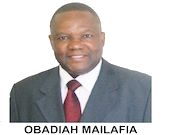
Obadiah Mailafia