|
Getting your Trinity Audio player ready...
|
Influx of refugees from other countries into Nigeria is putting strain on the country’s scarce resources and reducing the quality of livelihood of the already impoverished citizens.
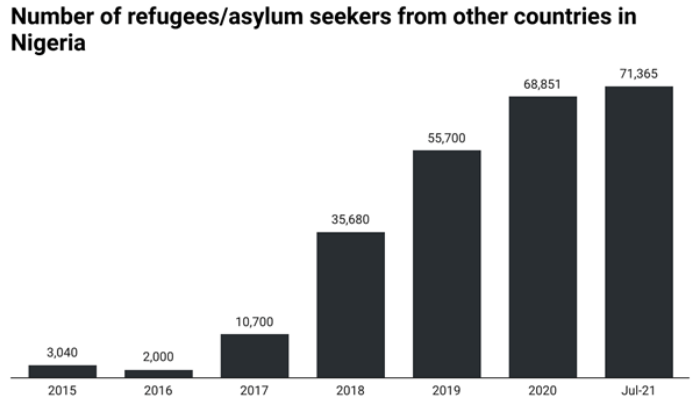
Data from the United Nations High Commissioner for Refugees (UNHCR) show that over 68,851 refugees sought refuge in Nigeria in 2020 compared to about 2000 refugees as of 2016.
These refugees are fleeing violence and conflicts in their countries and coming into Nigeria where violent attacks perpetrated by Boko Haram and other armed groups are also on the rise.
According to data from Nigeria Security Tracker (NST), there have been 2,943 abduction cases and 5800 death cases due to insecurity between January and June 2021.

However, refugees are hoping Nigeria would be better than their countries. This year alone, a total of 71,365 refugees have come into Nigeria as of July 2021, mainly from Cameroon, Niger, and Central African Republic.
The highest influx has been from Cameroon with a total of 67,456 Cameroonians seeking refuge in Nigeria as of July 2021.
The National Commission for Refugee, Migrants and Internally Displaced Persons (NCFRMI) federal commissioner, Imaan Sulaiman-Ibrahim, said recently that the political crisis in Cameroon has lingered unabated since 2016 and has occasioned gross human rights violations, wanton loss of lives and properties, especially in the two regions of Northwest and Southwest of Cameroon.
“An average of 300 Cameroonian refugees comes into Nigeria every week,” Sulaiman-Ibrahim said.
According to UN estimates, more than 679,000 people are currently internally displaced in Cameroon’s Northwest and Southwest regions and most come from areas near the border and have trekked across savannah and forests to reach Nigeria.

Read also: NDDC report: N6trn approved in 18 years yet projects uncompleted
Following Cameroon are refugees from Niger and Central African Republic with 1,436 and 717 persons currently in Nigeria’s refugee camps.
However, Nigerians continue to flee the country.
According to data from the UNHCR, about 352,000 Nigerians migrated to other countries as refugees in 2020, this is 19 percent higher than 296,000 refugees recorded in 2019.
Many of the refugees are fleeing the violence and armed conflict in the country. The Boko Haram insurgency, which began in 2009 in Nigeria’s northern state of Borno, combined with counter-insurgency operations and communal clashes over scarce resources has led to the loss of many lives.
Competition for scarce resources
The influx of refugees into Nigeria swamped with millions of displaced people will only create more competition for the already scarce resources.
According to the UNHCR, Nigeria has about 3.4 million displaced population including over 2.9 million internally displaced persons (IDPs) in north-eastern Nigeria.
Caught in the middle of Nigeria’s displacement crisis is host communities that have to share limited resources with thousands of homeless and needy refugees. With scarce resources, a fierce competition is inevitable.
The crisis has been exacerbated by conflict-induced food insecurity and severe malnutrition, which have risen to critical levels.
According to United Nations World Food Programme (WFP), 3.4 million people are facing acute hunger and 300,000 children are suffering from acute malnutrition in some North-eastern states.
The challenges of protecting the displaced are compounded by the deteriorating security situation as well as socio-economic, poverty, flooding, poor infrastructure and limited access to basic services.