Russian President Vladimir Putin has once again shifted blame for the war in Ukraine onto the West, arguing that NATO expansion and Western meddling left Moscow with little choice but to act militarily.
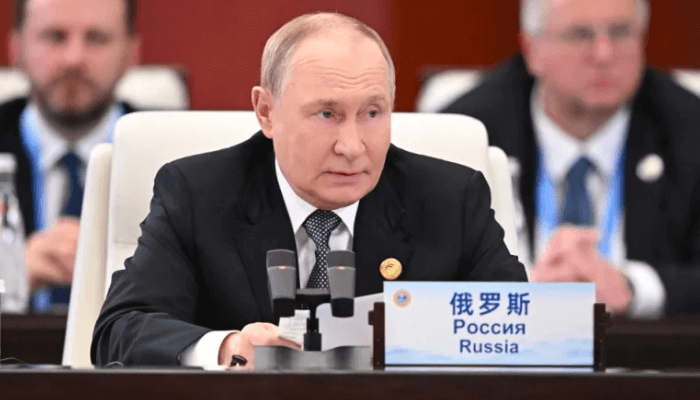
Speaking on Monday at the Shanghai Cooperation Organisation (SCO) summit in the northern Chinese city of Tianjin, Putin said the roots of the conflict stretch back to the 2013–14 uprising in Kyiv that toppled Ukraine’s pro-Russian president, Viktor Yanukovych. He described the Maidan protests as a Western-backed coup that destabilised Ukraine and set the stage for years of confrontation.
Read also: Modi, Xi vow partnership amid rising US pressure
“This crisis was not triggered by Russia’s attack on Ukraine, but was a result of a coup in Ukraine, which was supported and provoked by the West,” Putin told regional leaders, adding that attempts to draw Ukraine into NATO crossed Moscow’s red lines.

The Russian leader repeated that any peace settlement must address what he calls Russia’s “legitimate security concerns”. Without that, he argued, negotiations would be meaningless.
Putin also pointed to discussions he held with United States President Donald Trump in Alaska last month, claiming they had reached “understandings” on possible steps towards peace. He described the talks as “opening a way to peace in Ukraine”. However, he stopped short of confirming whether Moscow would accept Trump’s proposal for direct talks with Ukrainian President Volodymyr Zelensky.
Read also: Xi Jinping hosts world leaders as China, Russia push for new global order
US special envoy Steve Witkoff, speaking after the Alaska meeting, suggested Putin had agreed in principle to offer security guarantees for Ukraine as part of a potential deal — but Russia has yet to publicly confirm this.
Despite Trump’s calls for a ceasefire and negotiations, Moscow has so far rejected peace plans that fall short of its demands for Kyiv to cede more territory, conditions Ukraine has flatly ruled out.

At the SCO gathering, Putin thanked Chinese President Xi Jinping and Indian Prime Minister Narendra Modi for their “constructive efforts” in attempting to mediate the conflict. Both Beijing and New Delhi have maintained ties with Moscow throughout the war, buying Russian crude oil at discounted rates and keeping communication channels open — a position that has drawn sharp criticism from Western capitals.
Read also: Russia pounds Kyiv with missiles, killing 14 people, including four children
Putin framed the SCO itself as a necessary counterweight to “outdated Eurocentric and Euro-Atlantic models”, saying global security required new systems that reflected shifting power dynamics.
Since ordering the full-scale invasion in February 2022 — following the annexation of Crimea and backing of separatists in eastern Ukraine in 2014 — Putin has consistently justified Russia’s actions as defensive moves against NATO. For Kyiv and its Western allies, however, the war remains an unprovoked act of aggression aimed at undermining Ukraine’s sovereignty.