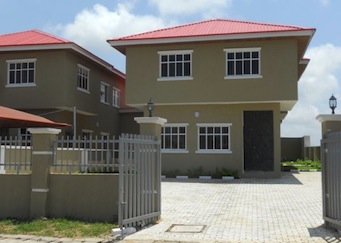
Price correction in the Nigerian property market is moving at very slow pace contrary to expectations that values, which reached dizzying heights during the boom days, ought to have hit the bottom by now.
Like any other sector of the economy, the real estate sector in the country is feeling the heat of the slowdown in the economy with low demand and significant price fall which analysts have interpreted to mean price correction, given that properties are over-priced and unsustainable.
“What we have seen in the market is price correction and not a drop because the prices in the market before now were unsustainable”, says Yemi Jolaosho, a property consultant, noting the correction has been this slow because developers and investors are still under the illusion that recovery would happen the next day, hence, their holding on to old prices and values.
“I see a market that is ruled by emotion; most of the developers are so emotionally attached to their property that they don’t want to let go, hoping that they will get a better deal tomorrow”, Jolaosho said, adding, “the reality that seems not to have dawned on some developers is that values have come down and will hardly go back to the pre-recession days when values appreciated by as much as 100 percent in 18-24 months.”

Bismarck Rewane, the CEO, Financial Derivatives Limited, in one of his quarterly economic reviews, noted that Ikoyi and other highbrow neighbourhoods in Lagos have seen vacancy rate as high as 20 percent. The highbrow locations in Abuja such as Maitama, Garki, Wuse, where slush ‘political’ money is alleged to have gone into construction, are not left out.
BusinessDay checks of Ikoyi market recently corroborates this as a walk through the Avenues and Roads in this exclusive settlement reveals that, in addition to new buildings coming to market, a good number of the old homes are empty with ‘to let’ or ‘for sale’ tags on them.
At Parkview Estate, for instance, it was discovered that, at least, two houses in almost each of the Roads and Avenues in this estate carried ‘to let’ or ‘for sale’ tag while on Bourdillon through Alexander to Gerard Roads, construction activities on high rise buildings are upbeat, while many completed ones are empty.
Though Sijibomi Ogundele, the MD/CEO, Sujimoto Construction Limited, believes houses are over-priced in Nigeria and he does not agree with the idea that demand has been weakened by the prevailing economic condition, which has crimped income and spending.
“The argument for supply exceeding demand is unfounded because luxury apartments are still in high demand; poorly finished buildings with exorbitant prices constitute the pile of empty apartments constantly littering highbrow areas. A developer who compromises on the quality of materials, no matter how highbrow the property is, has no right to place an exorbitant price on it,” he says.

The slow price correction may hold down the recovery of the market for too long and, according to Gbenga Olaniyan, an estate surveyor and valuer, “recovery is still a distant imagination because, by my projection, I don’t see the market rebounding before the end of next year.”
“And we have to be careful in using the word recovery when talking about the market especially in places like Ikoyi in Lagos. What some people call recovery is when they are able to sell an acre of land for N1.2 billion. I think those days are over. Whoever bought at that price should count his losses and know that he is not going to sell at that price for the next10 years,” he said.
Continuing, he said, “the recovery that we should be talking about is being able to develop a house or an estate and being able to sell or rent; or there is a property that is appropriately priced and you are able to sell it.”
Olaniyan noted that besides developers’ insistence on old prices, poor infrastructure is also another factor responsible for the high vacancy rate in Ikoyi, citing Parkview Estate, which, he said, has very poor drainage system.
“Parkview is seeing competition from Banana Island and Osborne Phase 1. The drainage system in Parkview is so poor that there are some streets that people do not want to rent house in. That has been corrected in the two competing estates; a typical tenant therefore, has options,” he said.
CHUKA UROKO