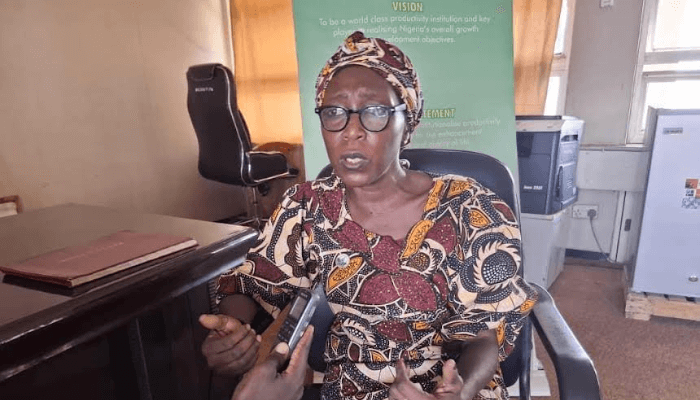
Hannatu Dauda Ndahi is a deputy director, Corporate Affairs Department at the National Productivity Centre, and Fellow, Institute of Productivity Practitioner of Nigeria. In this interview with OLATUNJI OMIRIN, she spoke on the impact of insurgency, low productivity, untapped opportunities and what state actors should do, among other issues. Excerpts:
Looking back how Borno State was in the early 2000 and now, don’t you think insurgency has taken the state 20 steps backward?
The Borno State and Northeast generally were centre of attraction for economic activities. Traders came from Lagos, Port Harcourt and neighboring countries to do their businesses without any problems. Until we began to have the issue of insurgency, which has grossly affected our productivity, such that our input determines our output; so, our input was affected. Of course, you can see that our output is also not the way it should be. That is not to say cannot be better, okay? When insurgency came, a lot of people lost their means of livelihood. Some people had to abandon what they were doing. Even farming became a challenge. Many of us are farmers. So, if we cannot farm, it means even our food security was affected. So, a lot of people lost their means of livelihood, and a lot of our youths were affected. Many youths got arrested, many fled the region and others formed a good percentage of the population who were involved in insurgency, thousands lost their lives in insurgency, and some were physically affected. Now, that affected our input, because those are the ones that work, the ones that give into the system.
Read also: BusinessDay Organizes Millennial Hangout to Tackle Personal Branding and Networking Challenges

Could you better describe how the 15 years of Boko Haram insurgency affected productivity?
Borno State is a place where a lot of commercial activity and agriculture activity take place like massive production of wheat. We farm a lot of wheat. I know wheat is found at the outskirts and in local government areas, which were actually affected grossly by insurgency. So, our wheat production dropped, and flour mills depend on what we produce. We produce one of the best species of wheat, but because of the effects of insurgency, our production has grossly dropped. You know, we share border with quite a number of countries, and that gave us a lot of financial flow into the state. Borno is gateway to Sub-Sahel Africa and international trades. And then, during insurgency, it was not easy to travel to those countries or bring in goods from those countries, or move cattle from in and across the country. We are one of the highest exporters of cattle in Nigeria. Most of the best cattle come from Borno State. Trailer loads of cattle leaves Borno State to other states. But during insurgency, that had to stop, because in the course of travelling, your vehicle could be stopped and burnt down. Also, look at fish farming too. You know, we are at the shores of the prestigious Lake Chad one of the best fish markets, also in Nigeria, is found in this state, which is in Baga in Kukawa Local Government Area. We even have a fish market in Maiduguri called Baga fish market. The best fish, smoked fish, of different species, come from there. But because of insurgency, you know, they attacked Baga axis. And so, access to the Lake Chad also became a challenge. So, fishing activity was almost halted to a very large extent, very little fish was coming from that part of the state. And so, that affected those who sell fish, those who farm, those who go and fish. You know, it affected their livelihood, and it also affected the food chain, because fish is a major protein, and then it’s no longer in abundance as it used to be. I can tell you that insurgency caused unimaginable manner of destruction to Borno and Northeast region.
Our productivity was affected. It cannot be what it used to be before it dropped to a certain percentage. The insurgency is in dimension. So, every state in the north was affected by terrorism, one way or the other. So, all of them were affected by it, and their productivity also dropped. Yobe that is next to us here, they barely escape, and Adamawa too, and every part of the North East was affected. So, productivity was affected everywhere, negatively.
Talking about the productivity and unemployment, are there any link?
When we talk about productivity, what is the link between productivity and unemployment, there’s a lot of it. If you’re unemployed, automatically you’re not doing anything or you are not giving to the system. That’s why when we talk about productivity, how is it affecting the development of the entire citizen? How is it affecting the standard of living? So, when people are unemployed, it means their standard of living is affected. The standard of living generally, is affected. There is no development where there is unemployment. Insurgency and unemployment, they are very related, because if you are unemployed, because of insurgency, you cannot go to work, or you cannot do your business, or you cannot get your job, it means your productivity is low. I think our youths can do better, if given the platform, given the opportunities, given the enabling environment. I believe our youths can do better than what they are doing now, that’s what I see.

What is your organisation doing to ensure that the teeming youths are productive in society?
At National Productivity Center, we create awareness through lectures on productivity in every NYSC camp that takes place in Nigeria. We advise corps members by telling them the tenets of productivity, including, efficiency, effectiveness, time management, and having personal goals. So, education is one part. Secular education is good, religious education is good, but there are skills that they can have that can help them to become better people in the society. We talk about soft skills. We talk about hard skills. There are many things out there that our youths can leverage on to reduce their dependency on government. Depending on government to do something for them. But it’s high time that we know that government cannot do everything. We have to stand up and do something for ourselves. Their role is to provide enabling environment for us to give back to the society. Our population is on the increase. So, look inwards. There is a gap that you can fill. There is something happening in society that needs you. Look around you, there is a gap you can fill. There is a difference you can make and begin to look at how you can make that difference by developing yourself in that direction.
Read also: Experts advocate proper branding, packaging of agro products at AWAP meeting
Looking at unemployment rate among the teeming youths, what is your advice?
I think there is for government to start working on reviving state-owned factories and industries. But I believe the earlier we do that the better. Probably, they are already working on reviving some of the factories. I believe they are. But for me, the earlier we revive them, the better so that these teeming young men and women out there can be gainfully employed. if you revive them honestly, our youths will be employed. They will get a lot of employment. And I know our Governor, Babagana Zulum being a good man. I know he is working on that, but I think the earlier, the better. So, for me, what I’ll ask the government to do, apart from other things they are doing beautifully well, is for them to actually build more factories and engage these young people in those activities, looking at them for having many factories but they are not active. We should have tomato processing plants in this state. We build more factories and involve our youths. There are factories where we can practically produce a lot of things. Let me give an example. We produce tomatoes, grains, and livestock. Let some factories process these things into consumable products, and then we can employ our young people. That’s for creating employment. We have a factory that employs all these young people, let them work. And that way, you know you don’t have to go out there to source for manpower. You already have the manpower. Our leaders need to wear their thinking caps and understand that we are in the 21st century, where you need creativity to be on top of games because we have the raw materials, but I discovered that they are not making use of these opportunities.
Do you think Borno State is doing enough in terms of packaging and branding of their products to the world?
You know, packaging and branding is a lot of things in one and so for me, in Borno State, we’re just recovering and still recovering from the effects of insurgency, and so, we’re picking up. But I believe that a lot of talk has been going on on branding and packaging, especially when we have opportunity to talk to entrepreneurs, brand your product, package well, so in no time, Borno State will be on its feet in that direction. Borno is gateway to international trades and Borno was known for making local caps, I think, the state is one of the highest producers of caps that men wear and that they are doing well. The caps are going countries, not even states. They are going to many countries. Borno also produce one of the largest cattle markets and many more. That’s because they are working on branding and repackaging. Another one is hides and skin, they are working on it, tomatoes, wheat and others. I believe, if we can improve on branding and packaging of goods and services the state would generate huge income through exports agricultural produce that would not only sustain its economy but the state will be eased of financial burdens in the entire north due to its massive potential and manpower but there’s room for improvement. I think Governor Babagana Zulum is trying in this direction but more needed to be done to maximize the opportunities. I will like to say that rebranding of agricultural produce will contribute huge income.
How do you assess the level of farming activity last year?
Yes, last year, thankfully, our office was involved in the National Survey on agriculture. We did a national survey where we interviewed farmers all over the country, and we interviewed hundreds of farmers as an office National Productivity Center, and we got farming activity was quite on the increase, except, of course, the harvest was affected by the flood, if not, more land was farmed, more people were involved in farming in 2024 than other years. But the flood affected the harvest. That’s just what happened to the farming last year. As rainy season is approaching. I will suggest that more farmland should be made accessible by providing security. Insurgencies on the decrease due to the activity of the re-integration, the processes of integration that is taking place, which is a good development. Insurgency is really, really on the decrease. And people should know that the state is pretty safe again. So, for me, more land should be made accessible for farming, more farming tools like seedlings, fertilizer, and pesticide. Government should help the people, because in the course of our interview, most of them were complaining of lack of funds, and then they could not really access fertilizer. The fertilizers came much later. So, I think if all these should come in earlier, and then government should provide more tractors, more machinery for farming, and harvesters and all of that our food security will be guaranteed and the price of food items would keep reducing as we are witnessing this year.
Read also:
Where do you see Nigeria in the next 10 years?
Oh, well, with the current move that our Director General, Baffa Babba Dan’Agundi is making, on making sure that productivity gets to the grassroots, I believe in 10 years, we should be better off than where we are. Our DG is truly doing a great work, ever since he came on board to see that productivity goes to the grassroots, gets to the people, that you know. But you know, most of the time we leave productivity at the top, but productivity is supposed to be from the grassroots, and then it goes to the top; so, he’s doing his best, and which is yielding fruit. So, I believe, in 10 years, if we imbibe and apply these opportunities that we’re trying to create consciousness about Nigeria, we will be better off. We should depend on made-in-Nigeria goods. I believe in Nigeria and I believe in Borno State. If I had to buy beans, I will not go and buy beans anywhere else, but in Borno State. So, let us encourage made-in-Nigeria goods. And the governments should provide the enabling environment for made-in-Nigeria goods to be competitive in the market out there. Let us do it, because we are talking entrepreneurship a lot, but we don’t look at quality; we don’t look at standard; we don’t look at competitiveness. Now, competitiveness plays a lot, plays a great role in the market out there. There’s a need for us to work on the standard and the quality of goods.