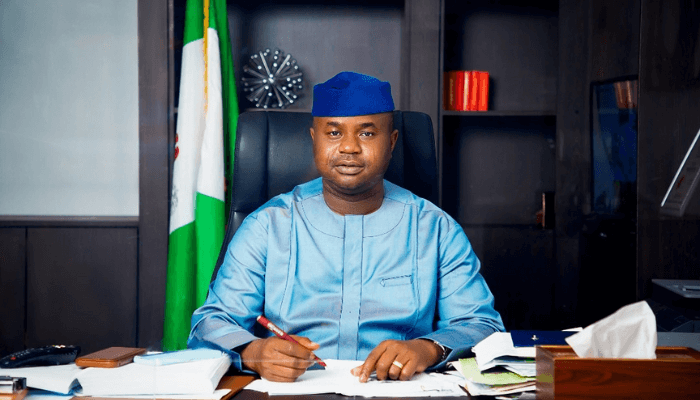
It is commendable that President Tinubu, in his wisdom, unbundled the Petroleum Ministry and gave us Ekperikpe Ekpo, and the minister with great wits is untangling issues in the sector to give us gas for transportation, electricity, and agriculture.
The gas minister is said to have made several interventions that promoted confidence building among the investment and joint venture partners in the Brass Methanol Project, and when his efforts paid off, he personally announced the resolution of all issues in April 2024, and the all-important agreement was finally signed on October 11, 2024, in Abuja, marking yet another significant milestone in efforts to monetise Nigeria’s largely untapped gas resources.
“A 127 km long gas supply line project with a 2 billion cubic feet (bcf) daily delivery is no half measure from the President and his ministerial team. This is huge and big enough to cancel out any substantial deficits.”
On October 22, 2024, sounding confident and fulfilled, President Tinubu told his audience while speaking to a delegation from Nigerian Independent Petroleum Company (NIPCO) that he has given Nigerian motorists a cheaper alternative to petrol with CNG selling for N200 per standard cubic meter, the equivalent of a litre of Premium Motor Spirit (PMS).
Read also: President Tinubu’s gas administration politics: Visionary leadership or crass opportunism (Part 1)

When are Nigerians going to say the same about LPG, I mean our everyday cooking gas? Because the price of Liquefied Petroleum Gas is still considered high two years into the life of this administration. Is LPG at N200 per kg possible? If not now, at least in the nearest future?
Over the last two years, the price of cooking gas has risen dramatically from N700 per kg in June 2023 to as high as N1,500 per kg in May 2024, with some fluctuations in between.

By April 2025, a further decline was reported at a little lower than N1,000 per kg, with a 12.5 kg cylinder costing approximately N11,875 depending on your location.
According to available data, 60 percent of our LPG consumption is imported. Nigeria produces less than 40 percent of its 1.5 million metric tonnes of annual LPG consumption locally, making it vulnerable to global price volatility and exchange rate fluctuations. This explains it all: “We must grow what we eat,” should we desire lower prices.
In addition, experts like Suresh Kumar of NIPCO are of the opinion that explorers like Chevron should be persuaded to convert more propane to butane for domestic use in order to boost local supply to 5 million metric tonnes annually. Good thinking, one may say, but do we have the adequate infrastructure to handle huge gas volumes, be it for storage or haulage?

Expectedly, our gas infrastructure deficit is no surprise, owing to the fact that Nigeria’s industrial development and energy needs in both colonial and post-independence eras were predicated on hydropower sources with no priority burden for a robust gas infrastructure development plan.
This deficit gap in infrastructure is why the Honourable Minister for Gas Resources is often heard talking about OB3 or seen visiting AKK. He calls both the OB3 and AKK projects “…the lifeline of gas supply in Nigeria.” What really then are OB3 and AKK?
In an interview with the Daily Times newspaper, Ekpo said, “That’s true. We talk about OB3 and AKK more often. This is because a lot depends on these two transmission line projects. They make up a critical part of our gas infrastructure network, especially as it relates to gas supply around the country. OB3 is simply the Obiafo-Obrikom-Oben gas project.
Read also: President Tinubu’s gas administration Politics: Visionary leadership or crass opportunism (Part 2)
“The project runs from the Obiafo-Obrikom gas plant near Omoku in Rivers State to the Oben node in Edo State. It traverses 127 km of land… It is expected to move about two billion cubic feet of gas daily into the Ajaokuta-Kaduna-Kano gas pipeline network, also known as AKK, for subsequent distribution.”
A 127 km long gas supply line project with a 2 billion cubic feet (bcf) daily delivery is no half measure from the President and his ministerial team. This is huge and big enough to cancel out any substantial deficits.
Honestly, this gives hope. Should this come on stream anytime soon, it is going to be the selling point of the administration and would win more admirers for the Tinubu presidency than the 700 km Lagos–Calabar Coastal Highway, which is earning him new points by the day as it progresses.
In the words of Mr. President, “…our gas assets are receiving the attention they deserve. Investors are coming back.”
Yes, this is true, considering the fact that multi-billion dollar international investors like the Jindal Steel Group of India are already at our arrival lounge.
Jindal Steel Group is in Nigeria to offtake 450 million standard cubic feet of natural gas per day for use in a 10 million tonnes per annum Hot Briquetted Iron (HBI) steel plant to be located in the Ibom Solutions Hub Industrial Park (ISHIP), a free zone facility in Akwa Ibom State. This is a $4b investment.
The Chinese are not missing out on this. In a signed deal, the BFI Group and China National Chemical Engineering Corporation are revving up the gas power plant engines at the moribund Aluminium Smelter Company of Nigeria (ALSCON) in Ikot Abasi, bringing it back to life.
The $1.2b deal is to generate 540 MW of power for electricity. With this intervention by the federal government, ALSCON is clearly positioned once again to take back its place as a major aluminium producer for both domestic and international markets.
Indeed, our gas assets are receiving the attention they deserve, including the poster boy of this alternative energy revolution, Obongemem Ekperikpe Ekpo.
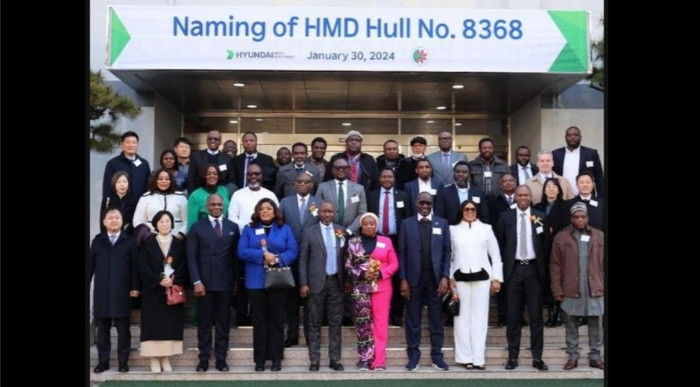
Ekpo got a formal invitation from Temile Development Company to attend and witness the commissioning of a 23,000 cubic meter ultramodern LPG carrier in faraway South Korea.
The ceremony took place at Hyundai Mipo Dockyard in Ulsan, South Korea, where his beautiful wife, Lady Esitmbom Ekpo, was given the honour to perform the naming and breaking of the symbolic champagne bottle on the new vessel, Alfred Temile 10.
Should the President and his first 11 team members in the gas field choose to break a bottle of champagne for these milestones and the significant progress made so far, like the Nigerian lady in Ulsan, I think it is in order, for indeed hope is renewed.