The building and construction sector is one of the most crucial — mainly for its contribution to the basic human need of shelter — and fastest growing industries in the Nigerian economy. In the last three years, the industry has experienced rapid double digit growth rates, outgrowing all other sectors in the economy.
Despite this recent boom, the construction sector’s overall contribution to GDP is still significantly low. Amongst other factors responsible for this slow impact is, shortage of funds for project execution. Infrastructure in Nigeria in particular has suffered some of the major consequences of deferred maintenance and underinvestment in the construction industry. This has constantly led to fatal building collapses, bad roads and loss of lives and property.
Working to solve these problems by creating lasting solutions, the Nigerian government has been leveraging public-private partnership (PPP) as its core strategy in the financing of infrastructure projects. Public-private partnership is a generic term that rightly describes the multitudes of structures put in place to pave the way for private sector involvement in the provision of public services. It helps to ensure optimal use of resources as well as efficiency in service delivery. These added benefits translate to an increased value for money as a result of utilisation of private sector expertise and technology, leading to superior products and services at a lower cost.
Looking at infrastructure in Nigeria, this particular strategy is borne out of a desire to solve Nigeria’s huge infrastructural needs coupled with inadequate funding for such needs. It has the capacity to both meet these needs and generate the requisite funds for the provision and management of these infrastructure. So far, quite a number of projects have been successfully executed over the years. Some very popular examples include the Lekki-Epe Expressway, the Lagos State Blue Line, the domestic Wing of the Muritala Muhammed Airport General Aviation terminal II amongst others.

Recently, also in partnership with private sector players the government established Infra-Co. a trillion naira ($2.4 billion dollar) company. This company is backed by the Central Bank of Nigeria, Nigerian Sovereign Investment Authority and the Africa Finance Corporation. Infra-Co is expected to grow its capital and assets to 15 trillion naira over time and will fund public Infrastructure projects like housing, road, rail and power. It is also projected to help Nigeria achieve a Gross Domestic Product (GDP) growth by ten percent over the next ten years.
Interestingly, the public-private partnership strategy has not only helped governments to procure long-term infrastructure services from private providers, but has brought about added benefits for other stakeholders. Private companies for instance have the opportunity to develop knowledge, experience and skills, which can be constructively reapplied into the private sector. They can also be provided with access to reduced risk, secure, long-term investment opportunities that are underwritten by government contracts. It has also drastically reduced construction costs and tax burdens on citizens, allowing funds to be redirected to other infrastructural projects.
Read also: Why policies fail in Nigeria
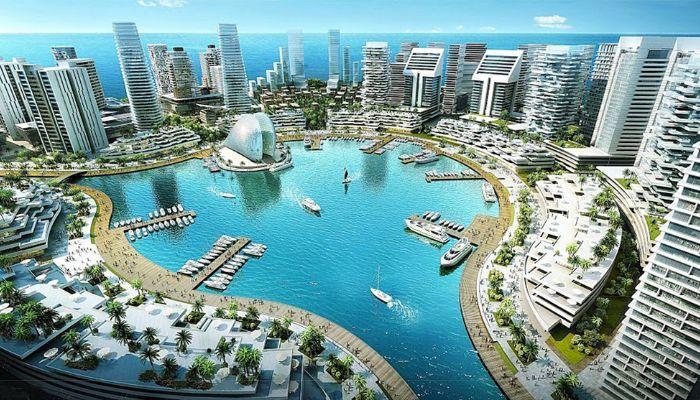
Capitalising on this massive economic potential of private-public partnership is Arkland Group through its construction subsidiary, Arkland Structures. Being the first purely indigenous construction company to build towers in the Eko Atlantic City — land reclaimed from the Atlantic Ocean — the company has set itself apart as not just any construction company, but one with sustainability at its core. Designed in compliance with the International Finance Corporation’s (IFC) Green Edge Standard, the City is built to be utterly self-sufficient, managing water consumption and energy consumption, greenhouse gas emissions, waste disposal and more. It is projected to house about 250,000 residents once completed, taking a small but significant amount off the current 17 million housing deficit.
With a total of 10 districts, spread across a land area of approximately 10 square kilometres, Eko Atlantic is expected to rise as a new breed of property on the continent, catering to financial, commercial, residential and tourist accommodations.

Currently, the total construction project pipeline in Nigeria, as tracked by the Construction Intelligence Centre (CIC), including all mega projects with a value above US$25 million, stands at N167.4 trillion ($511.7bn), with private sector involvement in a vast majority of the projects. This shows a promising outlook for Nigeria’s construction space.
It is projected that efforts to enhance transport and residential infrastructure will support the growth of the industry over the next few years. Considering the immense benefits provided by private sector participation, one can confidently say that the growth of the construction sector is on a steady, upward trajectory, triggering development at every level.
Awofisoye, head of operations, Arkland Properties & Investment Co., writes from Lagos