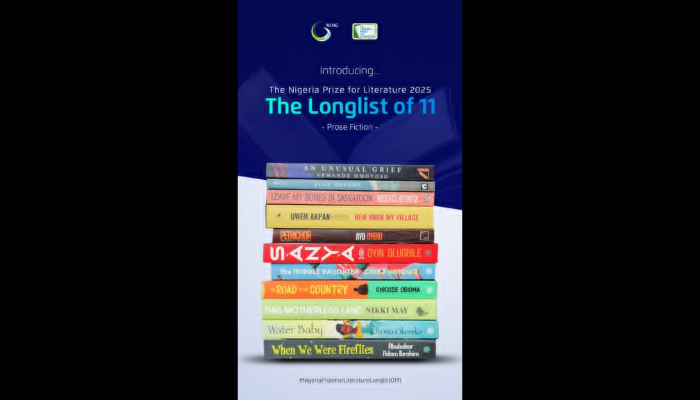
The Advisory Board of the Nigeria Prize for Literature announced on 23 July a distinguished longlist of 11 writers competing for Africa’s leading literary award. The Nigeria Prize for Literature offers the winner $100,000.
The longlist includes established writers, previous winners, and newcomers. The Advisory Board whittled down 252 entries to select the final 11.
The 2025 entries are a record. The 252 novels exceed the number in previous prose fiction cycles (2021 had 202 entries; 2024 children’s category had 163).
Professor Saeedat Bolajoko Aliyu chaired the panel. Judges include Stephen Mbanefo Ogene, Olakunle Kasumu, and international consultant Dr. Grace Musila.
The selected works are:

An Unusual Grief – Yewande Omotoso
Fine Dreams – Linda N. Masi
Leave My Bones in Saskatoon – Michael Afenfia
New York, My Village – Uwem Akpan
PETRICHOR: The Scent of a New Beginning – Ayo Oyeku

Sanya – Oyin Olugbile
The Middle Daughter – Chika Unigwe
The Road to the Country – Chigozie Obioma
This Motherless Land – Nikki May
Water Baby – Chioma Okereke
When We Were Fireflies – Abubakar Adam Ibrahim.
Notable highlights:
Female authors are notably prominent. Women make up seven of the 11 authors on the longlist. Analysts say this gender representation reaffirms the vitality and influence of women writers in contemporary Nigerian literature. Recurring themes explore female agency, family, and generational tension.
The list combines established literary names (such as Chika Unigwe, Chigozie Obioma, Abubakar Adam Ibrahim) with emerging voices (like Ayo Oyeku, Oyin Olugbile)
Chika Unigwe (winner in 2012) returns with The Middle Daughter.
Abubakar Adam Ibrahim (winner in 2016) appears with When We Were Fireflies.
Masobe Books, the publisher, has multiple titles in the list—including works by Unigwe, Obioma, Olugbile and Okereke.
Local and international media offer a deep analysis of the longlist.
Literary trends
Setting: Many stories connect Nigeria’s local realities with experiences abroad or in the diaspora, reflecting continued interest in transnational journeys.
Innovation: The panel commended several works for their innovative structure and narrative voice, showcasing ongoing experimentation in form within Nigerian prose.
Social commentary: Issues of grief, national identity, political change, and the environment weave through the longlisted works. They illustrate a commitment to interrogating personal and collective histories.
Read also: Nigeria Prize for Literature 2025: Meet board, jury panel
Major Thematic Currents
Grief, Loss & Healing
Six of the eleven titles hinge on bereavement—An Unusual Grief’s suicidal daughter, Fine Dreams’ slain schoolgirls, Leave My Bones in Saskatoon’s murdered family, This Motherless Land’s fatal car crash, The Road to the Country’s kidnapped brother, and When We Were Fireflies’ multiple past-life deaths. The recurrence suggests a national literary preoccupation with mourning and post-traumatic growth in a period marked by insecurity and migration.
Migration & Diaspora
Four books (Leave My Bones in Saskatoon, New York, My Village, Water Baby, This Motherless Land) dramatise outward or internal migration, highlighting economic push factors (“japa” wave), culture shock, and the politics of belonging. This aligns with demographic data indicating a rise in Nigerian emigration since 2020.
Conflict & Political Memory
Civil-war memory emerges in The Road to the Country and New York, My Village, building on literary conversations initiated by Chimamanda Ngozi Adichie’s Half of a Yellow Sun, but updated with Gen-Z sensibilities and metafictional techniques. Linda Masi’s Fine Dreams and Chioma Okereke’s Water Baby portray contemporary violence—Boko Haram and urban poverty—through intimate narratives.
Feminism & Female Agency
From Sanya’s warrior-princess arc to Nani’s fight for emancipation in The Middle Daughter and Funke’s decolonial awakening in This Motherless Land, the list highlights women reclaiming power. Notably, seven of the eleven long-listed authors are women, signalling a gender tilt unseen in recent prize cycles.
Authorial Snapshots
Yewande Omotoso
South Africa-based Nigerian Barbadian architect turned novelist. Previous works, Bom Boy and The Woman Next Door, received multiple international nominations. An Unusual Grief continues her exploration of unconventional family dynamics.
Linda N. Masi
Debut Nigerian American writer whose Fine Dreams won a Juniper Prize and uses a spectre narrator—an inventive risk applauded by Foreword Reviews.
Michael Afenfia
Nigerian Canadian lawyer: Sixth novel examines the emotional toll of the “Canadian dream”. Critics commend his skill in suspense and his depiction of immigrant realism.
Uwem Akpan
Catholic priest and author of Oprah-endorsed Say You’re One of Them. His satirical debut novel, New York, My Village, critiques the gatekeeping in publishing and ethnic trauma.
Ayo Oyeku
Known for prize-winning children’s books, Oyeku’s shift with Petrichor marks a genre leap. Limited early reviews highlight an adventurous spirit, but a complete critical consensus is still pending.
Critical Reception & Literary Strengths
An Unusual Grief
Reviewers laud Omotoso’s “sharp and precise” prose and taboo-breaking depiction of BDSM as a pathway to emotional catharsis. Its intimate
Johannesburg-Cape Town setting contrasts with diaspora-heavy competitors, offering a continental vantage.
Fine Dreams
Masi fuses mythic allusion (Persephone) with Nigeria’s mass-abduction trauma. The ghost narration provides Brechtian distance, allowing readers to process violence without succumbing to voyeurism. Judges may appreciate the risk-taking structure.
Leave My Bones in Saskatoon
Afenfia’s dual-continent narrative showcases Saskatoon’s immigrant cold shock and Abuja’s corruption. BusinessDay praises its unpredictability and cultural exposition. Some critics note a slower pacing than his earlier thrillers, which could divide opinion.
New York, My Village
Akpan’s comedic tone masks razor-sharp dissections of U.S. racial hierarchies. Brittle Paper calls it “a moving story about the delights and traumas of coming to America”. Its metafictional treatment of the Biafran anthology may resonate with academic jurors.
Petrichor
Information is relatively scarce, positioning it as the longlist’s dark horse. Early teasers describe an adventurous girl overcoming fear on a dangerous mission. Novelty could either intrigue or penalise it, depending on the clarity of execution once thoroughly scrutinised.
Sanya
Olugbile re-imagines the Yoruba thunder-god myth with a female protagonist, drawing praise for feminist inflexion. Rich world-building and orisa lore provide fantasy breadth rarely seen in NLNG submissions.
The Middle Daughter
Unigwe’s Hades–Persephone echo supplies classical scaffolding while addressing domestic violence. Comparative critics align it with Buchi Emecheta’s Second-Class Citizen, bolstering its canon credentials.
The Road to the Country
Obioma combines myth and realism; Publishers Weekly awarded it a starred review for a “heart-racing, mystical” war narrative. Obioma’s double-Booker-shortlist pedigree gives it prominent status, though previous acclaim can raise jury expectations.
This Motherless Land
May’s decolonial rewrite of Mansfield Park traverses four decades and two continents. Creative Writing News hails its “balanced survey of Nigeria and England”. Its TV-adaptation momentum may boost public buzz but is irrelevant to jury criteria.
Water Baby
Okereke renders Makoko’s floating slum with immersive detail; reviewers admire her portrayal of drone-mapping activism intersecting with social-media virality. The novel’s environmental undertone offers policy resonance.
When We Were Fireflies
Ibrahim’s reincarnation tale melds magical realism with philosophical inquiry on fate. As a previous NLNG winner (2016), Ibrahim must surpass his benchmark to avoid “lifetime-achievement” complacency.
Diversity Metrics
Gender: seven women, four men.
Location of primary setting: Nigeria (8), Diaspora mixed (3).
Genre range: Realist (6), Mythic/Magical (3), Satirical/Metafictional (1), Speculative reincarnation (1).
Author residence: Nigeria, South Africa, Canada, United Kingdom, United States—indicating the global spread of Nigerian letters.
Publishing Landscape
Independent presses dominate: Cassava Republic (An Unusual Grief), Dzanc Books (The Middle Daughter), Parresia (New York, My Village), UMass Press (Fine Dreams), Griots Lounge (Leave My Bones in Saskatoon). Only Obioma’s title is published through an international “Big Five” imprint (Faber & Faber/Deep Vellum), highlighting the growing influence of independent publishers in promoting Nigerian voices.
Shortlisting Dynamics: What May Sway the Jury
Literary Risk vs. Accessibility: Fringe-structure novels (Fine Dreams, New York, My Village) deliver innovation, while emotionally direct works (An
Unusual Grief, This Motherless Land) may garner reader empathy.
Historical Gravitas: The Road to the Country’s war canvas and Obioma’s reputation could weigh heavily.
Previous Winner Factor: The panel often avoids naming repeat laureates in quick succession; Ibrahim’s 2016 win could either confirm mastery or lead the judges to highlight new laureates.
Gender Equity Perspective: With a woman-majority list, the jury may favour maintaining that representation in the final trio.