|
Getting your Trinity Audio player ready...
|
Peter Obi, a former governor of Anambra State, is today seen by many observers as an example of what a public office holder in Nigeria should be. He is being touted as nursing a vice presidential ambition for 2019.
By the time he exited office in 2014, Obi left an indelible mark in the political sand of Anambra, nay south east. No wonder he has become a sought-after keynote speaker at events that have to do with governance.
He shares his personal experiences and how and why he succeeded as governor of Anambra State.
It would be recalled that before he became the governor of Anambra, the state was completely on the thumbs of undertakers, and godfatherism thrived.

Before his arrival on the scene, money politics had been elevated to an intolerable level.
It began with the sponsorship in 1999 of Chinwoke Mbadinuju, a lawyer, by an oil magnate, Emeka Offor. The governor was like a puppet. He was just dancing to the dictates of his financiers. And Anambra paid dearly for it. There was no form of development and schools were shut down for a long time over non-payment of teachers’ salaries.
The situation became worse with the election of Chris Ngige, a medical doctor that was bankrolled by Chris Uba, a young man at the time who wielded enormous influence with his deep financial pocket.
At the time Ngige was governor, every one of those at the state and federal legislative houses were sponsored by Uba and almost all the political appointees in the state were planted by the moneybags. So, Anambra was working for just a few individuals.
That was the situation until Obi became governor and said ‘never again’.

While on the beat as governor, he ensured that government worked for all Anambrarians and not just for a few people.
He demystified governance and removed the veil that shrouded government activities. Of course, he received cheers and jeers on equal measure.
Some critics of the former governor say he has an araldite hand. They said it to his hearing to the point that Obi explained why people thought he was “stingy.”
“It all depends on what you are stingy about. It is not the issue of perception; it is the issue of ‘you are managing public money’. When you are talking about public money, public money must be used for public good,” he explained.
“It’s not Peter Obi’s personal money, it is money meant to rebuild the schools, it is money meant to construct roads, it is money meant to provide health facilities, and it is money meant to support small business,” he further said.
‘All Nigerians are complicit’
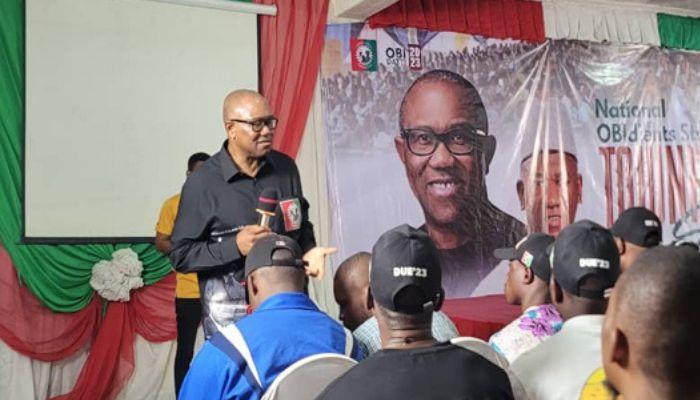
While he was still in office in 2013, Obi addressed an enlightened audience at the Nigerian Institute of International Affairs (NIIA), Lagos. He held his listeners spell bound.
It was the 10th Annual Lecture of the Centre for Values in Leadership (CVL) themed: ‘Leadership values: The challenge for the next generation of leaders’. The CVL was founded by Pat Utomi.
Peter Obi pointedly told the gathering that they were all part of the problem of Nigeria. He said members of the audience or any other Nigerian for that matter should not only point fingers at political office holders, but must also hold themselves culpable for the leadership deficit the country is grappling with.
He said the pressure usually being mounted on public office holders by their family members, relations and friends encourages such officers to steal.
Speaking in his usual tiny voice which was amplified with a microphone, Obi said: “Every citizen of Nigeria must be blamed for what is happening in the country. We make cost of governance to be very high. The church, the society, everybody is corrupt. This is a country where people idolise those whose sources of wealth are questionable. Almost all the states are going to the bond market borrowing money for consumption and not for production.”
Recounting his personal experience how he was able to make remarkable impacts in education and health care needs of the Anambra people without pandering to the whims of corrupt public officers who hide under the guise of ‘due process’ to perpetrate fraud, Obi said most office holders think only about themselves and not about the country.
According to him, had he succumbed to the pressure from some interest groups, Anambra State would have been bleeding by now, pointing out however, that his insistence on doing the right thing has won him a sobriquet which he said he did not regret anyway.
He also deplored the practice of some governors who travel outside their home states with retinue of aides who have no business travelling in the first place. He said such past times bleed states’ treasuries. He also lamented the deployment of many vehicles and noisy sirens within the state.
Obi spat on the attitude of some governors who push people off the way, even elderly people who are harmless. He wondered: “Why do you push harmless people who gave you the mandate you are exercising?”
“150 jets registered in one year, who are the owners, what is the source of their livelihood? We must change the style of our living. This is a country where a person who had nothing before going in for an election, after he won the election, within six months he has bought six vehicles, built or bought houses and traditional rulers will be falling over themselves to give him titles,” he said.
Obi did not spare the church, which he said was not helping matters in the fight against corruption. According to him, even in the church hero worship is prevalent.
His modest achievements while he presided over the state must have inspired him to aspire for a higher office.
Although this ambition is yet to be made public, the former governor believes if given the opportunity, he will serve Nigeria more creditably under a focused and disciplined president.
The man, Peter Obi
Obi was born on 19 July 1961 at Onitsha. He attended Christ the King College, Onitsha where he completed his secondary school education. He was admitted to the University of Nigeria, Nsukka, in 1980, graduating with a B.A (Hons) in philosophy in 1984.
Going into business, he became chairman of Next International Nigeria Ltd, then chairman and director of Guardian Express Mortgage Bank Ltd, Guardian Express Bank Plc, Future View Securities Ltd, Paymaster Nigeria Ltd, Chams Nigeria Ltd, Data Corp Ltd and Card Centre Ltd. He was the youngest chairman of Fidelity Bank PLC. Obi married Margaret Brownson Usen in 1992 after which they had their first child Gabriella Nwamaka Frances Obi, two years later they had their first son Gregory Peter Oseloka Obi. He was appointed the chairman of the Security and Exchange Commission (SEC) by former President Goodluck Jonathan after the 2015 general election. Obi operated a very meticulous financial regime in Anambra State that includes cutting of unnecessary spending, and ploughing of revenue wastage, among others.
Political journey
He contested the Anambra State governorship election as candidate for the All Progressives Grand Alliance (APGA) party in 2003, but his rival, Chris Ngige of the People’s Democratic Party was declared winner by the Independent National Electoral Commission (INEC).
After nearly three years of litigation, Ngige’s victory was upturned by the Court of Appeal on 15 March 2006. Obi took office on 17 March 2006. On 2 November 2006, he was impeached by the state House of Assembly after seven months in office and replaced the next day by Virginia Etiaba, his deputy, making her the first ever female governor in Nigeria’s history. Obi successfully challenged his impeachment and was re-instated as the governor on 9 February 2007 by the Court of Appeal sitting in Enugu. Etiaba handed power back to him after the court ruling.
He once again left office on 29 May 2007 following the general election, which Andy Uba won. Obi returned to the courts once more, this time contending that the four-year tenure he had won in the 2003 elections only started to run when he took office in March 2006. On 14 June 2007 the Supreme Court of Nigeria upheld Obi’s contention and returned Obi to office.
On 7 February 2010, the INEC declared Obi the winner of the 6 February 2010 gubernatorial election, where he defeated Professor Charles Soludo, former governor, CBN. This election victory gave Governor Obi an additional four years as the governor of Anambra State. On the 17th of March 2014 Peter Obi served out his second term and handed over the governorship to Willie Obiano.
Zebulon Agomuo