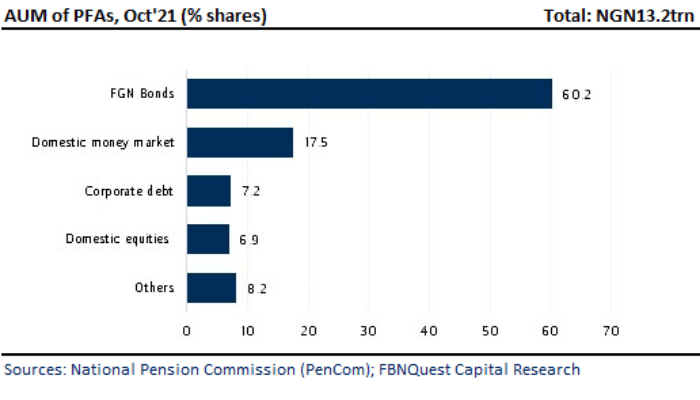
Nigeria’s total assets under management has risen to more than thirteen trillion naira, a growth of near ten per cent year on year to October 2021.
According to PenCom’s latest monthly report for Oct ’21, the assets which came in at N13.2trn, grew by about one per cent month on month.
Of this total, FGN debt securities represented 63.2% of the total and when you include corporate and state government issuance, fixed-income exposure surges to 71.2% of the industry’s assets under management or AUM.
According to a report by analysts at FBNQuest, the asset allocation of Nigerian pension funds has generally been biased toward government debt, due mainly to the scarcity of good investible securities available to them.
However, in comparison, June ’21 data from the Kenyan Retirement Benefit Authority estimates that government securities accounted for only 44.1% of the KES1.48trn (USD12.97bn) AUM of the Kenyan pension industry.
Read also: Soft drink prices up 33% on sugar tax

The value of domestic equities in PFA portfolios increased by c.29% over the 12 month period, bringing the share of equities in the portfolio up to c.6.9% from around 5.8% a year earlier.
With respect to equities, Nigerian PFAs have adopted a cautious approach, having taken some losses during the stock market meltdown of 2008 to 2009.
Another noteworthy point is that despite the Nigerian Stock Exchange’s market capitalisation of over USD60bn, selecting high-quality, liquid shares that fit the investment criteria of PFAs is extremely challenging.
The analysts said “over the course of a year, PFAs cut their holdings of Nigerian Treasury Bills (NTB) from c.NGN653bn to c.NGN280bn.
“The depressed (low-single-digit) yields on the NTBs is the major reason. In comparison, yields on FGN bonds retraced by well over 500bps across the curve between Q4 ’20 and Q3 ’21.
“Looking ahead, the DMO has an onerous domestic borrowing target of c.NGN2.57trn this year. This target does not take into consideration the supplementary budget meant to cover the NGN3trn for subsidy payments by the NNPC. As such, we see yields rising again this year on account of increased supply of paper from the DMO.”