The Nigerian pension industry’s Assets Under Management (AUM) has grown by N452 billion at the end of May 2025, to N24.12 trillion, reflecting steady growth across key asset classes compared to April.
This is as enrolment also called Retirement Savings Account (RSA) registration grew by 44,938 in May to N10, 763,593, as against 10,718,655 in April.
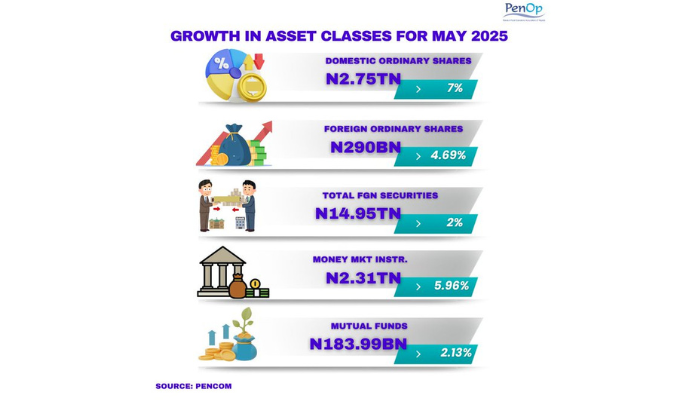
Domestic Ordinary Shares grew by 7 percent, driven by increased market participation and marginal improvements in the equities market, according to analysts at Pension Fund Operators Association of Nigeria (PenCom).
Notably, the NGX All Share Index recorded a growth of 18.52 percent in May, reflecting improved investor sentiment and favorable market conditions, which contributed to the positive equity performance in pension portfolios.

Total FGN Securities rose by 2 percent, maintaining their role as a safe haven for pension assets amid prevailing macroeconomic conditions, supported by consistent subscriptions to bonds and Treasury bills.
Mutual Funds recorded a growth of 2.13 percent, indicating cautious but steady allocations as pension operators continue to diversify
Money Market Instruments grew by 5.96 percent, reflecting attractive short-term yields and proactive liquidity management by pension fund administrators. Foreign Ordinary Shares increased by 4.69 percent, signaling continued but cautious exposure to foreign equities as part of currency and portfolio diversification strategies, they said.
Read also: PenCom stands strong on employee’s right to choice of PFAs
“Overall, the consistent month-on-month growth across these asset classes and the solid performance of the equities market demonstrate cautious optimism and adaptive strategies by pension fund managers as they navigate evolving market conditions, says Oguche Agudah, chief executive officer, PenOp.

The National Pension Commission (PenCom) recently announced consideration of diversification of pension assets investments to alternative asset classes for higher returns, amid rising volatility in the economy.
According to the Commission, while traditional asset classes such as bonds and public equities have served their purpose, the current economic landscape characterised by volatility, rising inflation and declining purchasing power of RSA Contributors, requires dynamic and resilient investment strategies.
Today, over 80 percent of pension fund assets are invested in fixed income securities with Federal Government Securities accounting for 62 percent of total pension assets valued at N24.11 trillion as of 30 May 2025, while allocation to alternatives assets, that is private equity and infrastructure funds stands at only about 3 percent.
Omolola Oloworaran, director general, PenCom spoke at a sensitization workshop organised by the Industry in partnership with FSDA-Africa, on ‘Investment In Alterative Assets For Chairpersons Of Board Investment Strategy And Risk Management Committees Of Pension Fund Administrators(PFAs) held in Lagos.
Oloworaran said this potential shift comes as part of efforts to optimize returns for pension contributors, amid evolving market conditions and the need for more resilient, higher-yield investment options.
She said that alternative assets provide a complimentary pillar to core investment strategies of pension funds offers. “Investments in infrastructure and private equity, in particular, help align pension fund portfolio with their investment horizon, provide opportunities for diversification of pension assets and enhance risk adjusted returns.”
Charging the board of PFAs for action, she said, “As chairpersons of the Investment Strategy and Risk Committees, you occupy a position of trust. You have a fiduciary duty, a legal and ethical obligation to act in the best interests of RSA holders at all times. This responsibility includes ensuring that investment decisions are based on sound strategy, robust risk assessments, and are compliant with the guidelines issued by the Commission, she said.
“Fiduciary responsibility also means independence of thought. It means resisting undue influence, asking hard questions, and insisting on transparency. It requires that every investment decision is not only justifiable on paper but also defensible in principle. You must continuously interrogate whether your PFAs’ investment strategy aligns with the long-term liabilities of the pension scheme and reflects a prudent balance of risk and return.”
Oloworaran stated that the global financial landscape is becoming more complex, with growing exposure to market volatility, geopolitical uncertainties, and evolving asset classes.