|
Getting your Trinity Audio player ready...
|
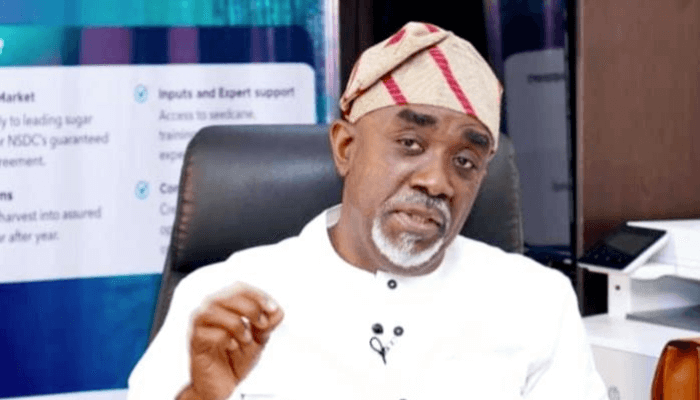
Adeniyi Adebayo, Nigeria’s minister for trade and investment during a media parley, speaks on how the ministry has led efforts to make industries viable in pushing the country closer to desired economic outcomes. He also spoke on his vision for export, which is to take the country away from being a supplier of commodities to a strategic supply chain partner to the world’s biggest off-taker nations. Bashir Hassan provides excerpts.
Looking at your Ministry’s portfolio of agencies it wouldn’t be an overstatement to say that you are arguably the most critical player in Nigeria’s non-oil economy. How well is your ministry positioned to carry out its mandate?
My Ministry is well positioned to execute its mandate. I think this is a good opportunity to outline what our mandate comprises of so people can better understand how well the Federal Ministry of Industry Trade and Investment (FMITI) is doing.
FMITI as you stated is one of the most critical actors in the Nigerian economy. Its primary mandate is to diversify Nigeria’s economic base and, through this achieve our vision of growing the economy, creating jobs and generating wealth.

Our mission is to formulate and implement policies and programs to attract investment, boost industrialization, increase trade and exports and develop enterprise.
In addition to our mission and vision, our mandate is derived from the following:
· The Nigerian Economic Sustainability Plan (NESP) which aims to prevent or at least limit the recession that is expected as a fall out of the Covid-19 pandemic, and avert the accompanying prospects of business failures, job losses, and increased poverty;
· Executive Orders: EO 001 on the promotion of transparency in the business environment; and EO 003 on support for local content in public procurement
· The 9th Sustainable Development Goal which aims to promote inclusive and sustainable industrialization and, by 2030, significantly raise industry’s share of employment and gross domestic product, in line with national circumstances, and double its share in least developed countries

These are the guiding inputs that drive our work and we deliver them through our various programs. We are working to fast track the implementation of the Nigerian Industrial Revolution Plan (NIRP), we have programs to support the growth and access to markets of MSMEs like the National Enterprise Development Program (NEDEP) and sector-specific plans and programs like the sugar and automobile backward integration plans.
I personally sit on a number of inter-agency and inter-ministerial committees that support the objectives of our ministry. I also sit on international committees like the UK-Nigeria Economic Development Forum in a bid to facilitate exports, establish 21st century trade agreements that benefit Nigeria and ensure Nigeria’s voice is recognized in global trade conversations.
The president recently held a 2-day ministerial retreat to evaluate the performance of the ministries. To the man on the street how can you say the ministry has impacted his or her life?
2020 was one of the most difficult years that the current generation has ever faced. The Covid 19 pandemic negatively affected the entire world. In Nigeria, which we all know has the largest population in Africa, it was truly challenging to ensure that the most at-risk populations, who rely on daily work for subsistence did not fall further into poverty.
The Ministry stepped forward to help when the pandemic was at its height by setting up an Emergency Operations Centre (EOC) that ensured the availability and free passage of essential items like food and medicine. We also assisted companies involved in the local manufacture of PPE’s, face masks, ventilators and sanitizers.
Read also: Human Capital Africa to redefine education for accountability
As part of the Nigeria Economic Sustainability Plan (NESP) we were charged with the enactment of the MSME Survival Fund Initiative, to help MSMEs respond to the shock caused by the pandemic. We have given payroll support to almost half a million MSMEs enabling them to pay staff and remain in business. We have also given MSME Grants to over 82,000 beneficiaries and 293,000 artisans and transporters. We have also successfully provided free CAC company registration and formalization support to over 240,000 MSMEs that just needed a small amount of encouragement to realize their entrepreneurial dreams.
In addition to being there in times of crisis, our everyday operations have an impact that is strongly felt by both the business community and the general public. The trade policy work we do helps improve business processes, we intervene on behalf of businesses to ease investment and business operations and reduce trade barriers in a bid to increase job opportunities and reduce the costs of goods and services.
Things are not as easy as they were when oil was $107 a barrel and the dollar was N150/$1 but I think that instead of looking at the past we should concentrate on the future we can build now. A future in which oil no longer has such a stronghold on our economy and hard-working Nigerians can fulfil their potential. This is a future we are in the process of creating and I think the progress made is becoming more and more evident.
In addition to being there in times of crisis, our everyday operations have an impact that is strongly felt by both the business community and the general public
We hear of challenges faced by exporters especially regarding the time and cost of exports. What are you doing about this?
Supporting exporters is integral to Nigeria’s diversification agenda. I am the Vice Chairman of the Presidential Enabling Business Environment Council (PEBEC) –we have made consistent progress in improving the experience of companies trading across borders. Exporters now benefit from automated export processes and a reduction in the number of documents and processes required to export successfully. We have also ensured that Apapa port now operates 24 hours a day 7 days a week, a move that has significantly reduced congestion and weekend demurrage costs have also reduced.
I am however mindful that a lot more needs to be done to help improve our export environment. I have given the Nigerian Export Promotion Council (NEPC) a mandate to track and improve the cost and time of exporting certain benchmark commodities. There must be improvements in this area and I will ensure they are made.
NEPC does however have a lot of support they currently offer to exporters. Our Export Development Fund provides exporters with financial assistance to cover a wide range of export activities from training, to advertising and marketing in foreign markets to supporting MSMEs with certificates and pre-shipment quarantine issues.
NEPC also oversees the Export Expansion Grant (EEG) a post-shipment incentive designed to encourage Nigerian exporters to expand export volume, value and improve global competitiveness of Nigerian products. This scheme has been fraught with challenges over the years but under this administration billions of naira in back payments going as far back as 2007 have been paid to exporters through the Debt Management Office. EEG has suffered from funding constraints but a lot of work has been done to ensure all outstanding promissory notes are issued.
My vision for export is one that takes us away from being a supplier of commodities and makes us a strategic supply chain partner for the world’s biggest off-taker nations. Nigeria can strategically position firms to partner with foreign retailers, buyers and end users. International entities should be able to both source from Nigeria and also contract production to centralized production centers. We should be able to build supply relationships with retail chains for not just raw produce but pre-packaged consumer products. My vision moves Nigeria from being a country that exports predominantly raw materials to one in which the manufacturing and export industries work hand in hand to reposition Nigeria as an essential trade partner to the rest of the world.
With the massive unemployment situation in the country, one would expect that the industrial sector would play a lead in addressing the challenge through creation of sustainable jobs. What should we expect from FMITI in solving this potential time-bomb?
I have reflected deeply on the unemployment problem in the country. We need to ensure unemployed Nigerians have access to both technical skills training and access to opportunities. I work hand in hand with the Industrial Training Fund (ITF), a parastatal under my ministry to ensure that as many Nigerians as possible are equipped with practical skills that will allow them to earn a living.
The National Industrial Skills Development Program, NISDP, under ITF, has equipped over 200,000 Nigerians nationwide with the skills they need for various trades. We are working hard to provide the unemployed with opportunities to either find paid employment or get started as either an entrepreneur or self-employed person.
There are numerous other programs under ITF and other agencies that offer a wide variety of training programs that the unemployed can benefit from. Nigeria’s population is exploding, and everyday young people are coming of age and joining the job market. To tackle what you have termed a ‘time-bomb’ a complete paradigm shift is needed.
We are working to reposition Nigeria as a destination that Western countries can outsource their business processes to. Nigerians are intelligent hard-working people with skills that are highly sought after both here and internationally. The world is changing, and companies no longer require physically present workforces. We are positioning Nigeria as a hub for outsourced services like call centres, admin, tax and legal services offices etc. This is just one of our strategy’s to not only attract forex into the country but also give young Nigerians the opportunities that many may wish to travel abroad for, right here at home. We are constantly looking for innovative solutions like this to tackle this challenge.
Earlier in the year, you promised that we would soon have a revamped automotive industry policy. In view of AfFCTA and the imminent competition by well-established players like South Africa and Morocco as well as emerging players like Ghana, what is the outlook for Nigeria?
Automobile production in Nigeria dates back to the 1950s and there was a time when luxury motor vehicle companies like Daimler Benz and Leyland-Land Rover assembled here. Internationally we are seeing European car manufacturers move their production to Eastern Europe. Africa is a similar distance to mainland Europe and there is now more scope than ever for Nigeria to revive our local automotive industry.
The automotive policy will be ready by early 2022. It will support a marked increase in production driven by vehicle financing and auto-component manufacturing and coupling.
In addition to improving production, FMITI plans to strengthen the implementation of Executive Order 003 to encourage increased purchase of locally produced vehicles. As a country we need to support the patronage of local vehicles. I have had the pleasure of driving many foreign cars, but my everyday vehicles are produced locally. They are just as comfortable and functional as any imported car but driving them gives me a real sense of pride and I encourage anybody who is in the market for a new car to give locally assembled vehicles a test drive, I am sure you will be pleasantly surprised.