|
Getting your Trinity Audio player ready...
|
… Afreximbank’s balance sheet rise by 400% in 10 years
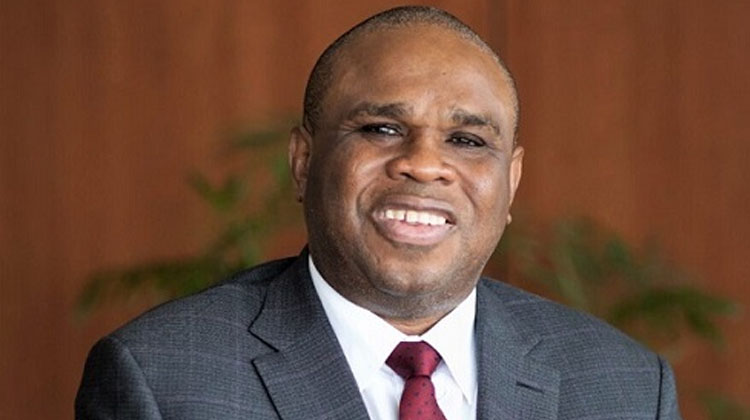
Benedict Oramah, the outgoing President of the African Export-Import Bank (Afreximbank), has been described as “the living AI of our time” for his visionary and decisive leadership that reshaped Africa’s economic resilience.
Robert Ochola, chief executive officer of Africa Nenda, made the remark during the Afreximbank Legacy Conference and Investiture held in Cairo, Egypt, where he spoke on ‘Helping Countries Adjust to Health and Economic Shocks’.
Reflecting on his early days at the Bank, Ochola drew a vivid comparison between artificial intelligence and Oramah’s human ingenuity.

“I did a small experiment,” he said. “One of the things we hear a lot about today is artificial intelligence. So, I asked ChatGPT to imagine being in 2015 and design a nine-month program focused on local currency stabilisation, rapid forex liquidity, and backstops for trade. The results were logical, but they lacked the human vision and urgency that the continent needed then. That’s why I like to say President Oramah was our living AI but with a crucial difference. He didn’t just generate solutions in minutes or hours; he conceived bold ideas, took decisive action, and inspired the courage and urgency Africa desperately needed, not just at that time, but throughout his presidency.”
Read also: Afreximbank’s Oramah reveals African Stock Exchange initiative to channel homegrown capital
Recalling the economic turbulence of 2015, Ochola said the continent was facing a crisis similar to the “lost decade” of the 1980s, when collapsing commodity prices and shrinking global demand left African nations struggling with severe liquidity shortages. “Some nations, like Sierra Leone, were left with only two trade instruments and credit lines to sustain their economies,” he said.
He explained that, unlike AI which might take nine months to devise a program, Afreximbank under Oramah had just nine weeks to act. “At my first board meeting in December 2015 in Seychelles, the President gave us only one month to forge Africa’s financial future, and we did it through what became the Countercyclical Trade Liquidity Facility, or COTRALF,” he said. “The facility provided foreign currency liquidity to central and commercial banks, enabling them to meet trade obligations at a time of crisis.”
Ochola described COTRALF as the cornerstone of innovation during Oramah’s presidency, laying the foundation for the Bank’s transformation. “When I joined, the Bank’s balance sheet was about $6 billion. Today, it stands at over thirty billion. That experience taught me powerful leadership lessons. As I like to say, ‘The mind once expanded shall never return to its original dimension.’”

He concluded by calling Oramah’s tenure Africa’s “second emancipation.” “The first was political liberation,” he said. “But this one is an economic transformation. President Oramah reminded us that the freedom fighters who won our political independence didn’t stop there they paved the way for a new struggle, the struggle for economic empowerment and prosperity. This is the legacy we celebrate today.”
Following his remarks, Gwen Mwaba, managing director of Trade Finance and Correspondent Banking at Afreximbank, spoke about the Bank’s leadership during the COVID-19 crisis through initiatives such as the Pandemic Trade Impact Mitigation Facility (PATIMFA) and the Africa Vaccine Acquisition Trust (AVAT).
Read also: Tinubu confers Oramah with Nigeria’s Second highest National honour
“My presentation today is about Afreximbank redefining Africa’s economic resilience through leadership in crisis,” Mwaba said. “Under Professor Oramah’s guidance, the Bank foresaw the need for African-led crisis response mechanisms. His philosophy has always been that African problems require African-designed solutions.”
She explained that when the COVID-19 pandemic struck, it triggered an unprecedented health, trade, and economic crisis that severely disrupted supply chains and created liquidity shortages. Under Oramah’s leadership, Afreximbank launched the three-billion-dollar PATIMFA program in 2020 to help African countries withstand the pandemic’s shocks. “The facility had three main objectives,” she said. “To support liquidity and stabilise trade, to enable the procurement of medical therapeutics and equipment, and to finance industries affected by the pandemic.”
Through the liquidity support window, Afreximbank ensured that governments and businesses could continue importing essential goods and services. “At the onset of COVID-19, there was a massive shortage of PPE and medical supplies,” Mwaba recalled. “To address this, the Bank supported the creation of the African Medical Supplies Platform, a digital marketplace that aggregated procurement orders across Africa to secure better prices and direct supply from producers, mainly in China.”
While waiting for imports, Afreximbank also financed local industries to retool their factories. “We supported garment manufacturers to switch to producing face masks and distilleries to produce sanitizers,” she said. “By the time the first vaccine doses became available, Afreximbank had already disbursed close to ten billion dollars under PATIMFA. About seventy-nine percent of this funding went to financial institutions, seventeen percent to large corporates, and around four percent to governments.”
Mwaba also described the Africa Vaccine Acquisition Trust (AVAT), established to address Africa’s vaccine access gap. “It took nearly two years after the first COVID-19 vaccine was administered in the West for African nations to begin receiving doses,” she said. “That inequity led to the creation of AVAT, which aimed to secure sufficient vaccines for herd immunity, mobilize funding for procurement, and create financing mechanisms for African and Caribbean countries.”
Under Oramah’s leadership, Afreximbank secured a two-billion-dollar financing package to procure vaccines through pooled procurement for 31 African and Caribbean nations. “We estimated that around 220 million doses would be required to reach herd immunity,” Mwaba said. “We contracted firmly with these countries to make this possible.”
She added that one of the most remarkable achievements was the creation of Africa’s first-ever No-Fault Compensation Scheme, a fund designed to compensate individuals or families in rare cases of vaccine injury or death. “It was another first for Africa and a defining moment for the continent’s health sovereignty,” she said.
Mwaba recalled a symbolic moment that captured African unity and determination: “The night the contract was signed between Johnson & Johnson, Afreximbank, and the African Vaccine Acquisition Task Team. It was close to midnight, done virtually, with Professor Oramah overseeing the signing. It was a proud moment for Africa.”
In closing, she said, “Professor Oramah’s leadership has transformed Afreximbank into a pillar of continental stability. His legacy is not only about the policies he changed but also about the lives he touched both within the Bank and across the continent. Through innovation and unity, Africa can chart its own destiny. Thank you, Professor Oramah, for your vision and courage.”
She concluded by introducing a short video excerpt from an upcoming documentary highlighting Afreximbank’s work during the pandemic and Oramah’s instrumental role in Africa’s crisis response.