In reflecting on Nigeria’s potentials and on the way forward, eight development challenges come to mind. Let us consider each of these challenges.
The first relates to the age-old question of leadership. The great English historian Arnold J. Toynbee, in his epic study of the rise and fall of world civilisations, alluded to the role of “creative individuals” in the making of great nations. Leaders do make an awful lot of difference. Leadership refers to the ability to galvanise people and to build effective teams that can accomplish great national undertakings. In our day and age, leadership requires high ability not only in terms of intellect and creativity but also in terms of courage and audacity. Leaders must also be men and women of integrity who are guided always by the precepts of virtue ethics in their private and public lives. Leaders set the goals around which great national enterprises are undertaken. They are selfless and incorruptible; leading by example.
Second, there is the question of nation building. Over the last three decades Nigerians have continued to drift apart. One of the greatest tasks of leadership in our generation is to bring our people back together as one nation with one destiny. The beauty of federalism as a philosophy of government is that ethnic nationalities are free to govern themselves and preserve their cultural autonomy while belonging to a wider national family that preserves the national interest and the common good. Through the decades of misrule and corrupt maladministration, our various nationalities have become highly alienated from the federal centre, viewing one another from the cocoon of competitive ethnicity. Religion and tribe have become rallying banners of communitarian exclusivism. Now is the time to build bridges across the frightful lines of mistrust. We need leaders who look beyond the narrow confines of tribe and religion; men and women whose passion is for Nigeria and our collective destiny as a people.
Third, we need security. Law and order is the supreme responsibility of civil government. It is the first and most primordial duty of the state. Violence and insecurity inform the daily lives of most Nigerians. Armed banditry and criminal violence have made us a byword among the nations. It is up to our generation of leadership to put a capital stop to the nihilistic violence that has made ours a quintessential anti-civilisation. I want to see a New Nigeria where everyone is at peace with everyone else. We must reverse the “Americanisation” of our society where guns are everywhere and violent homicide is a feature of everyday life. In ancient Africa, policemen and women did not exist because random nihilistic violence was rare. Strangers were welcome in their host communities, so long as they explained the nature of their visits to the local chiefs and could prove that they had a bona fide means of livelihood. In our twenty-first century, policing is a necessary aspect of civil administration. At community, state and national level, we must rid our country of gun culture and violence. We must aim to institute the culture of peace as the foundation of our national existence.
Fourth, we must re-commit to the tenets of justice and the rule of law. The history of world development shows that a prosperous democracy is possible only on the basis of the rule of law. This refers not only to enactment of just and fair laws; it also refers to government and the leadership strictly adhering to the rule of law in ordinary business of governance. Economic science shows that the advancement of nations is predicated on the construction of robust public institutions that administer a people with fairness, equity and justice. A civilised nation in today’s world is a society whereby men and women are equal under the law and justice is administered without fear and favour. It is a route we must follow if we are to achieve the great society of our dreams.
Fifth, we must address the critical question of governance. Governance has to do with the capabilities of the state to fulfil its role as the servant of the people. Mine is a vision of a servant that is far removed from the perennial Leviathan that has sucked the blood of the African people for more than a half-century. It was President Barack Obama who first reminded us that Africa needs strong states rather than strong men. I could not agree more. We need strong states that are capable of delivering those social goods that make for a better life. Good governance also requires a merit-based civil service manned by highly competent professionals who have a sense of mission and national destiny.
Linked to governance is the age-old disease of corruption. Simply defined, corruption obtains when a person uses a public office for private gain. Corruption is a sickness that afflicts all societies. The challenge for Nigeria has to do with the problem of “grand corruption”, where huge chunks of the national patrimony are haemorrhaged abroad by wicked politicians and the members of the higher civil service. Private businesspeople and transnational corporations are also part of the chain in the murky business of corruption. I agree with those who say that if we do not kill corruption, corruption will kill us. Corruption robs a society of its foundational morality. It makes nonsense of excellence while glorifying people of low degree who manage to rob the state of billions of dollars. Nigeria will never regain its standing among the councils of the family of civilised nations unless we wrestle down the monster of corruption.
Seventh, we have the challenge of innovation and human capital. Health and social development are critical to the welfare of all our citizens. We must build robust health systems that ensure access and affordability to all citizens. Wiping out illiteracy is also of paramount importance. I believe education is the key to social emancipation. Creativity is the foundation of national progress.
What makes America a great nation is its inventiveness. This entails nurturing its talents, encouraging creativity in science and technology and building world-class universities. Although recent years have seen a remarkable expansion in higher education, we are still far from where we ought to be. No Nigerian university is within the first 1,000 of the world’s great universities. Relatively less prosperous countries such as Mozambique and Senegal have universities that outclass the best of Nigeria. We still do not have a Nobel laureate in the sciences. We must invest more in our educational system. But we must re-orient our intellectual culture towards innovation, scientific invention and deploying research in tackling our manifold development challenges.
And finally, there is the need to address the massive infrastructure gap that continues to stare us in the face. In our day and age basic social services such as electricity and water are not luxuries; they the first prerequisites of a civilised existence. Every other home in most Nigerian cities rattles with smoke-filled electrical generators. It is a national shame that a great country such as ours cannot provide steady electricity to its citizens. I feel dismay and shame for my country that after nearly $20 billion that has been spent on the power sector over the last decade, we have little to show for it.
My vision is one in which we launch a war for electricity; where every city, town and village is connected to the national grid and 90 percent of our people have access to steady and affordable electricity. Linked to this is the need to revamp our parlous infrastructures and to build the highways and fast trains that link all our major cities and towns. I see inland waterways and new canals being developed so that ships can move cargo from the coastal harbours into the hinterland of our country.
All is possible in God’s great universe. And where there is a will, there will surely be a way.
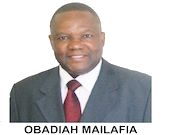
Obadiah Mailafia