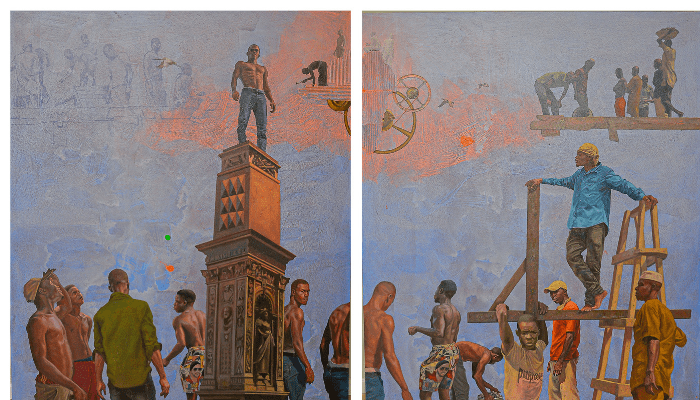
As Lagos enters into its visual art season dotted with lots of activities and exhibitions, O’DA Art Gallery is using the opportunity to present, The Ascendancy of Machine, an exhibition worth seeing.
Curated by Sunshine Alaibe, manager/curator, O’DA Art Gallery, the exhibition brings together the works of Kelani Abass (b.1979) and Olu Amoda (b.1959) at its gallery space from October 29 to November 19, 2022.
In this exhibition, both artists, although highly distinct in style and subject matter, share a common focus in which the evolution of modern and contemporary practices affect their interpretation of socio-political and environmental discourses in today’s Africa. In Kelani Abass’ work, he revisits the history and relationship between Man and Machine as it pertains to Africa’s potential in capitalizing production and industrialisation. Similarly, using repurposed objects to create his work, Olu Amoda’s sculptures intersect past and present contexts as a means to measure cultural value and encourage appropriate structural reforms in Nigeria.
In a sense, both artists call for a shift in ideals, focusing primarily on encouraging a more progressive and forward-thinking environment with machinery and technological advancements.

Following on from the artists ‘Man and Machine’ series, this seminal exhibition expands upon Kelani Abass’ exploration of the synergies between the workmanship of man and the ease of the machine. Through painting and mixed media, this body of work showcases the interplay between the manual and mechanical, influenced by the processes of industrial printing, which the artist learned from his parents’ printing press business during his formative years. From capturing the specific moments of ‘men at work’, the figures populating Abass’ canvases take viewers on a journey through the stages of labour intensive duties, welcoming scenes that go beyond the lens of realism. A mixture of superimposed figurative elements are brought to the fore as they weave in and out of earthy ochre and grey backgrounds; yet, the elements of abstraction of applied objects and mixed media do not go unnoticed.
Read also: NAFEST to spotlight Nigerian art, culture
In the Chronological Remuneration, Valour and Heroism Triptychs, the physicality of workmanship is held together by the visibility of wheels, cogs and dials. Similarly, in Chronological Remuneration, XII the gear is embedded in the centre of canvas’ foundation alluding to a need for mechanical elements beyond man’s capabilities. He explains that, “the importance of machinery in aiding manpower in today’s fast growing technological advancement” is the only way to “take advantage of the resources in our arsenal”.
A decade on, Olu Amoda’s body of work, created between 2014-2015, offers complex interpretations of the Nigerian socio-political and environmental framework. The necessity to showcase and present these is timely and these ideas still remain relevant to today’s Nigeria as she bears the same weight of poor structural reforms and dated political infrastructure; along with a reluctance to fully adapt to what is innately ‘new’. In using repurposed materials such as rusty nails, metal plates, bolts and pipes in his creations, all of which has endured and survived the detritus of consumer culture, Amoda speaks to a shared responsibility of all these materials in bringing something substantial into existence. We see this in the ‘Rotation Against Masses (Rams), 2014’ installation, which critiques the lack of political reform in Nigeria and it questions the rationale for the coexistence of the Nigerian people. Each Ram is an indication of regional areas in Nigeria and the disparity that lends itself to faulty voting systems through prideful individuals and out-dated systems. Ultimately ‘the political dispensation is the rotation against the masses’, yet Amoda states that if each element (in this case, each ram) is brought together to achieve a common goal, the outcome will always be progressive.
Beyond its metaphorical meaning, is the materiality and sculptural expression which Olu Amoda seeks to expand: “I attemptto unearth the latent energy that is trapped in discarded objects, and I refract the energy that resides in every repurposed object in my sculptures.”

Creatively, using the welding process to create his work challenges traditional modes of sculpture expression; however for Olu Amoda, it is the process itself that lends itself to new forms and possibilities. “This process, driven by forensic and archaeological inquest, brings to the fore the sculptural discourse on technological upgrade of an object and invites my audience on a collaborative journey in which process and product exist side by side.”
The life-sized structure of ‘Expectation, 2015’ created from welded bronze cast from firewood, is an indication of the possibilities created from the intricate process of welding. The artist’s intention to recreate a familiar pose of an individual awaiting a bus is brought to life in a performative and life-like manner as the references, metaphors and symbols are embodied in physical works. The dialogue between the discarded materials is a call to ingenuity and development in creating something new and living.
While both artists engage different processes, styles and mediums, their works are linked by a powerful sense of vitality and a need for change to the complexities of the African and Nigerian experience.
As such, The Ascendancy of Machine welcomes viewers to view the potential of progressive ‘work’ both physically and metaphorically by experiencing the boundless creativity of these talented artists.
The exhibition runs from October 29 – November 19, 2022 between 11am – 6pm daily at O’DA Art Gallery , located at #10 Sir Samuel Manuwa Street, Victoria Island, Lagos.