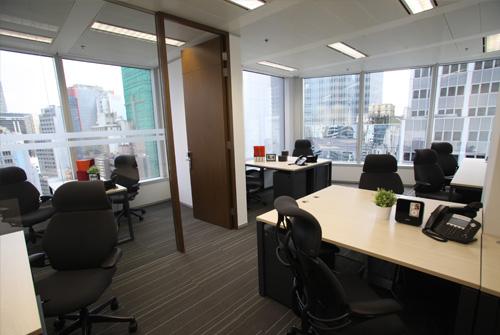
As the Nigerian property market continues to struggle following the weakening of the economy and investor confidence, the commercial office space segment is taking a bashing with an average of a 10 percent fall in rents to $750 per square metre in some locations and $900 per square metre in others.
In the last 12 months, falling investor confidence remained the general narrative for the Nigerian investor market as falling oil prices, naira volatility and general uncertainty in the policy direction of the Buhari administration have held the economy hostage within the period.
Before now, asking rents for Grade A office space, such as in the Civic Towers on Ozumba Mbadiwe, Victoria Island, Lagos, The Wings on the same location and Heritage Place in Ikoyi, among others, hovered between $1,000 and $1,110 per square metre.
Broll Nigeria in its Q4 2015 report made available exclusively to BusinessDay, says, average asking rents in Victoria Island, Lagos fell by 5 percent to US$735 per square metre per annum, indicating a 14 percent dip throughout 2015, while average asking rents in Ikoyi also fell by 6 percent to US$910 per square metre per annum, indicating a fall of 10 percent throughout the year.

In reaction to this, and as part of strategies to sustain their businesses, landlords and retail space investors are offering incentives aimed at wooing tenants and stimulating demand. These include fit out deposits, quarterly rental payments and even rent-free periods.
Nnenna Alintah, a researcher at Broll, explained that the number of firms in the oil and gas sector, who previously had the ability to take up large amounts of space had reduced and even with demand from professional and financial services firms emerging, the pockets of space they are demanding is considerably smaller.
The volume of transaction in this market segment has dropped and the small activity still taking place in there is driven mainly by relocations from Grade B space which, Alintah estimated, accounted for up to 51 percent of all transactions, adding that expansion and new entrants follow closely, accounting for 31 percent and 10 percent of the activity, respectively.
“The remaining 8 percent is driven by other factors. A tough economic and political landscape together with over 60,000 square metres of office space delivered in Lagos in 2015 put significant pressure on rental, especially in the prime segment,” she noted.
“Rental rates of US$1,000 per square metre per annum seen in 2014 are now unrealistic and a number of landlords are offering incentives, including fit out deposits, quarterly rental payments and even rent-free periods, resulting in Lagos’ prime office market becoming a tenant market,” she added.

In the last 24-36 months when investors ‘invaded’ this segment of the market in response to perceived increase in demand, there were fears that there might be an over-supply to the market.
According to one of the investors, “Everybody is still speculating building in expectation of foreign investors. The market is expecting over 200,000 square metres to be delivered.”
The investor, who does not want to be named, however pointed out that, what was happening in the market was based on perception, explaining that “most of the buildings are being built speculatively; many of them haven’t got tenants and rents may be trending downwards in order to absorb the huge supply expected in the market.”
To stay ahead of competition in a struggling market, Obi Nwogugu, head, Real Estate Investment Unit at African Capital Alliance, noted that there would be product differentiation, explaining that there were going to be differences in designs, parking spaces, energy efficiency, environmental friendliness, etc., that would differentiate one product from another.
CHUKA UROKO