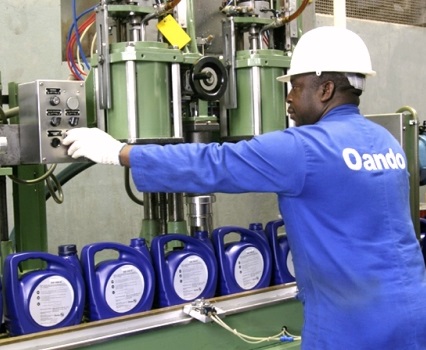
Oando Energy Resources (OER), the upstream subsidiary of Oando PLC, has hit first oil from its Qua Iboe field with a commercial production of 2,150 barrels per day (bpd) barely nine months after the completion of its landmark $1.5bn ConocoPhillips Nigeria acquisition deal.
Oando Energy Resources holds a 40 percent working interest in the field. In its capacity as technical services provider, the company, together with the operator and 60 percent owner, Network Exploration and Production Nigeria Limited (NEPN), brought the field from conceptualisation, through development, to first oil in two years, a record time for fields of this nature in Nigeria.
The commercial oil production from the field’s reservoirs has now commenced at 2,150bpd. The crude processing facility commissioned in the fourth quarter of 2014, was delayed until the completion of the associated cluster crude delivery and sales infrastructure into the Qua Iboe Terminal.
Pade Durotoye, CEO Oando Energy Resources said; “We are delighted to have achieved this milestone, having taken this field through the full cycle of asset development, from drilling to facility engineering, construction and commissioning and also increasing our organic production contribution from our portfolio.

READ ALSO: Iran, Libya make oil strides as Nigeria drags
“We will now be focusing our attention on maturing the potential of this field through seismic acquisition and interpretation, and a possible multi-well drilling programme. We hope the Qua Iboe field will follow in the footsteps of our successful Ebendo field, where production has increased from 900bopd (gross) at inception to over 7,500bopd (gross) through the identification and drilling of new reservoirs in the field”, Durotoye added.
Meanwhile, Erha deepwater development oil production is expected to add about 140,000 barrels a day (b/d) to ExxonMobil’s global production by the fourth quarter of 2017 amid local and international challenges facing the oil industry.
Deepwater expansion projects at Erha, offshore Nigeria and other projects which include Hadrian South in the Gulf of Mexico, Banyu Urip offshore Indonesia and Kizomba off Angola, would lift ExxonMobil’s global production by 2 percent in 2015 to more than 4.1 million barrels of oil equivalent per day (boe/d).
The world’s largest publicly traded oil company produced 4 million barrels oil equivalent per day (boe/d) in 2014 and it plans to ramp up to 4.3 million boe/d in 2017.

Rex Tillerson, Exxon Mobil CEO expects the price of oil to remain low over the next two years because of ample global supplies and relatively weak economic growth adding that Exxon assumed a price of $55 a barrel for global crude, which is $5 below where Brent crude currently trades on.
The price of oil plunged in the second half of 2014 when it became apparent that production was outpacing global demand. There were a number of drivers that brought about the free-fall of crude prices which included rising US tight oil production. The rise in US production last year of 1.5 million barrels per day was the third largest in the history of the global oil industry.
Other factors are slowing economic growth, particularly in China; a warm start to the North American winter; a temporary return of Libyan oil production; and OPEC’s decision at its November 2014 meeting to not function as a swing producer.
Brent crude rose above $61 a barrel last Friday, supported by geopolitical tensions in Libya and Iraq, while traders eyed the outcome of Iran nuclear talks for further trading cues.
FRANK UZUEGBUNAM