|
Getting your Trinity Audio player ready...
|
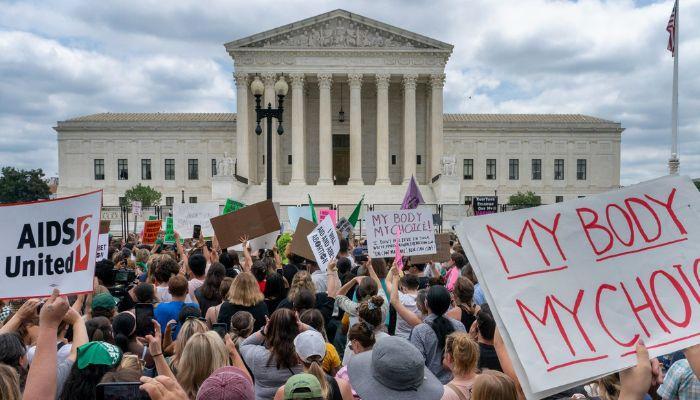
Last month, the US Supreme Court did what many expected and overturned the Roe v Wade ruling on abortion. The right to abortion has reverted to the country’s states, and almost immediately, 13 conservative states made abortion illegal.
This was no accident. The Supreme Court gave the Roe v Wade ruling on 22 January 1973, and a few weeks later on 16 February 1973, three conservatives, Paul Weyrich, Edwin Feulner and Joseph Coors came together to form the Heritage Foundation. Of the three, only Feulner is still alive. Coors died at 85 in 2003, Weyrich followed in 2008. Feulner, who will be 81 in August, will have the news of a great victory to report to his seniors when he joins them in the afterlife.
This victory, the result of patient, plodding work, was half a century in the making, and I am willing to bet my house that all three were more than willing to make it a multi-generational fight. A fight that they would not be around, like Coors and Weyrich, to see the end of.
In January 2021, the brilliant American comedian/political commentator, Bill Maher, talked about Henry Waxman, a Democratic congressman who according to Thomas Scully, a Republican congressman, “created 50 percent of America’s social safety net when no one was looking.” That’s the thing about being a workhorse rather than a showhorse. No one notices a workhorse, so it gets things done. A showhorse on the other hand…

Leaders should be visionaries or at least experienced map-readers with a clear idea of the destination but what we have in Nigeria are reactionary followers of the crowd who lead the people backwards by playing on their base desires and the outcome has been our ruinous lack of progress. This is mainly because as a people we reward appearance, not substance. We love our showhorses.
We have blamed our political class but the truth is that the political class Nigerians have is what we want by virtue of what we reward with attention, votes, and loyalty. It is one thing to verbally ask for a productive and principled political class but the actual actions of the people show the political class what actually sells.
As an example, the South and Middle-Belt regions have expressed a desire for devolution of powers and restructuring, and one would expect that after the experience of the Buhari era, much of the discussion around the 2023 campaign would revolve around practical ways to get devolution and use the freedom to improve regional governance outcomes, especially those related to economic and security goals.
This hasn’t been the case, what we have had instead have largely been debates about the ethnicity and religion of the next President, for good reason I might add because representation is very important in a diverse country such as ours, but we need to walk and chew gum at the same time.
In March, the National Assembly passed bills seeking to take responsibility for airports, electricity generation, and distribution, prisons, and railways from the Exclusive list and place them on the Concurrent List. Presidential assent has not been given but it is a huge step forward because at least it means that the legislative resistance that has been a factor for decades is melting away.

Read also: Reps push bill to raise retirement age of persons with disabilities
One would expect that Southern and Middle-Belt political conversations would strongly factor this position into discussions on the goals that should be agreed on in the light of this development and those who would be strategically useful presidential candidates and governorship candidates that could help achieve these goals. But sadly enough, hardly anything of the sort has happened.
This is why we are always going to have a much higher supply of showhorses who focus on pandering to the audience and don’t buckle down to do the hard, unglamorous work needed to deliver quality governance. Nigeria’s political marketplace is very clear on what it rewards and the politicians are going to keep trading as they are until we offer mature political followership.
Legislative competence comprises the knowledge, capacity, skill, qualification, and authority to get the constitutional amendments and oversight over the executive. The technical and character quality of candidates we put forward for this task is very important. It is important that we set clear national, regional, and state goals for legislators and ensure that the people we entrust with the responsibility have the legislative competence needed for success.
The failure to appreciate Workhorses and reward Showhorses is not a uniquely Nigerian failing to be honest, which is why I started with the American examples. The human inclination to exciting spectacle over what is productive but not very entertaining is a factor everywhere in the world albeit in varying degrees dependent on the level of political maturity of the society at the moment. But for our survival in Nigeria, we need to start identifying the workhorses and advancing them quickly
Nwanze is a partner at SBM Intelligence