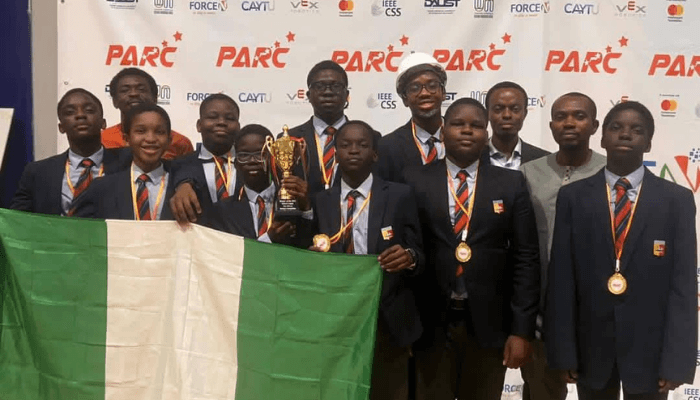
Whitesands School, a Nigerian secondary school in Lagos State, emerged first-place winners of the Makers League at the 2025 Pan African Robotics Competition (PARC).
The competition, which was held in the NBA Africa Academy in Sally, Senegal, on July 19, had participants from across the continent and one team from the United States of America.
The participants who qualified and made it to the competition were from Kenya, Uganda, Tanzania, Liberia, Madagascar, Niger, Zimbabwe, Cape Verde, Ghana, Mali, Senegal, Gambia, America, Burkina Faso, and Ivory Coast.
The Whitesands team in the 2025 PARC competition consisted of Ebube Chinedu, Michael Okpala, Edosa Odiase, Seun Abiola, Anthony Oputa, Eric Jack, Jaden Jack, Nathan Alawode, and Oluwafemi Oloyede.

The students’ achievement is memorable as the school celebrates its 25th anniversary and the official unveiling of a Robotics and AI Lab.
In the 2024 edition of the competition, the Whitesands Robotics Club won second place in the ‘Makers League’ category of PARC.
The victorious youngsters had earlier secured the second position at the 2025 national World Robotics Olympiad (WRO) on July 1, before embarking on their journey to Senegal on July 14.
Read also: Whitesands School emerges winners of Helmbridge Science Challenge 2025
The innovative student made several projects, such as a smart vacuum cleaner, a smart home and also concluded a smart solar panel project, before embarking on the journey.

They were accompanied by their coach and club patron; Chinedu Ernest and Barry Josiah whose passion, dedication, guidance, and mentorship played a crucial role in the team’s success.
The Staff of Projectcage Technology were also instrumental in providing the technical training the boys received.
The Whitesands School Robotics team’s achievement at the 2025 PARC is a testament to their hard work, creativity, and teamwork.
The school’s commitment to fostering an environment that nurtures technological innovation and ethical use of technology promises a bright future for its students and the broader community.
This year, the school was given the VEX IQ kit. This would be very useful in preparing for future competitions in the TECH League category.
The Whitesands’ SMART HELMET aims at enhancing the health, safety and rate of emergency response of workers in factories, the construction industry and mining.
The helmet could be used to detect air quality, environmental temperature, physical impact, heart rate, worker temperature, danger zone, location and other vital data of a worker during work hours.
All this data is sent to a Central Monitoring System (CMS), which is a desktop application that stores data transferred from the smart helmet.
The project gained recognition because it provided real-time notification and analytics to aid informed decisions about the health and safety of workers. It could also reduce the cost incurred annually for worker health and safety.
The project of the Whitesands team addressed SDGs 3, 8, and 9, which are: Good Health and Well-being, Decent Work and Economic Growth, and Industry, Innovation and Infrastructure.
The project’s success underscores the importance of engaging students in STEAM fields and encouraging technological advancements with practical applications.
The institution’s vision is to produce well-rounded, intellectually competent, morally upright, and socially responsible individuals.
Its mission is to provide an educational environment that promotes academic excellence, character development, and leadership skills.
Read also: 2025 UTME: Whitesands School celebrates over 40% students’ score, over 300
Sidy Ndao, the founder of PARC, emphasised that the competition aims to foster a culture of innovation, creativity, and technological advancement among African youth.
By providing a platform for students to showcase their skills and collaborate with peers from different countries.
“PARC seeks to empower the next generation of African leaders in STEM fields, driving sustainable development and positioning Africa as a global leader in technological innovation. The 2025 Pan African Robotics Competition celebrated collaboration, innovation, and the resilient potential of Africa’s youth,” Ndao said.
This year’s theme, “The Future is Now”, challenged participants to develop technological innovations that propel the African continent into the 5th Industrial Revolution.
Today, the largest robotics competition in Africa, PARC, has educated 2500 African youth in STEM over the past six years. Beginning with seven West African countries, the competition has rapidly expanded to include participants from 37 countries across Africa and its diaspora.
“The best part about PARC is seeing the enjoyment and satisfaction on the faces of young people as they not only solve problems, but in doing so realise that they can break social and economic stereotypes, and open new possibilities of learning and prosperity for their lives,” Ndao noted.