



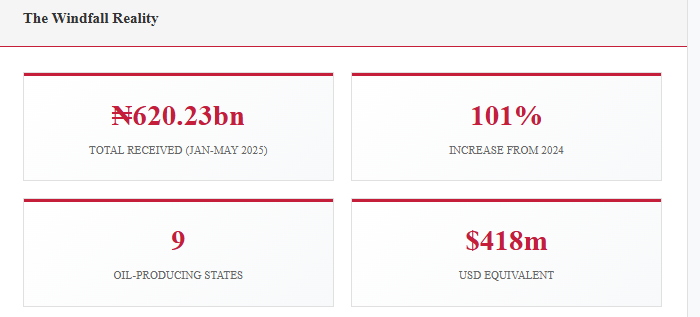
Nigeria’s oil-producing states have received an unexpected gift that could prove either transformative or catastrophic. Between January and May 2025, these nine states collected N620.23bn ($418m) in derivation payments—more than double the N308.19bn received during the same period last year. The windfall, driven by higher oil prices and improved remittances from the Nigerian National Petroleum Company, represents a 101 per cent increase that should be cause for celebration. Instead, it demands urgent introspection.

The Geography of Abundance
The distribution follows predictable patterns. Delta State leads with ₦185.16bn, followed by Bayelsa (₦130.21bn), Akwa Ibom (₦124.79bn), and Rivers (₦114.06bn). These four Niger Delta states capture nearly 90 per cent of all payments, while Edo, Ondo, Imo, Abia, and Anambra share the remainder. For states grappling with mounting debt and limited internal revenue, these sums represent unprecedented fiscal space. Yet history suggests caution. The Niger Delta has received hundreds of billions in derivation payments since 1999, when the 13 per cent constitutional provision took effect. The results have been disappointing. Despite this largesse, the region remains trapped in a paradox of wealth and poverty that would be comical if it were not so tragic. Port Harcourt’s soot-blackened skies, Bayelsa’s flood-ravaged communities, and Delta’s crumbling schools tell a story of squandered opportunity that this latest windfall threatens to repeat.


The Curse of Easy Money
The fundamental problem is not lack of money but absence of vision. Nigeria’s oil states have treated derivation payments as political slush funds rather than development capital. Recurrent expenditure consumes outsized portions of budgets, leaving little for infrastructure. Contracts are awarded to cronies at inflated costs, with projects either abandoned or executed with substandard materials. The concept of long-term economic planning appears alien to political leaderships more focused on electoral cycles than generational transformation.
Global Lessons in Resource Management
This pattern reflects deeper governance failures that oil wealth has actually exacerbated. When governments can fund themselves through resource rents rather than taxation, the social contract between state and citizen becomes attenuated. Citizens lose leverage over their leaders, while politicians lose incentives to deliver public goods efficiently. The result is a rentier state model that Norway’s sovereign wealth fund was specifically designed to avoid. The current surge in derivation payments stems from specific global and domestic factors that underscore both the opportunities and risks ahead. Internationally, geopolitical tensions and post-pandemic recovery have supported oil prices above $80 per barrel. Domestically, the removal of petrol subsidies and foreign exchange liberalisation under President Bola Tinubu has increased both dollar inflows and their naira conversion rates. These are largely temporary factors that could reverse quickly, making prudent management essential.

The Development Paradox
The temptation will be to treat this windfall as permanent income and increase spending accordingly. Previous oil booms in the 1970s, early 2000s, and 2010s followed precisely this pattern, with windfall revenues encouraging both increased expenditure and borrowing. When prices inevitably fell, painful fiscal adjustments followed. The current boom offers an opportunity to break this cycle, but only if state governments resist familiar temptations. International best practice suggests that resource-rich jurisdictions should save substantial portions of windfall revenues while focusing spending on investments in human capital, infrastructure, and institutional capacity. Alaska’s Permanent Fund Dividend distributes oil revenues directly to citizens while preserving capital for future generations. Botswana’s sovereign wealth fund has helped transform the country from one of the world’s poorest to an upper-middle-income economy. Norway’s Government Pension Fund Global, worth over $1.6tn, insulates the domestic economy from oil price volatility while preserving wealth for post-petroleum generations.
The Energy Transition Imperative
Nigeria’s oil states have adopted none of these approaches. Instead, they have spent derivation payments as quickly as received, often on consumption rather than investment. The results speak for themselves: despite receiving derivation payments worth over ₦6.5tn between 1999 and 2022, according to the Nigeria Extractive Industries Transparency Initiative, the Niger Delta remains one of Nigeria’s most underdeveloped regions. The development paradox extends beyond simple mismanagement to encompass deeper structural challenges. Oil extraction has imposed enormous environmental costs on the region, including land degradation, water pollution, and ecosystem destruction that offset economic benefits. Traditional livelihoods in fishing and agriculture have been disrupted, creating dependency on oil revenues that may not last. Climate change and the global energy transition add urgency to these challenges, as international demand for fossil fuels will eventually decline.
For this windfall to yield different results, fundamental changes in governance and economic strategy are required. States must establish transparent mechanisms for tracking derivation fund usage, with quarterly reports published online and subjected to independent audit. Participatory budgeting processes should involve communities in deciding how funds are allocated. A substantial portion should be saved in stabilisation funds to smooth expenditure during inevitable downturns.More importantly, spending should focus relentlessly on building post-oil economic foundations. This means massive investments in education and healthcare to develop human capital. It requires infrastructure projects that support economic diversification rather than just political visibility. It demands creating special economic zones and industrial parks that can attract private investment and generate sustainable employment.
The environmental imperative cannot be ignored. States should use derivation windfalls to invest in renewable energy infrastructure, environmental remediation, and sustainable agriculture. The Dutch government’s decision to end natural gas extraction in Groningen Province, despite economic costs, illustrates how environmental considerations increasingly constrain resource extraction globally. Nigeria’s oil states must prepare for similar constraints. The concentration of derivation payments in a few states also raises questions about regional equity and national cohesion. While the constitutional principle reflects legitimate compensation for environmental costs, it creates fiscal disparities that can undermine national unity. Lagos State, Nigeria’s commercial centre, receives no derivation payments despite hosting oil company headquarters and refineries, while Bayelsa, with a fraction of Lagos’s population, received ₦130.21bn.
Perhaps most critically, the current windfall arrives as Nigeria’s oil production faces long-term decline. Aging infrastructure, security challenges, and underinvestment have reduced production capacity significantly. Global energy transition will eventually reduce demand for Nigerian crude, particularly as major importers implement net-zero commitments. The current windfall may represent one of the last opportunities for oil states to use petroleum revenues for economic transformation.
The stakes extend beyond the Niger Delta to Nigeria’s broader democratic project. Regional inequality has fueled separatist sentiment and undermined national cohesion. If oil states continue to squander their advantages while other regions struggle with limited resources, the resulting tensions could threaten Nigeria’s stability. Conversely, successful transformation of the Niger Delta could provide a model for resource-led development that benefits the entire country.

For Nigeria’s private sector, the current moment presents both opportunities and warnings. Increased state spending may create business opportunities, but the volatility of oil revenues makes diversification beyond government-dependent sectors essential. The experience of companies operating in resource-dependent economies worldwide suggests that sustainable success requires building capabilities that transcend commodity cycles. The ultimate test of leadership in Nigeria’s oil states will be whether they can resist the siren call of windfall spending and instead use this abundance to build lasting foundations for prosperity. This requires political courage to save rather than spend, vision to invest in transformation rather than consumption, and institutional capacity to ensure resources reach intended beneficiaries rather than disappearing into familiar channels of patronage and corruption.
The ₦620.23bn question facing Nigeria’s oil states is not how to spend this windfall, but how to use it to ensure they never again depend entirely on such windfalls for their prosperity. History suggests that this will be their greatest challenge yet. The consequences of failure, however, may be their last.





