|
Getting your Trinity Audio player ready...
|
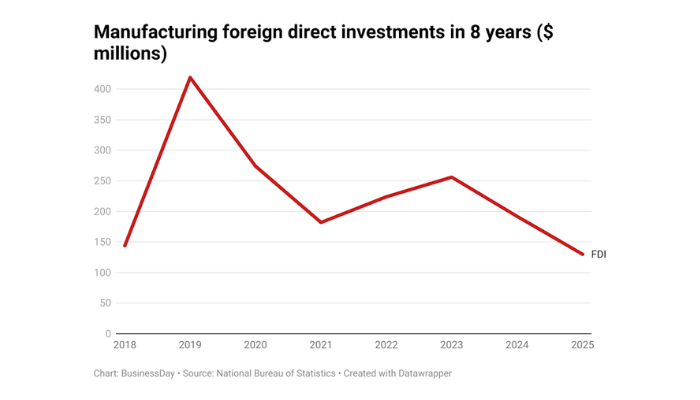
Nigeria’s capital importation into the manufacturing sector has dipped to its lowest level since 2017 despite foreign exchange stability, data from the National Bureau of Statistics (NBS) shows.
Foreign investments into the sector declined by 10 percent in eight years from $144.09 percent in the first quarter of 2018 to $129.9 million in the same quarter of 2025.
On a quarter on quarter basis, it plunged deeper by 69 percent from $421 million in the fourth quarter of 2024 to $129.9 million in the first quarter of 2025. This decline occurred despite the country recording a surge in overall foreign direct investments for the period.
Read also: FX stability lifts manufacturing’s GDP contribution in first quarter

Manufacturers attribute this sharp decline to the worsening business environment in the country, saying that the decline raises questions about investors’ sentiment towards the sector.
They added that the country’s huge infrastructure gaps are also increasing the burden of doing business in Africa’s most populous country.
“The decline is as a result of the worsening business environment in the country,” said Frank Ike Onyebu, former chairman of Manufacturers Association of Nigeria (MAN), Apapa branch.
Onyebu noted that despite the stability in the foreign exchange market, which has brought some form of respite for manufacturers, all other costs of operation have continued to surge.
“The government just introduced the four percent free on board (FoB) charge after suspending it, in addition to increasing costs of power, inputs and logistics,” he said

“All these are stifling the country’s manufacturing and business environment,” he noted.
Read also: Cutting-edge technologies seen driving sustainable manufacturing in Nigeria
According to him, the country needs a conducive business environment and deliberate policies to attract more foreign direct investments into the manufacturing sector.
He urged the government to work with the manufacturer association to enact policies for the sector, saying that the country needs lots of jobs from the sector to drive sustainable growth.
The availability of adequate infrastructure is a major determinant of the success of every country’s industrial sector.
However, Nigeria lacks the necessary infrastructure needed to grow businesses, especially developed transport systems such as roads and rail that are connected to the nation’s seaports.
Also, energy is a key element of the production process. Nigeria’s inability to supply and distribute sufficient electricity has left businesses at the mercy of generators that consume diesel and petrol.
Manufacturers spend 40 percent of their total production cost on generating energy for their businesses, according to MAN.
Read also: Nigeria below regional peers as manufacturing accounts for just 12.7% of GDP – Minister
According to MAN 2024 second-half -half economic review report, the electricity supply situation for industries improved in 2024, with the average daily supply increasing to 13.3 hours per day, up from 10.6 hours in 2023.
On a half-on-half basis, electricity supply rose from 11.4 hours per day in H1 2024 to 15.2 hours in H2 2024.
However, electricity tariffs surged by over 200 percent for Band A consumers, significantly increasing manufacturing costs.
While power availability improved, many manufacturers still faced frequent outages and costs, as the country witnessed 12 national grid collapses and this remained a major concern, the report said.