|
Getting your Trinity Audio player ready...
|
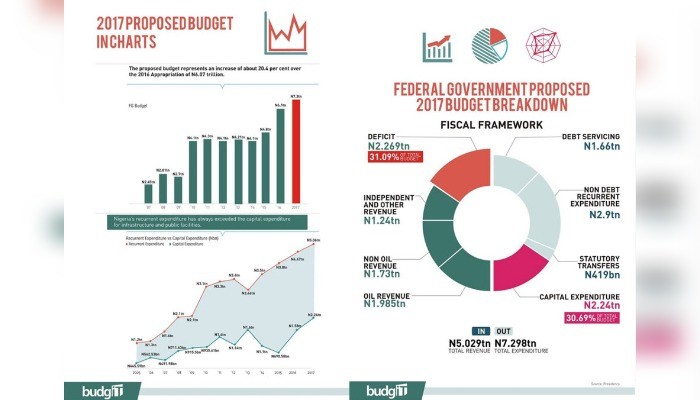
For the third consecutive year, President Muhammadu Buhari is putting out a very ambitious budget when compared to the previous year, even though in each of the last three years, the budget has not lived up expectation. President Buhari on November 7 announced plans to spend N8.6 trillion in 2018. This is 15.5% higher than the N7.4 trillion budget in 2017 and 42 per cent higher than the N6.06 trillion budgeted for 2016. Basically, the government has increased its expenditure plans in each of the last three years.
A comparative analysis of the 2017 and the 2018 proposed budget gives an idea of where extra expenditure is going into. Two key expenditure items have short up in the 2018 budget. These are non-debt recurrent expenditure and debt service. Non-debt recurrent expenditure in 2018 is expected to hit N3.5 trillion, about N500 billion higher than the N2.98 trillion proposed in 2017.
READ ALSO: As recession bites, Nigerians hold 2021 budget to critical scrutiny
On the other hand, debt service is projected to hit approximately N2 trillion which is about N300 billion higher than the N1.7 trillion budgeted for similar expenditure in 2017. These two expenditure items have therefore shut up by approximately N800 billion in the last one year. It must be noted that these two expenditure items are usually non-negotiable expenditure items. The non-debt recurrent expenditure, which is mainly composed of salaries and overheads has been traditionally cash-backed 100 per cent while debt service is also always cash-backed 100 per cent since the government cannot afford to default on its debts.

Combined, non-debt recurrent expenditure and debt service stand at N5.5 trillion in 2018, which is higher than the country’s total budget is 2015, the year President Buhari became President. The country’s total budget in 2015 was N4.4 trillion of which N2.6 trillion was earmarked for non-debt recurrent expenditure, and N943 billion for debt service. This basically means that between 2015 and 2018, the country has added a cumulative N2 trillion to its recurrent and debt service bill.
The significant increase in recurrent and debt service should be of concern to the government and Nigerians considering that these expenditure lines are always cash-backed usually at the expense of capital expenditure. It must be noted that recurrent expenditure has shut up, even when the government is yet to negotiate new minimum wage demand from Labour unions.
This means that when and if the government finally comes around to agreeing to new minimum wages for labour, which is already overdue, personnel cost and consequently, the recurrent expenditure would balloon even further. The last minimum wage increase in 2010 had a significant impact on Nigeria’s budget and contribute largely to the country rising debt profile from 2010 to 2014.
President Buhari in his budget speech admitted as much that a big chunk of the recurrent expenditure will go into payment of salaries and overheads. He also disclosed that personal cost will rise by 12 per cent in 2018 but said that the government is putting an embargo on future recruitment. But this is already like shutting the door after the horse has bolted. At a time, the country was supposed to put a cap on recurrent expenditure, we have actually added about a trillion more even before we agree on a wage increase.
The outlook for debt service is also not looking good and looks set to keep rising. The 2018 budget is projecting non-oil revenues of N4.2 trillion. This is about N1.2 trillion more than the N2.955trillion that the government projected from non-oil revenues in 2017. President Buhari admits that non-oil revenue projections for the 2017 budget were not met, so it is bit ambitious to hope that the projections will be met in 2018.

READ ALSO: Senate demands BPP’s records of projects valued in 2020
The fact is that in the last three years, the government has never been able to meet its revenue projection targets for non-oil revenues. To now think that it would happen in 2018 is a bit far fetched. But projected oil revenues of N2.4 trillion is likely to be met, and maybe even surpassed considering that crude oil prices are well above the US$45 benchmark used in the budget and crude oil production has also been quite healthy, hitting a 12-month high of two million barrels per day in August.
If the Niger Delta Avengers are kept away from Nigeria’s oil assets in the whole of 2018 and OPEC keeps a lid on production, oil prices are likely to remain in the high US$50s and keep Nigeria’s oil revenues healthy enough to perhaps pluck some of the holes that could open up by not meeting non-oil revenue targets. Nonetheless, the government is expected to surpass its planned borrowing of N1.6 trillion as it has always done in the last three years. This means we could see debt service expanding further in 2019. Capital expenditure at the end of the day suffers in the face of rising debt service and recurrent expenditure.
The 2018 budget shows that capital expenditure is lagging once again. Total capital expenditure planned for 2018 is N2.44 trillion, only about N200 billion higher than the N2.2 trillion that was planned for 2017. It must be noted that of the N2.2 trillion planned capital spending in 2017, only N450 billion or 20 per cent has been cash-backed so far. President Buhari promised that efforts will be made to raise this to about 50 per cent by the end of the year. To achieve this, the ministry of finance would have to release additional cash of about N650 billion before December. This is most unlikely. The best bet is that by March, which is the earliest date that the 2018 budget is likely to be signed into law, that 50 per cent target would be met. That will bring total capital expenditure to about N1.1 trillion, N100 billion less than the N1.2 trillion released in 2016. In real terms, this is equivalent to the county’s proposed capital expenditure in 2015 in dollar terms at an average spend of US$3.9 billion. Capital expenditure has not changed in three years running while recurrent expenditure has ballooned in the same period.
Anthony Osae-Brown