



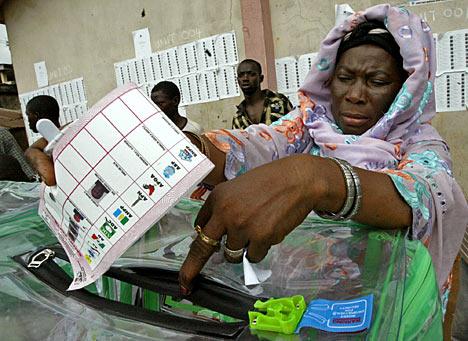
Nigerians have expressed confidence that the general elections beginning with the presidential, on Saturday, March 28, will be largely credible.
Part of the reasons for their optimism is that neither the ruling People’s Democratic Party (PDP) nor the All Progressives Congress (APC) appears to have won Attahiru Jega, chairman, Independent National Electoral Commission (INEC) to its side.
According to them, “Jega is likely going into the exercise with an independent mind.”
Speaking with BusinessDay, a highly credible source from a coalition of civil society organisation who craved anonymity, said that from the group’s independent investigations, it appeared that the 2015 elections would be largely different from others since 1999.

According to him, “politicians appear to be confused about what to do with the card readers or how to manipulate the technology. Everybody seems to be watching to see how the new introduction will work out, especially now that INEC insists it is either card reader or nothing else. So, there’s no way to manipulate the process from that end. We are very optimistic about that.”
READ ALSO: In Nigeria, ‘business as usual’ signals the beginning of the end
The source, who also said his group was working toward seeing how to monitor the collation centres, said they were not so much worried about what could happen at the polling units.
“Our major concern now is how people can get involved to help in building integrity in the results that will be declared after the election. We are not so much bothered about what happens at the polling units because INEC has directed voters to stay around until the votes are counted. Our worries are the collation centres where the voters will not be around; when the votes are going to be moved from the ward level to the local government level and then to the state level where some other people will be involved. That is our fear,” the source said.
Itse Sagay, a professor of Law, human rights activist and constitutional law expert; and Festus Keyamo, a lawyer and human rights activist, share the same sentiment.

Expressing confidence in the innovation introduced by the INEC, Sagay, said it would shut out people from trying to manipulate.
“Professor Jega has told us that once you get to the polling unit, you present yourself for accreditation and you leave until the voting time. Everybody will go through the same process including the politicians. I know that you can’t put anything beyond the ingenuity of Nigerians, but I am confident that there will be no manipulations,” he said.
On the INEC preparations, the senior advocate of Nigeria (SAN) and former dean of the Faculty of Law, University of Benin, said: “I think the card reader makes the credibility of INEC much higher. I am quite satisfied with INEC preparations.”
By the same token, Keyamo, said the 2015 election was going to be the only credible poll since the return of Nigeria to civil rule.
“Let me say that anybody who tries to circumvent the use of the card reader will be putting the chances of their candidates in jeopardy. I expect about 75 to 80 percent success by Saturday. Jega said that wherever an error is detected, election could be shifted there. It is better to have a scattered election and get it right than trying to have it all at the same time and achieve nothing,” Keyamo explained.
According to him, “We have never had any election since 1999. This is the only time a legitimate government will emerge through a credible electoral process. I wonder why people are afraid. They should understand that it is in their own interest that things are done right. I think they are not comfortable with the whole thing, because it puts the opposition on equal footing with them. In the past, everything was skewed in favour of the party in power without giving the opposition a chance.”
It would be recalled that the INEC had come up with a technology which has been used elsewhere in the world. The card reader, which has since become an object of controversy, is introduced for the purpose of accreditation- to ensure that people do not vote with cloned permanent voters cards (PVCs).
Zebulon Agomuo



