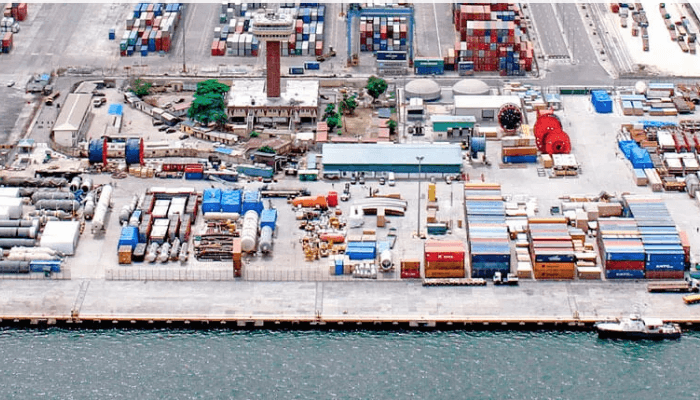
The Sea Empowerment and Research Center (SEREC) says Nigeria’s seaports are lagging behind key regional competitors, with longer cargo dwell time and vessel turnaround compared to Lome and Tema seaports.
Eugene Nweke, Head of Research at SEREC, made this observation at the centre’s 2025 Maritime Outlook communiqué issued on Tuesday in Abuja.
The News Agency of Nigeria (NAN) reports that Tema is a major port city and an industrial hub in southeastern Ghana, while Lomé Port serves as Togo’s principal deep-sea port and a critical trans-shipment centre in the sub-region.
Both Tema and Lomé ports are located on the Gulf of Guinea and ranked among the key maritime hubs driving trade and logistics across West Africa.

Assessing Nigeria’s port performance for 2025, SEREC in the communiqué observed that ship calls into Nigerian ports remained largely flat with modest improvements in turnaround time linked to reduced truck congestion in Lagos ports.
It said that despite truck-time reduction, Nigerian ports still trailed behind regional peers with average vessel turnaround of five to seven days, compared to two to three days in Lome and three to four days in Tema.
The communiqué noted that average cargo dwell time in Nigerian ports remained between 10 and 18 days, far above Lome and Tema’s seven to 10 days and global best practice of three to five days.
“We observed that the prolonged dwell time is due to multiple agency inspections, documentation duplication and partial automation which continue to erode Nigeria’s port competitiveness.
“However, truck turnaround time improved significantly in 2025 to 24 to 48 hours in controlled corridors, though call-up system costs and logistics charges remain higher than regional averages.

“Amidst the port’s systemic challenges, port security remained stable with zero piracy incidents recorded within Nigeria’s maritime domain, reinforcing improved compliance with international maritime security standards,” it said.
The communiqué noted that Nigeria has one of the highest port business costs in West Africa, driven by arbitrary charges, high terminal handling fees and overlapping levies which should be addressed to attract foreign lines.
According to it, these high costs necessitate the accelerated cargo diversion to neighbouring ports, further weakening Nigeria’s trans-shipment potential and regional dominance.
It, therefore, called for cost reduction, consolidation of automation, FX stability, and intermodal transport integration in 2026 as critical elements to improving port competitiveness.
The communiqué added that Nigeria must urgently convert policy intentions into measurable performance outcomes to reclaim its maritime position in the sub-region and strengthen investor confidence.
“Nigeria must consolidate port automation, the National Single Window, as well as the Foreign Exchange (FX) stability for trade predictability and reduction in port costs and arbitrary charges.
“She should also encourage functional intermodal transport integration, clear operationalisation of port economic regulation and sustained maritime security gains.
“The government must continue to support export growth which recorded double-digit percentage increases in non-oil segments in 2025,” it said.
According to the communiqué, the maritime sector neither collapsed nor transformed dramatically in 2025 but underwent recalibration amid policy realignment.
However, it said, early-stage reforms and macroeconomic pressures affected trade volumes and investor confidence.
It, therefore, called for stability in foreign exchange, and steady port modernisation efforts.
These, it said, would sustain port development and automation which had remained highly articulated but weakly implemented.
“A steady modernisation, especially digitalisation, will ease Nigeria from operating over 15 separate trade platforms that lack interoperability and eliminate heavy human interface in cargo clearance processes.
“Human contact still accounts for about 60 per cent to 70 per cent of clearance touch points, compared with less than 30 per cent in leading regional ports, undermining efficiency and transparency,” it said.
The communiqué, however, acknowledged notable structural gains, including the wider deployment of scanners, expansion of the Authorized Economic Operator programme, adoption of geo-spatial surveillance, and strengthening of the post-clearance audit system.
It urged that these achievements be sustained and further consolidated to enhance efficiency, transparency, and competitiveness across Nigerian seaports.
It reiterated the commitment of the research center to objective, constructive and evidence-based analysis to support the global competitiveness of Nigeria’s maritime sector.