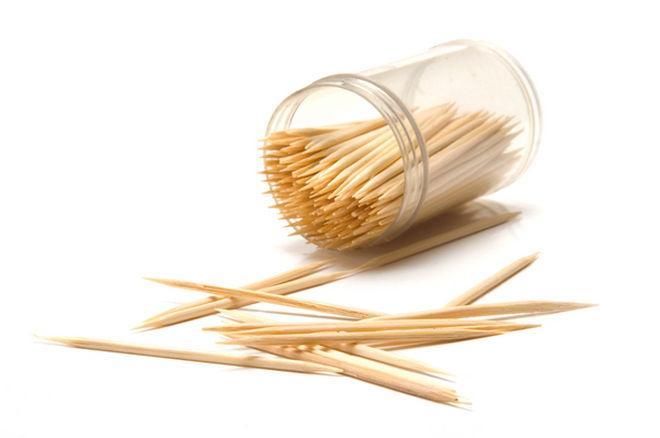
“Next time you have meat or fish stuck in your teeth, you don’t have to struggle or bear it till you get home. You can take your Baton Nigeria toothpicks everywhere you go, and it won’t look out of place,” says OWPPiN, an indigenous company focused on the production of wood-derived branded products in Nigeria.
Among other things, OWPPiN is locally producing and packaging toothpicks in such a way that it sits comfortably in your bag, work table, dining table, car dashboard, or any other place.
Until recently, Africa’s largest economy relied on importation of toothpicks manufactured and packaged in other countries. According to reports by Africa facts zone, Nigeria imports toothpicks when it has bamboos, starch when it is largest cassava producer, and tomatoes when it has a tomato base.
This is even as the Federal Government set 2020 as the year for local production of pencils to stem the tide of importation. But OWPPiN and other local firms have beaten the Federal Government to it and are fast changing that narrative.
“The Baton Nigeria processing passes through high levels of quality control to ensure the finished product has no defects,” the company said in a series of tweets via its Twitter handle.
“At Baton, we have taken all these into consideration and have created a brand that is focused on quality. Sometimes the packaging is unattractive or simply inadequate for transportation, sale and/or consumption. A lot of toothpicks in the market today are produced with defects – like inadequate information and fungal decay,” it explained.
Our research shows that while Baton produces toothpicks in Lagos, another firm, Pemo Groups, has also been producing toothpicks from bamboo in Edo State.
“Through Taiwanese technology, we have been able to bring in machines that made us to produce toothpick at Anegbette in Edo State. Presently, we are unable to meet the local demand of toothpick not to think of exporting our products. I only service Lagos and Kaduna and I have not been able to meet their demands,” John Yacim, Pemo Group’s group head, business development, said in an interview in 2014.
“The Bank of Industry has come and they indicated interest to help me expand my machinery so that I can produce more toothpicks for the country. With the expansion, it will create more employment and conserve foreign exchange by stopping importation of toothpicks. We have about seven product lines. They did not come in one day. We have the toothpick, chopstick, window blinds, furniture, floor tiles based on customer’s demand and requirement,” he said.
In 2016 when the National Directorate of Employment (NDE) commissioned the first toothpick and pencil making factory in Akure, the minister of Agriculture and Rural Development, Audu Ogbe, quoting a Central Bank of Nigeria (CBN) report, said the country spends over $18 million annually on importation of toothpicks.
Just recently, the Akwa Ibom State government flagged off a pencil and toothpick factory in the state as part of an industrialisation drive under the Akwa Ibom Enterprise and Employment Scheme (AKEES).
Nsisiong Umoh, administrative and utility manager of the state-owned factory, said although the factory is currently on a test-run with a staff strength of over 60, all drawn from AKEES database, it has been producing for two months now.
According to her, the factory currently produces about 4,000 to 5,000 pencils per day, 25,000 per week, and 100,000 per month, adding that although the factory is yet to start selling its products, many companies have indicated interest to act as their marketers/distributors.
According to her, the factory currently produces about 4,000 to 5,000 pencils per day, 25,000 per week, and 100,000 per month, adding that although the factory is yet to start selling its products, many companies have indicated interest to act as their marketers/distributors.
Umoh said the pencil and toothpick factory has received orders from the Sokoto State government to supply 144,000 pencils every three months.
“We all know the Nigerian economy needs to fully transition from an import-dependent to an export-driven one. Nigeria’s over-reliance on oil and resulting pressure of its price decline has placed a strain on our FX reserves. Because of this strain, access to FX is reduced, making demand high and causing inflation. One way to reduce this is to locally manufacture some of these things we import. When this is done, we not only reduce demand for foreign currency, but we create jobs locally,” OWPPiN said on Twitter.
“This ensures the value of the naira improves, people get jobs, and the government generates tax revenues. In summary, we need more establishments to make consumable products locally. When these products are locally made, we need Nigerians to patronise them. But should Nigerians patronise made-in-Nigeria products simply because they are made locally? We do not think so. While we want people to patronise made-in-Nigeria, quality must never be compromised,” it explained.
With what these firms and several others have started, all geared towards promoting made-in-Nigeria goods, it is becoming clear that former President Olusegun Obasanjo was right when he said that God has no hands in the myriad of problems facing Nigeria.
While chairing the 38th Kaduna International Trade Fair seminar with the theme ‘Promoting Public Private Partnership as Panacea for Accelerated Growth and Development’, Obasanjo had asked Nigerians to stop blaming God for the nation’s problems. He had also identified inconsistency in policies as one of the factors affecting the country.
“I banned importation of toothpick in 1977, because it was the most stupid thing to import when we can produce it here. But about 40 years after, one of the presidents that came after me, I won’t mention his name, unbanned toothpick. Then, I put on my Babariga and went to Abuja to express my shock about the policy, but to my greatest surprise, the president told me he signed the document unbanning toothpick without reading it. Until we get the right leadership, the problem will continue,” he said.
But there is no record to show that after the ban in 1977, any company set up toothpick production to meet the needs of Nigerians, or maybe alternatives were used by many.
Obasanjo also emphasised that lack of synergy in public-private sectors was responsible for the setback in the nation’s economy and growth, stating that both must work together to accelerate growth and development.
During the commissioning of the NDE pencil and toothpick company in Akure, Kunle Obayan, director-general, NDE, said the country spends millions of dollars annually in the importation of toothpicks and pencils.
“The Central Bank of Nigeria no longer provides foreign exchange for the importation of toothpicks. Therefore, the viability of this project is not in doubt,” he said.
With initiatives like this and government’s new drive to support and encourage entrepreneurship and industry, analysts say the country is on the right path, though more needs to be done.