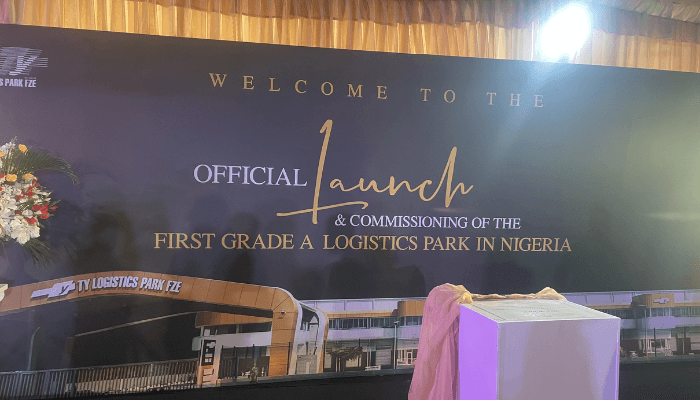
Nigeria has taken a significant step toward establishing itself as West Africa’s logistics gateway with the commissioning of the region’s first Grade-A warehousing facility, a development that could reshape trade flows across a market valued at $11 billion.
TY Logistics Park FZE officially opened its 29,000-square-meter flagship facility in the Lekki Free Zone on Monday, introducing international-standard contract logistics capabilities to a region long hampered by supply chain inefficiencies that cost businesses millions in delays and inventory losses annually.
The facility, strategically positioned adjacent to the Lekki Deep Sea Port and near a planned international airport, represents a shift in how goods move through West Africa’s largest economy.
With capacity for over 45,000 pallet positions and a fully automated Warehouse Management System promising 99.99 percent inventory accuracy, the park aims to address bottlenecks that have historically made Nigeria a challenging operating environment for multinational corporations.

“This is a purpose-built platform that solves long-standing supply chain inefficiencies and positions Nigeria as a competitive hub for regional trade,” said Theo Danjuma Jr., Chairman of TY Logistics Park, at the commissioning ceremony attended by government officials and industry leaders.
The facility’s launch comes as Nigeria seeks to capitalize on the African Continental Free Trade Area agreement and position the Lekki corridor as a manufacturing and distribution nucleus.
Babajide Sanwo-Olu, governor of Lagos state speaking at the event, emphasised the state’s commitment to private-sector-led industrial expansion, noting that infrastructure like TY Park strengthens the investment case for the broader Lekki axis.
Read also: Lekki free zone and Lagos’ economic potential
The timing also aligns with growing pressure on businesses operating across West Africa to modernize their logistics networks. Regional supply chains have traditionally relied on fragmented, non-standardised warehousing that lacks the technology and compliance frameworks required by sectors such as pharmaceuticals, electronics, and fast-moving consumer goods.

Arno van der Merwe, managing director of TY Logistics Park FZE, framed the problem in economic terms. “Every hour lost to poor logistics is a cost to businesses,” he said. “This facility was built to eliminate those inefficiencies by providing a reliable, centralized, systems-driven logistics engine for Nigeria and the region.”
The park’s infrastructure includes sector-specific standard operating procedures covering FMCG, pharmaceuticals, retail, electronics, and agriculture, alongside services such as cross-docking, pick-and-pack operations, and import-export processing within the Free Zone framework.
Environmental considerations are integrated into the design, with solar-ready infrastructure, EDGE certification, and electric material handling equipment forming part of the operational model, an approach aligned with increasing corporate sustainability mandates.
Stephen Jennings, founder and group CEO of Rendeavour, which developed the surrounding Alaro City industrial ecosystem, highlighted how integrated industrial and residential zones enhance Nigeria’s competitiveness for foreign direct investment in manufacturing and logistics.
West Africa’s logistics sector has attracted growing interest from investors and operators seeking to serve markets across Nigeria, Ghana, Ivory Coast, and neighboring economies.
However, the gap between demand for modern facilities and available supply has remained pronounced, particularly for operations requiring cold chain capabilities, pharmaceutical-grade storage, or technology-enabled inventory management.
The $11 billion addressable market that TY Park is targeting reflects the combined value of warehousing, distribution, and contract logistics services across the region, a figure expected to grow as e-commerce expands and manufacturers seek regional consolidation points.
Client onboarding is already underway, according to company officials, with full commercial operations set to begin in the coming weeks.
The facility’s performance will likely be watched closely by other logistics operators and investors evaluating Nigeria’s viability as a regional distribution hub.
The launch included demonstrations of the park’s digital operations suite and end-to-end contract logistics capabilities, showcasing systems designed to provide real-time visibility and audit-ready documentation, features particularly valued by multinational corporations navigating complex regulatory environments.
For Nigeria, the facility represents both an infrastructure milestone and a test of whether the country can overcome persistent challenges around power reliability, transportation networks, and regulatory predictability to compete with more established logistics markets in East and Southern Africa.